


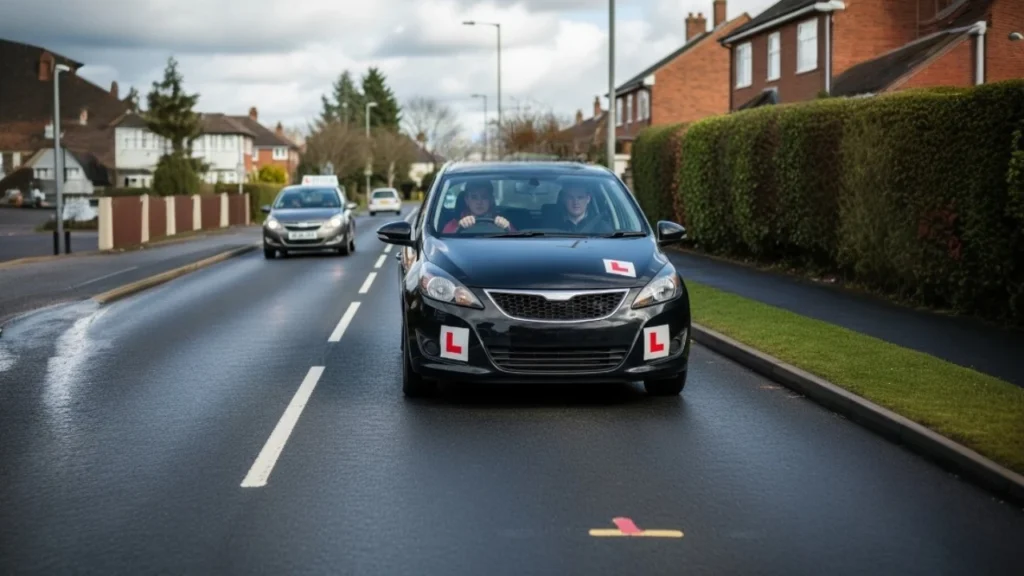
Every day on UK roads, rear-end collisions happen. The cause? Drivers following too closely. It’s one of the most common and preventable types of accidents. Yet many drivers – especially beginners – don’t fully understand how much space they need to stop safely.
This guide to safe following distance will teach you everything you need to know about safer driving. You’ll learn the 2-second rule, how weather affects stopping distances, and practical tips for maintaining a safe gap. Whether you’re learning with a driving school in Ilford or have found the cheapest driving instructor near me, mastering following distance is essential. And once you’ve mastered this, you’ll be ready to tackle other challenges like our beginner guide to driving safely on roundabouts .
Part 1: Why Following Distance Matters
The Simple Physics
Your car cannot stop instantly. At any speed, you need time and space to react and brake safely. The faster you’re going, the more distance you need.
Reaction time + braking time = total stopping distance
| Speed | Thinking distance | Braking distance | Total stopping distance |
|---|---|---|---|
| 20 mph | 6 metres (20 feet) | 6 metres (20 feet) | 12 metres (40 feet) |
| 30 mph | 9 metres (30 feet) | 14 metres (45 feet) | 23 metres (75 feet) |
| 40 mph | 12 metres (40 feet) | 24 metres (80 feet) | 36 metres (120 feet) |
| 50 mph | 15 metres (50 feet) | 38 metres (125 feet) | 53 metres (175 feet) |
| 60 mph | 18 metres (60 feet) | 55 metres (180 feet) | 73 metres (240 feet) |
| 70 mph | 21 metres (70 feet) | 75 metres (245 feet) | 96 metres (315 feet) |
Figures from The Highway Code
The Human Factor
Your reaction time is about 0.67 seconds on average. In that time, at 30mph, you’ve already travelled 9 metres before you even touch the brake. At 70mph, it’s 21 metres – almost the length of two double-decker buses.
The Consequences of Tailgating
- Rear-end collisions – the most common type of accident
- Higher insurance premiums – fault accidents increase costs
- Penalty points – careless driving can mean 3-9 points
- For new drivers – points add up quickly; 6 points = licence revoked
Part 2: The 2-Second Rule – Your Safety Guideline
How It Works
The 2-second rule is a simple way to maintain a safe following distance in good conditions:
- Pick a fixed point on the road ahead (a lamppost, sign, bridge, or road marking)
- When the vehicle ahead passes that point, start counting: “Only a fool breaks the two-second rule”
- If you pass the same point before finishing the phrase, you’re following too closely
Why “Only a fool breaks the two-second rule”?
This classic phrase takes about 2 seconds to say. It’s been taught to generations of UK drivers as a simple way to check following distance.
When to Use It
- In good conditions (dry road, good visibility) – 2 seconds is the minimum
- This is a MINIMUM – more space is always safer
- Check regularly – your following distance changes with speed
Part 3: Adjusting for Conditions – The 4-Second and 8-Second Rules
The 4-Second Rule (Wet Roads, Poor Visibility)
In rain, fog, or poor light, double your following distance to 4 seconds.
Why? Wet roads increase braking distance significantly. At 30mph on a wet road, your stopping distance is almost double what it would be in dry conditions.
The 8-Second Rule (Ice, Snow, Heavy Rain)
In icy or snowy conditions, quadruple your following distance to 8 seconds.
Why? On ice, stopping distances can be 10 times longer than on dry roads. At 30mph on ice, you could need over 200 metres to stop.
Condition Quick Reference
| Condition | Following Distance | How to Count |
|---|---|---|
| Dry road, good visibility | 2 seconds | “Only a fool breaks the two-second rule” |
| Rain, poor visibility | 4 seconds | Say the phrase twice |
| Fog | 4+ seconds | Increase based on visibility |
| Ice, snow | 8+ seconds | Say the phrase four times |
| Night driving | 4 seconds | Reduced visibility |
Remember: These Are MINIMUMS
More space is always safer. There’s no penalty for leaving a larger gap.
Part 4: Factors That Increase Stopping Distance
Road Conditions
| Condition | Effect on Stopping Distance |
|---|---|
| Wet road | Doubles stopping distance |
| Icy road | Up to 10x longer |
| Snow | 5-10x longer |
| Leaves | Reduces grip significantly |
| Oil/diesel spills | Very slippery – extreme caution |
Vehicle Factors
- Tyre condition – worn tyres (below 3mm) increase stopping distance
- Tyre pressure – under-inflated tyres reduce grip
- Brake condition – worn pads/discs reduce braking efficiency
- Load weight – heavier vehicles need longer to stop
- Vehicle type – HGVs and buses need much more space
Driver Factors
- Tiredness – increases reaction time significantly
- Alcohol/drugs – impairs reaction time and judgement
- Distractions – phone, passengers, eating, adjusting controls
- Medication – some drugs affect reaction time
Part 5: How to Maintain Safe Following Distance
Practical Techniques
1. The Fixed Point Method
As described above – pick a fixed point and count.
2. The “Car Lengths” Rule (Less Accurate)
At 30mph, leave about 2-3 car lengths. But this varies with car size – the 2-second rule is more reliable.
3. Look Beyond the Car Ahead
Don’t just watch the car directly in front. Look 2-3 vehicles ahead to anticipate braking.
4. Check Your Mirror
Regular mirror checks help you understand traffic behind you. If someone is tailgating you, increase your own following distance to create more time to react.
Common Mistakes
| Mistake | Why It’s Wrong | Better Approach |
|---|---|---|
| Copying the driver ahead | If they brake late, you’ll crash | Keep YOUR safe distance |
| Following closer in traffic | Traffic stops suddenly too | Maintain 2 seconds even in queues |
| “They’ll think I’m slow” | Safety over ego | Safe drivers leave space |
| “I’m a good driver” | Reaction time is still 0.67 seconds | Physics applies to everyone |
Part 6: Tailgating – What to Do When Someone Follows You Too Closely
Don’t React Aggressively
- Don’t brake check – this is dangerous and could be considered careless driving
- Don’t speed up – you’ll just encourage them to follow closer
- Don’t stare in your mirror – keep focus on the road ahead
What to Do Instead
| Step | Action |
|---|---|
| 1 | Stay calm – don’t let them rush you |
| 2 | Increase your own following distance to the car ahead |
| 3 | This gives you more time to react, reducing the risk of being rear-ended |
| 4 | If safe, move left to let them pass |
| 5 | If they’re aggressive, don’t engage – pull over when safe to let them go |
Can Tailgaters Be Prosecuted?
Yes. Driving too close is considered careless driving and can result in:
- 3-9 penalty points
- Fine up to £5,000
- Possible disqualification
Dashcam footage can be submitted to police.
Part 7: Following Distance in Special Situations
Roundabouts
When approaching a roundabout, maintain following distance even as you slow. Don’t “creep” into the vehicle ahead’s space – you’ll need room to accelerate when you see a gap.
Traffic Jams
In slow-moving traffic, you can reduce following distance slightly, but maintain at least a car’s length of space. This gives you room to manoeuvre if needed.
Merging onto Motorways
When joining a motorway, don’t force your way into small gaps. Wait for a safe space – a 2-second gap is plenty of room to merge smoothly.
Emergency Vehicles
If an emergency vehicle approaches with lights and sirens, create a clear path by pulling over when safe. Don’t stop abruptly – check mirrors and signal before moving.
Towing
If you’re towing a trailer or caravan, your stopping distance increases significantly. Double your normal following distance (4 seconds in dry conditions).
Part 8: The Highway Code Rules on Following Distance
Rule 126 – Tailgating
“You should always keep a safe distance between you and the vehicle in front. A safe distance is at least a 2-second gap in good conditions. In wet weather, you should leave at least a 4-second gap. In icy weather, leave an even greater gap.”
Rule 147 – Careless Driving
“You should not drive too close to the vehicle in front (tailgating). This is dangerous and can cause collisions.”
Penalties
- Fixed penalty notice: £100 and 3 points (may increase with new proposals)
- Court conviction: Higher fines, more points, possible disqualification
- For new drivers: 3 points uses half your 2-year allowance
Part 9: Teaching Following Distance to New Drivers
How Instructors Teach It
Professional instructors from a driving school in Ilford like Driving Academy Ltd use:
- Verbal prompts – “Check your following distance”
- The counting method – practice saying “only a fool breaks the two-second rule”
- Real-time feedback – “You’re too close, ease off”
- Demonstration – instructor shows correct distance, then student copies
Practice Exercises
- On a quiet road, practice maintaining 2 seconds at different speeds
- In rain, practice increasing to 4 seconds
- Discuss scenarios – “What if the car ahead braked suddenly?”
Common Learner Mistakes
| Mistake | How to Fix It |
|---|---|
| Following too close in traffic | “Traffic stops suddenly too – leave space” |
| “I can stop in time” | “At 30mph, you travel 9 metres before reacting” |
| Forgetting to adjust for weather | “Rain = double the distance” |
| Peer pressure from tailgaters | “Safety over ego – let them pass” |
Part 10: The Link Between Following Distance and Safer Driving
Mastering safe following distance is one of the most important skills for safer driving. It:
- Prevents collisions – the most common type of accident
- Reduces stress – you’re not constantly braking and accelerating
- Saves fuel – smoother driving uses less fuel
- Protects your licence – avoid points for careless driving
- Makes you a better driver – anticipation is a skill
For new drivers: Good following distance habits will serve you for a lifetime. They’re as important as mastering roundabouts, clutch control, and parallel parking.
Conclusion: The Space That Saves Lives
Maintaining a safe following distance is one of the simplest yet most effective ways to drive safely. The 2-second rule takes no special equipment – just your attention and a few seconds of counting.
Remember:
- 2 seconds in good conditions (dry, daylight)
- 4 seconds in rain or poor visibility
- 8+ seconds on ice or snow
And most importantly: More space is always safer. There’s no penalty for leaving a larger gap.
Ready to learn all the skills of safer driving with expert guidance?
📞 Call Driving Academy Ltd at 07399 696344 – Our patient instructors in Ilford and London specialise in building safe, confident drivers from the very first lesson.
📧 Email: drivingacademyltd@gmail.com
📍 Visit Us: 101 Whitechapel High Street, London, E1 7RA
Your journey to safer driving starts here. Book your lesson today.