


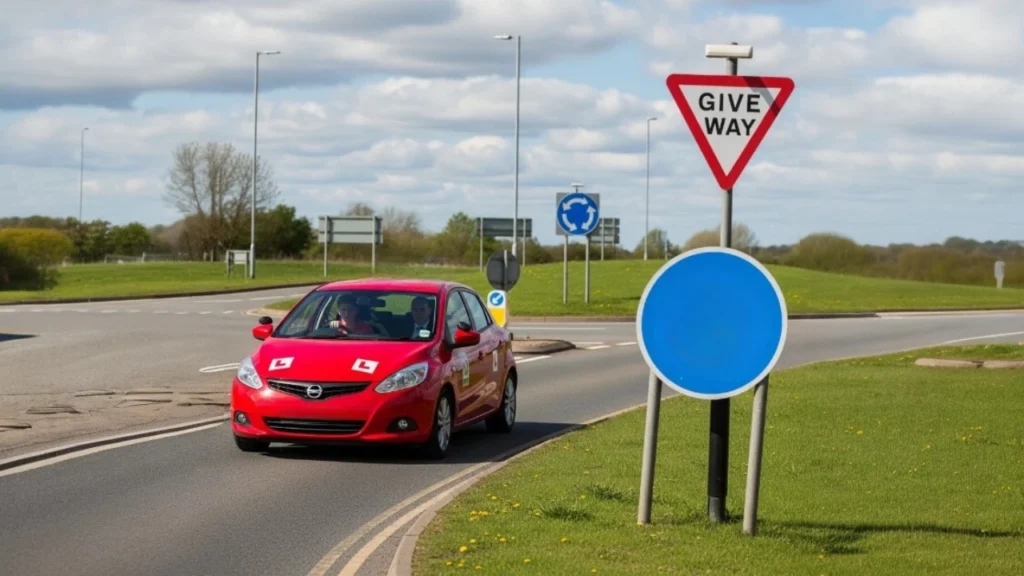
For many learner drivers in the UK, few road features inspire as much confusion and anxiety as roundabouts. With multiple lanes, continuous traffic flow, and split-second decisions, they can feel like a daunting puzzle. However, mastering roundabouts is a non-negotiable skill for passing your test and driving independently.
This beginner’s guide to driving safely on roundabouts breaks down the process into simple, logical steps. You’ll learn the golden rule, the systematic approach, and how to handle everything from mini-roundabouts to multi-lane giants. Whether you’re learning with a driving school in Ilford or have found the cheapest driving instructor near me, this guide will give you the clarity and confidence to navigate any roundabout safely – a key skill if you want to pass your UK driving test first time .
Part 1: The Golden Rule of Roundabouts
Always give way to traffic from your RIGHT. This is the fundamental law governing all standard roundabouts in the UK. Traffic already on the roundabout has the right of way. You must wait for a safe, clear gap before entering.
Why This Rule Exists
Traffic on the roundabout is moving faster and has priority. Entering when it’s not safe causes collisions and disrupts traffic flow. Respecting this rule is the foundation of driving safely on roundabouts .
Part 2: The Systematic Approach – MSM & PSL
Use the Mirror-Signal-Manœuvre (MSM) routine, combined with Position-Speed-Look (PSL) , as you approach every roundabout.
MSM (Mirror – Signal – Manœuvre)
| Step | Action |
|---|---|
| Mirrors | Check interior and appropriate exterior mirrors |
| Signal | Indicate your intention clearly and in good time |
| Manœuvre | Only act when safe |
PSL (Position – Speed – Look)
| Step | Action |
|---|---|
| Position | Get in the correct lane early |
| Speed | Adjust speed before the roundabout |
| Look | Assess traffic from the right and plan your exit |
Part 3: Lane Choice – Which Lane for Which Exit?
This is the most common source of roundabout confusion. The general rule:
| Exit | Lane | Signal on Approach |
|---|---|---|
| Left (1st exit) | Left lane | Signal LEFT |
| Straight ahead (2nd exit / 12 o’clock) | Left lane (unless markings say otherwise) | No signal on approach |
| Right (3rd exit or beyond) | Right lane | Signal RIGHT |
Important Exceptions
- Follow road markings – they override general rules
- Spiral roundabouts have lane markings that guide you to your exit
- Some roundabouts have different lane allocations – read the signs before you arrive
Part 4: Step-by-Step – Navigating a Standard Roundabout
Step 1: Approach
As you approach the roundabout:
- Reduce speed – you need time to observe and decide
- Choose your lane based on your exit
- Signal appropriately (left for left, right for right, no signal for straight)
- Check your mirrors
Step 2: Observe
Look to your RIGHT to assess traffic already on the roundabout. Also look ahead to identify your exit point.
Step 3: Give Way
Wait for a safe gap in the traffic from your right. Do not enter if you would cause another driver to brake or swerve.
Step 4: Enter
When safe, merge into the roundabout. Stay in your lane. Maintain a steady, appropriate speed.
Step 5: Position on the Roundabout
| Exit | Position on Roundabout |
|---|---|
| Left exit | Stay in left lane |
| Straight ahead | Stay in left lane |
| Right exit | Stay in right lane (or lane indicated) |
Step 6: Signal to Exit
As you pass the exit before the one you want:
- Check your left mirror
- Check your left blind spot
- Signal LEFT
- Exit smoothly
Step 7: Cancel Your Signal
After exiting, ensure your indicator has cancelled. If not, cancel it manually.
Part 5: Mini-Roundabouts
Mini-roundabouts are smaller and often found in residential areas. The same rules apply, but there are some differences:
Key Points for Mini-Roundabouts
- You must go around the central marking if possible (very small cars may need to drive over it)
- Signal left to exit
- They are often used in slower, urban areas
- Be extra cautious – other drivers may not position correctly
Common Mini-Roundabout Mistake
Some drivers treat mini-roundabouts as a “who gets there first” competition. Don’t. Always give way to traffic from the right, regardless of who arrived first.
Part 6: Multiple or Double Roundabouts
Some roundabout systems have two or more roundabouts in sequence.
How to Handle Them
- Treat each roundabout individually
- Apply the MSM/PSL routine afresh at each one
- Focus on your immediate path and the relevant road markings
- Don’t get distracted by the second roundabout before you’ve cleared the first
Part 7: Spiral Roundabouts
Spiral roundabouts have lane markings that “spiral” you towards your exit. You don’t need to change lanes – the lane markings guide you.
How They Work
- Lane markings curve around the roundabout
- Following your lane will naturally take you to your exit
- Read the signs before you enter to choose the correct lane
Tip for Spiral Roundabouts
Trust the markings. If you’re in the correct lane at entry, following the spiral will take you to your exit without needing to change lanes.
Part 8: Common Roundabout Mistakes and How to Fix Them
| Mistake | Why It Happens | How to Fix It |
|---|---|---|
| Not giving way to the right | Rushing or misjudging | Stop, look right, wait for a safe gap |
| Incorrect lane positioning | Not deciding exit early enough | Plan your exit before you arrive |
| Signalling incorrectly | Confusion about timing | Signal right for right exits, left to exit |
| Hesitating excessively | Lack of confidence | If it’s safe, go. Trust your judgment |
| Stopping when on the roundabout | Panic or misjudgment | Once on, you have priority – keep moving |
| Changing lanes on the roundabout | Poor planning | Choose your lane before entering |
| Not checking blind spots | Forgetting | Always check before changing lane or exiting |
Part 9: How to Build Roundabout Confidence
Practice Progression
| Level | What to Practice | Where |
|---|---|---|
| 1 | Small, quiet roundabouts | Residential areas |
| 2 | Mini-roundabouts | Local streets |
| 3 | Single lane roundabouts | Quieter A-roads |
| 4 | Two-lane roundabouts | Busier junctions |
| 5 | Multi-lane and spiral roundabouts | Major roads |
| 6 | Complex roundabout systems | City centres, motorway junctions |
The “Verbalise” Technique
Talk yourself through every roundabout:
- “Left lane, first exit”
- “Right lane, third exit, signal right”
- “Check mirrors, signal left to exit”
This keeps your brain focused on the task and reduces anxiety.
Practice with Purpose
Don’t just drive around roundabouts – practice with specific goals:
- Session 1: Focus only on lane choice
- Session 2: Focus only on signalling
- Session 3: Focus only on observation and gaps
Part 10: Roundabouts and Your Driving Test
What Examiners Look For
On your driving test, examiners assess:
| Criteria | What They Want to See |
|---|---|
| Approach | Correct lane, appropriate speed, good observation |
| MSM routine | Mirrors before every signal and manoeuvre |
| Giving way | Waiting for safe gaps, not forcing others to brake |
| Position on roundabout | Staying in correct lane throughout |
| Exiting | Correct signal, mirror check, smooth exit |
Common Test Fails on Roundabouts
According to DVSA data, roundabout-related faults are among the most common reasons for test failure :
- Junctions – observation (not looking properly at roundabouts)
- Positioning – normal driving (wrong lane on approach)
- Mirrors – change direction (not checking before exiting)
- Junctions – turning right (incorrect positioning or observation)
- Response to signs (missing lane direction signs)
Part 11: Real-World Roundabout Scenarios
Scenario 1: Busy Roundabout During Rush Hour
Challenge: Finding a safe gap in heavy traffic.
Solution:
- Be patient – a gap will come
- Look for a two-second gap – enough time to enter safely
- Don’t be pushed into a dangerous gap by impatient drivers behind
- If necessary, wait for a second or third gap until you’re comfortable
Scenario 2: Roundabout with Poor Visibility
Challenge: Can’t see traffic approaching from the right.
Solution:
- Slow down more than usual
- Edge forward carefully to improve your view
- Stop if necessary to get a better look
- Never assume it’s clear – wait until you can see
Scenario 3: Large Spiral Roundabout
Challenge: Following the spiral markings under pressure.
Solution:
- Study the roundabout on a map before driving it
- Choose your lane early using the signs
- Trust the markings – they’re designed to guide you
- Don’t change lanes – let the spiral do the work
Part 12: Advanced Roundabout Tips
The “Lifesaver” Look
Before changing lane or exiting, do a final check over your shoulder into your blind spot. This is called a “lifesaver” look and is especially important for:
- Cyclists filtering on your left
- Motorcycles overtaking on your right
- Vehicles in your blind spot
Dealing with Large Vehicles
Large vehicles (HGVs, buses) may need more space on roundabouts. Give them room – they may need to use both lanes to navigate.
When You Miss Your Exit
If you miss your exit:
- Don’t panic
- Don’t stop or reverse
- Continue around the roundabout again
- Take the exit on the next loop
This is perfectly legal and much safer than making a dangerous last-minute manoeuvre.
Part 13: The Connection Between Roundabouts and Passing Your Test
Mastering roundabouts is essential for passing your driving test. In fact, roundabout-related faults are among the most common reasons for failure .
Why roundabouts matter so much:
- They test multiple skills simultaneously (observation, positioning, signalling, control)
- They’re a core part of the independent driving section
- They appear on almost every test route
By mastering the techniques in this guide, you’ll dramatically improve your chances to pass your UK driving test first time .
Conclusion: Practice Makes Permanent
Roundabouts are not puzzles – they’re just one-way systems with a few simple rules. Once you understand the system and practice the technique, they become second nature.
Remember the essentials:
- Give way to the right
- Choose your lane early (left for left/straight, right for right)
- Signal correctly (right on approach for right turns, left to exit)
- Look, then go – don’t hesitate unnecessarily
Ready to master roundabouts with expert guidance?
📞 Call Driving Academy Ltd at 07399 696344 – Our patient instructors in Ilford and London specialise in building roundabout confidence from the ground up.
📧 Email: drivingacademyltd@gmail.com
📍 Visit Us: 101 Whitechapel High Street, London, E1 7RA
Your journey to confident roundabout driving starts here. Book your lesson today.