


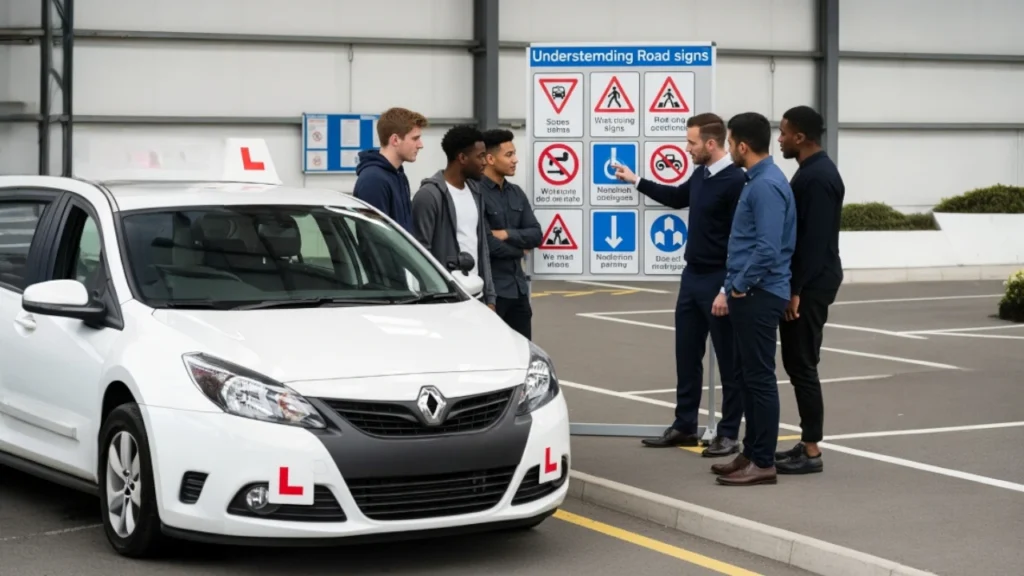
Navigating UK roads as a beginner involves understanding a universal visual language: road signs. These signs communicate vital information, warnings, and legal requirements that keep traffic flowing safely and efficiently. For learner drivers, understanding UK road signs for beginners is not just essential for passing the theory test—it’s fundamental to becoming a safe, confident driver. This comprehensive guide breaks down every major category of sign, explaining their shapes, colours, and meanings. Whether you’re studying independently or with a professional driving school in Ilford, this knowledge forms the foundation of your driving education.
Part 1: The Fundamentals – Shape & Colour Coding
Before learning specific signs, understand the coding system. The UK uses a logical combination of shapes and colours to convey a sign’s purpose at a glance.
1.1 Sign Shapes and Their Meaning
- Circular Signs: Give orders. Blue circles usually indicate a mandatory instruction (e.g., “turn left”), while red rings signify prohibitions (e.g., “no entry”).
- Triangular Signs: Give warnings. Almost always red-bordered, they alert you to hazards ahead like bends, junctions, or pedestrians.
- Rectangular Signs: Provide information. Blue rectangles give positive instructions for drivers (e.g., route directions), while white rectangles give general information (e.g., directions to a car park).
- Pentagon Signs: Indicate a school crossing patrol. Be prepared to stop for children crossing.
1.2 Sign Colours and Their Meaning
- Red: Signifies stop, prohibition, or warning. It commands attention for danger or things you must not do.
- Blue: Indicates positive instruction or information for drivers (e.g., mandatory direction, motorway guidance).
- Green: Used for primary route direction signs on non-motorway roads.
- White: Used for backgrounds on regulatory signs and for general informational signs.
- Yellow: Often used for temporary signs, such as those for road diversions or works.
- Brown: Points to tourist and recreational information like historic sites or picnic areas.
Part 2: Decoding Sign Categories with Examples
2.1 Warning Signs (Triangular, Red Border)
These alert you to potential hazards. You must recognise and react appropriately.
- Junction Signs: Variations like a side road, T-junction, or staggered crossroads.
- Road Layout Signs: Sharp bends, double bends, roundabouts, or steep hills ahead.
- Pedestrian & Hazard Signs: Children crossing, wild animals, pedestrians in road, traffic signals ahead.
2.2 Regulatory Signs: Orders & Prohibitions (Circular)
These tell you what you must or must not do. Disobeying them is a traffic offence.
- Blue Circles (Mandatory): “Turn left ahead,” “Ahead only,” “Mini-roundabout,” “Cycle route.”
- Red Rings (Prohibitive): “No entry,” “No motor vehicles,” “No overtaking,” Speed Limit Signs (white number on a red circle).
2.3 Speed Limit Signs
These are critical circular regulatory signs.
- National Speed Limit Sign: A white circle with a single black diagonal stripe. This means the national limit applies (60 mph on single carriageways, 70 mph on dual carriageways/motorways, 30 mph in built-up areas unless otherwise signed).
- Numbered Red Circles: The posted maximum speed (e.g., 30, 40, 50, 70).
- Remember: Street lights usually mean a 30 mph limit unless signs show otherwise.
2.4 Informational Signs (Rectangular)
These guide and inform without giving direct orders.
- Direction Signs on Motorways (Blue): Junction numbers, destinations, service areas.
- Direction Signs on Primary Routes (Green): Main routes and destinations.
- Direction Signs on Non-Primary Routes (White): Local destinations, town centres, car parks.
- Other Information Signs (White): “No through road,” “Hospital,” “Low bridge,” “Bus lane.”
Part 3: Advanced and Essential Signs for Beginners
- Road Works Signs (Yellow): Temporary warnings for lanes closed, workers in road, or temporary speed limits.
- Traffic Light Signals: Red (Stop), Red & Amber (Prepare to go), Green (Go if clear), Amber (Stop if safe to do so).
- Road Markings: These work with signs. Double white lines, zig-zags near crossings, and stop lines are legally enforceable.
Part 4: How to Study and Test Your Knowledge
Simply reading isn’t enough. You must actively learn.
- Use the Official Source: Study The Highway Code – it is the definitive guide.
- Practice with Apps: Use DVSA-approved theory test apps to take endless sign recognition quizzes.
- Learn on the Road: While practising with your instructor from a driving school (not just the cheapest driving instructor near me), verbally identify every sign you see. A good instructor will test you on them.
- Understand, Don’t Memorise: Learn why a sign is there. A “slippery road” sign means you should reduce speed and avoid harsh braking.
Part 5: The Role of Professional Instruction
While this guide is comprehensive, there is no substitute for real-world application. A professional driving school in Ilford like Driving Academy Ltd integrates sign knowledge into every lesson. We ensure you don’t just recognise a sign, but understand the correct driving response—whether it’s adjusting your speed, changing lane, or preparing to give way. This contextual learning is what separates a test-passer from a safe driver. For parents, this forms part of the UK parent’s complete guide to teen driving lessons, ensuring your child learns from experts who prioritise safety and proper understanding from day one.
Conclusion: Sign Knowledge is Safety Knowledge
Mastering UK road signs for beginners is a non-negotiable part of your journey. It empowers you to anticipate hazards, follow the law, and drive with certainty. Treat every sign as an essential message for your safety and the safety of others.
Ready to put this knowledge into practice on the road?
📞 Call Driving Academy Ltd at 07399 696344 – Our structured lessons in Ilford and London ensure you understand and correctly react to every road sign and situation.
📧 Email: drivingacademyltd@gmail.com – Ask us about our beginner courses.
📍 Visit Us: 101 Whitechapel High Street, London, E1 7RA
Start your lessons with a school that teaches you to read the road.