


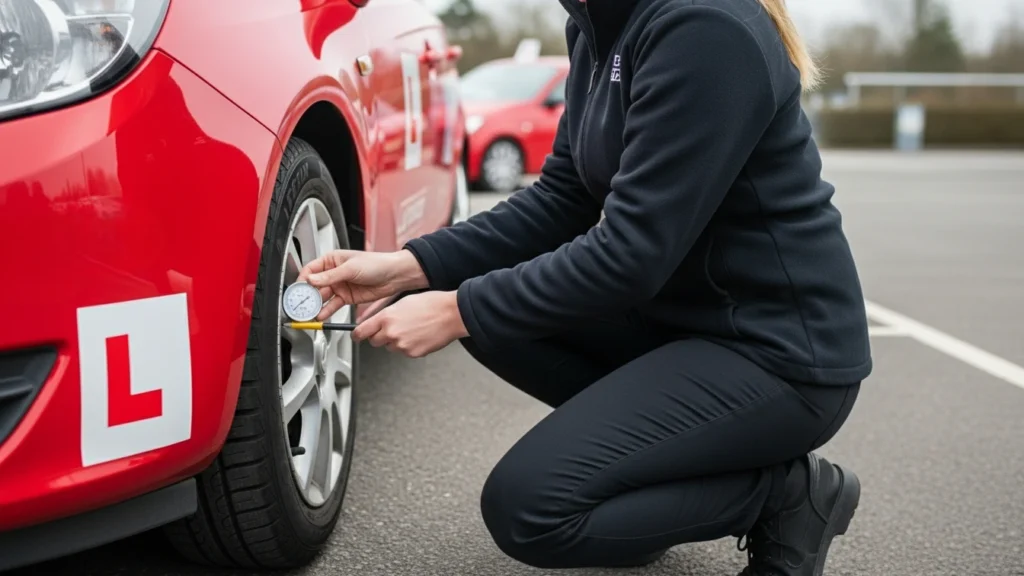
When you begin your UK driving lessons, your focus is rightly on mastering controls, rules, and road awareness. However, a crucial part of becoming a competent, safe driver—often emphasised by a good driving academy—extends beyond the cockpit. It involves understanding essential basic car maintenance tips, and at the very top of that list is knowing how to check tyre pressure correctly. This isn’t just a “nice-to-know” skill; it’s a fundamental aspect of vehicle safety, legal roadworthiness, and economical driving. For any learner attending a driving school, this practical knowledge bridges the gap between simply operating a car and truly understanding it. This guide, curated with insights from professional instructors, will walk you through why this is a cornerstone lesson, the exact steps to follow, and how it underpins everything you learn on the road.
Why This Basic Car Maintenance Tip is Lesson 1 at Any Driving Academy
Your driving lessons are designed to build responsible habits. A professional driving school integrates vehicle awareness into its curriculum because safety is proactive, not reactive. Here’s why tyre pressure is paramount:
- Safety & Control: Your tyres are your only contact with the road. Correct pressure ensures the tread sits flat for optimal grip during braking, cornering, and steering—directly impacting manoeuvres you’ll practice, like emergency stops and roundabouts. Under-inflated tyres overheat and risk blowouts, a severe danger at speed.
- Test & Legal Readiness: While an examiner won’t ask you to check pressure during your test, they must ensure the car is roadworthy. Demonstrating this knowledge shows supreme competency. Furthermore, illegal tread depth often starts with incorrect, accelerating wear from wrong pressure.
- Economy & Longevity: This is a key basic car maintenance tip for your wallet. Properly inflated tyres reduce rolling resistance, improving fuel efficiency by up to 10%. They also wear evenly, meaning your tyres last longer, saving significant money—a point every good driving academy will stress.
Your Essential Toolkit: No Mechanic Skills Required
You don’t need a garage. Here’s the simple kit, as recommended in any driving school vehicle maintenance briefing:
- A Quality Tyre Pressure Gauge: Avoid relying on fuel forecourt gauges, which are often inaccurate. A simple digital or dial gauge is a wise, one-time purchase.
- Access to an Air Pump: Available at most petrol stations (usually for a small fee) or via a portable compressor.
- The Manufacturer’s Recommended PSI: CRUCIAL: This is NOT the max pressure on the tyre’s sidewall. Find the correct figure for your specific car on the sticker inside the driver’s door frame, in the fuel filler flap, or in the handbook. Your driving academy instructor can show you this.
The Step-by-Step Guide: How to Check Tyre Pressure Correctly
Follow this precise method—it’s the standard taught in professional UK driving lessons for a reason.
Step 1: Ensure Tyres Are “Cold”
This is the golden rule. Pressure increases as tyres warm up from driving. A “cold” check means the car has been stationary for at least three hours. Checking after driving to the air pump will give a falsely high reading.
Step 2: Locate Valve and Remove Cap
Find the valve stem on the wheel. Unscrew the plastic dust cap and place it securely in your pocket to avoid loss.
Step 3: Take a Reading with Your Gauge
Press your tyre pressure gauge firmly onto the valve stem until the hissing stops.
- Digital Gauge: Read the PSI on the display.
- Dial Gauge: Note where the needle points.
Step 4: Compare to Recommended PSI
Check your reading against the vehicle’s recommended pressure (e.g., 33 PSI for normal load).
Step 5: Inflate or Deflate at the Pump
- If LOW: Attach the air hose. Add air in short bursts, checking frequently with your own gauge to prevent over-inflation.
- If HIGH: Gently depress the metal pin in the valve centre with your gauge to release air in small bursts, re-checking as you go.
Step 6: Final Verification and Secure
Do a final check with your gauge. Once correct, screw the dust cap back on tightly. This cap keeps out dirt and moisture, preventing slow leaks—a key basic car maintenance tip.
Step 7: Check All Five Tyres
Repeat for all four road tyres. Never forget your spare tyre. A flat spare is useless in an emergency, undermining all your safe driving practice.
Integrating This Skill into Your Driving School Journey
| What You Learn in Driving Lessons | How Correct Tyre Pressure Supports It |
|---|---|
| Cockpit Drill & Vehicle Safety Checks | Establishes that external checks are as vital as internal ones. A pre-journey walk-around should include a visual tyre inspection. |
| Braking Theory & Stopping Distances | Correct pressure provides maximum grip, meaning you can stop within the calculated distances discussed in theory and practice. |
| Fuel-Efficient Driving (Eco-Driving) | Proper inflation minimises rolling resistance, a core principle of economical driving taught by advanced driving academies. |
| Vehicle Handling & Stability | Optimal pressure ensures correct tyre shape for effective contact with the road during cornering and evasive manoeuvres. |
5 Common Mistakes (And How Your Driving Academy Would Correct Them)
- The ‘Visual’ Check: You cannot assess pressure by sight. A tyre can be 15 PSI under and still look normal. Always use a gauge.
- Trusting the Forecourt Gauge: These are frequently inaccurate. Use your own trusted gauge to measure; use the forecourt air to adjust.
- Ignoring Load Settings: The door sticker often lists two pressures. For typical driving lessons, use the “normal load” figure. Use the higher “full load” pressure for extended trips with passengers/luggage.
- Infrequent Checks: Tyres naturally lose 1-2 PSI per month. Make a monthly check part of your routine—a perfect habit to start during your learning journey.
- Forgetting the Spare: This turns a minor puncture into a major hassle. Your driving school teaches problem-solving; a checked spare is your first solution.
Frequently Asked Questions (FAQs) for the Learner Driver
1. Is checking tyre pressure part of the UK driving test?
Not as a direct “show me” question. However, presenting a car with clearly under-inflated or defective tyres could be considered a failure to ensure the vehicle is roadworthy. It’s part of your overarching responsibility as a driver.
2. How often should I check the pressure on my instructor’s car or my private practice car?
At least once a month and before any long journey. A great initiative is to ask your driving academy instructor to supervise your first check during a lesson. It demonstrates maturity and eagerness to learn beyond the minimum.
3. The family car and my driving school car need different pressures. How do I manage this?
Keep a note in your phone. The correct PSI is vehicle-specific, not driver-specific. Managing this is a practical basic car maintenance tip that shows adaptability and attention to detail.
4. My car has a Tyre Pressure Monitoring System (TPMS). Is that enough?
No. TPMS is a warning light, not a maintenance tool. It typically only alerts you when pressure is dangerously low (often 25% below recommendation). A responsible driver, as trained by a quality driving school, checks proactively, not reactively.
5. Is slightly over-inflating tyres okay for better fuel economy on my drives?
No. Always adhere to the manufacturer’s recommended pressure. Over-inflation reduces the tyre’s contact patch, worsening grip (especially in wet conditions), leading to longer stopping distances and uneven, rapid wear in the centre of the tread.
6. Can I practise this with my driving instructor?
Absolutely! Any reputable driving academy instructor should encourage this. Ask if you can spend five minutes at a fuel station forecourt during a lesson to be guided through the process. It’s a core life skill they’ll be happy to demonstrate.
Conclusion: More Than a Lesson—A Lifelong Habit
Mastering how to check tyre pressure correctly is the perfect embodiment of the responsible driver mindset a great driving academy strives to create. It moves you from being a passive operator to an active custodian of your vehicle. This basic car maintenance tip directly supports the technical skills you hone in your UK driving lessons, making you safer, more economical, and more confident.
Incorporate this simple monthly ritual into your life now. Discuss it openly in your driving school lessons, take ownership of the process, and carry this indispensable knowledge with you for decades of safe driving. By doing so, you’re not just preparing to pass a test; you’re committing to the highest standards of driving excellence.