


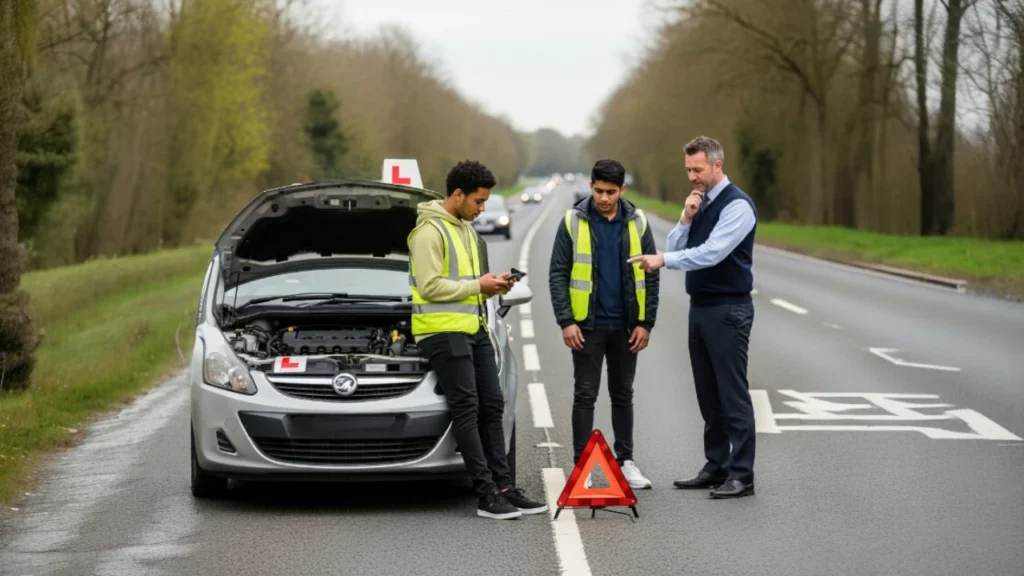
A car breakdown is an unexpected and often stressful event that can happen to any driver at any time. In that moment of panic, knowing the correct car breakdown safety steps can mean the difference between a minor inconvenience and a serious accident. While a good driving school prepares you for how to drive, being prepared for when your car stops is equally crucial for your long-term safety. Whether you learned with the cheapest driving instructor near me or a premium driving school in Ilford, this guide provides the clear, step-by-step actions you must take to protect yourself, your passengers, and other road users.
Part 1: The Immediate Golden Rule – Your Safety First
The single most important principle is this: Your personal safety is more important than the vehicle. Never try to repair the car on a live carriageway. Your primary goal is to get to a place of safety and alert others to your presence.
Part 2: Step-by-Step Breakdown Safety Steps
Follow this sequence of actions if your car develops a problem while driving.
Step 1: Signal and Slow Down Safely
- Indicate Early: Signal your intention to leave the carriageway as soon as you sense a problem.
- Gentle Deceleration: Take your foot off the accelerator and allow the car to slow down gradually. Avoid harsh braking.
- Pull Over If Possible: If you can safely reach the left-hand side of the road (or the hard shoulder on a motorway), do so. Try to stop in a lay-by, side road, or as far left on the verge as possible.
Step 2: Find the Safest Stopping Position
- If You Can’t Get Off the Road: Stop as far to the left as possible, with your wheels turned left (so if hit from behind, you roll off the road, not into it).
- On a Motorway: Aim for the hard shoulder (or an emergency area on a smart motorway). Stop as far to the left as possible, with the wheels turned left.
- Avoid Dangerous Spots: Never stop just after a bend, brow of a hill, or near a junction. If necessary, coast a little further to a safer spot, even if the car is struggling.
Step 3: Make Yourself Visible
- Hazard Warning Lights: Turn them on immediately after stopping.
- Side Lights/Headlights: Use them in poor visibility.
- Wear Hi-Visibility Clothing: If you have a hi-vis vest or jacket (a vital part of your breakdown kit), put it on before you exit the vehicle.
Step 4: Exit the Vehicle Safely (If It’s Safe to Do So)
- Assess Traffic: Check it is completely safe before opening your door.
- Exit on the Left: Always get out on the side away from traffic (the left/passenger side in the UK).
- Keep Passengers Safe: Ensure all passengers, including children and pets, exit from the left side. Move them well away from the carriageway, behind a barrier if available.
Step 5: Call for Professional Help
- Find a Safe Place to Call: Use your mobile phone from a safe distance behind a barrier or up the verge.
- Know Your Location: Use road numbers, marker posts (on motorways, look for small blue signs with a number and letter), or a mapping app to give your exact location.
- Who to Call:
- If You Have Breakdown Cover: Call your provider’s emergency number.
- If You Don’t Have Cover or Are on a Motorway: You can call a local garage or, as a last resort, the National Highways on 0300 123 5000 (they can contact a recovery service for you, but you will be charged).
Important: If you break down on a smart motorway (with no permanent hard shoulder), the process is even more critical. Follow the signs to an Emergency Refuge Area (ERA) if possible. If not, stop in the leftmost lane, turn on hazards, stay in the car with your seatbelt on, and call 999 immediately. The operator will switch the lane signals above you to a red ‘X’ to close the lane.
Part 3: What NOT to Do During a Breakdown
- Do NOT attempt repairs on the roadside, especially on motorways or fast A-roads.
- Do NOT stand behind, in front of, or to the right (traffic side) of your vehicle.
- Do NOT place a warning triangle on motorways or dual carriageways. It’s too dangerous. (It can be used on quieter, slower roads if safe to do so).
- Do NOT accept lifts from strangers. Wait for the official recovery vehicle.
Part 4: Your Essential In-Car Breakdown Kit
Being prepared reduces panic. Keep these items in your boot:
- A fully charged mobile phone and power bank.
- A hi-visibility vest or jacket for each occupant.
- A warning triangle (for use on safe, quiet roads only).
- A torch with spare batteries.
- Warm clothing, waterproofs, and a blanket.
- A first-aid kit.
- Non-perishable snacks and water.
- A physical road atlas (in case of no phone signal).
Part 5: The Link Between Safe Driving and Breakdown Preparedness
A quality driving school teaches proactive driving—anticipating problems before they happen. This mindset extends to vehicle maintenance. Regular checks (tyre pressure, oil, coolant) can prevent many breakdowns. Just as you need to understand the UK penalty points system to drive legally, you need to know breakdown protocol to drive safely. This knowledge is a non-negotiable part of being a responsible driver. An instructor from a trusted driving school in Ilford will emphasize this holistic approach to safety.
Conclusion: Knowledge Drives Confidence
A breakdown is a test of your preparedness and composure. By memorising these car breakdown safety steps and keeping a basic kit in your car, you transform a potentially dangerous situation into a managed, safe event. This knowledge empowers you to stay in control when your vehicle is not.
Learn to drive with a school that prepares you for every eventuality on the road.
📞 Call Driving Academy Ltd at 07399 696344 – Our instructors in Ilford and London build safety-first drivers, prepared for both driving and emergencies.
📧 Email: drivingacademyltd@gmail.com
📍 Visit Us: 101 Whitechapel High Street, London, E1 7RA
Stay safe, stay prepared. Book your driving lessons today.