


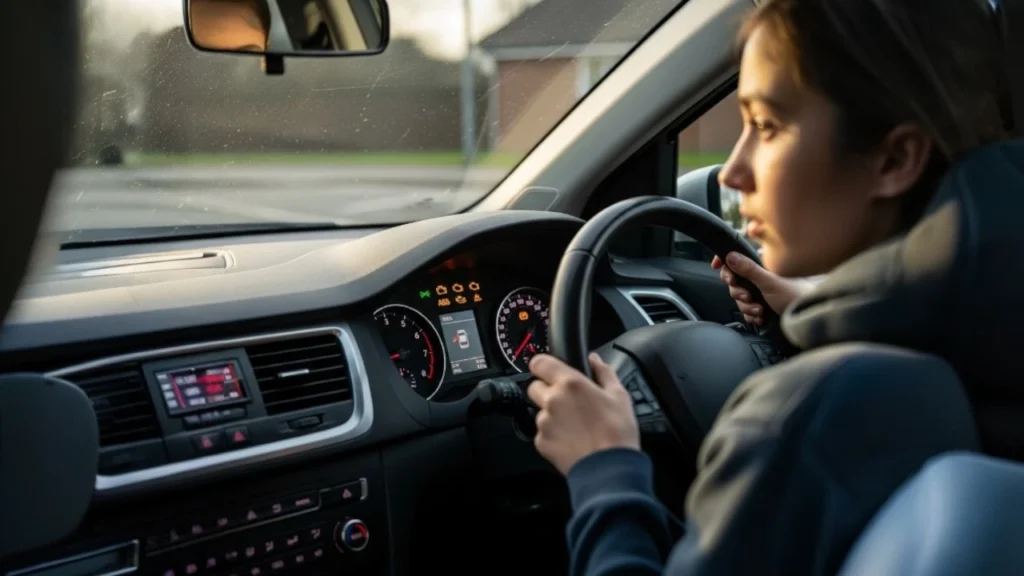
That little orange or red symbol that just lit up on your dashboard? It’s not a decoration – it’s your car communicating with you. Modern vehicles have dozens of warning lights and symbols, each designed to alert you to potential problems, from a loose fuel cap to a serious engine fault.
For new drivers especially, these lights can be confusing and intimidating. What’s urgent? What can wait? What does that weird symbol even mean? This dashboard warning lights guide will help you understand the most common lights, their colours, and what to do when they appear. Whether you’re learning with a driving school in Ilford or have found the cheapest driving instructor near me, this knowledge is essential for staying safe on the road. And once you’ve mastered your car’s warnings, you’ll be ready to tackle everything else – including understanding the new driver rules after passing the test .
Part 1: The Colour Code – Red, Amber, Green
Dashboard lights use a simple traffic light colour system to indicate urgency :
🔴 RED Lights – STOP Immediately
Red warning lights indicate a serious problem that needs immediate attention. If a red light appears:
- Stop the car as soon as it’s safe to do so
- Turn off the engine
- Check your owner’s manual
- Call for breakdown assistance if needed
NEVER ignore a red warning light – it could indicate brake failure, engine overheating, or low oil pressure, all of which can cause serious damage or dangerous driving conditions.
🟡 AMBER/YELLOW Lights – Check Soon
Amber lights indicate a problem that needs attention but isn’t immediately critical. You can usually continue driving, but you should:
- Check the issue as soon as possible
- Visit a garage if the light stays on
- Don’t ignore it – small problems become big ones
🟢 GREEN/BLUE Lights – Information Only
Green or blue lights simply tell you that a system is active and working normally. For example:
- Headlights are on
- Indicators are flashing
- Cruise control is engaged
These require no action – they’re just keeping you informed.
Part 2: The Most Common Warning Lights Explained
1. Engine Management Light (Check Engine) 🟡
| What it looks like | An engine-shaped symbol, often with the word “CHECK” |
|---|---|
| What it means | The engine’s electronic system has detected a fault |
| Urgency | Amber – needs attention soon |
| Possible causes | Loose fuel cap, faulty oxygen sensor, spark plug issues, catalytic converter problems |
| What to do | Check fuel cap first (often the simplest fix). If light stays on, get it diagnosed at a garage |
2. Oil Pressure Warning 🔴
| What it looks like | An old-fashioned oil can with a drop |
|---|---|
| What it means | Engine oil pressure is dangerously low |
| Urgency | RED – STOP IMMEDIATELY |
| Possible causes | Low oil level, oil pump failure, serious leak |
| What to do | Stop as soon as safe, turn off engine, check oil level. Do not drive without oil – it will destroy your engine |
3. Battery Charge Warning 🔴
| What it looks like | A battery symbol with + and – terminals |
|---|---|
| What it means | The battery isn’t charging properly |
| Urgency | Red – needs attention soon |
| Possible causes | Failed alternator, loose belt, dying battery |
| What to do | You can drive for a while on battery power, but get it checked immediately. If light comes on while driving, turn off non-essential electrical loads (radio, air con) |
4. Brake System Warning 🔴
| What it looks like | A circle with “!” inside, or the word “BRAKE” |
|---|---|
| What it means | Problem with your braking system |
| Urgency | RED – STOP IMMEDIATELY |
| Possible causes | Handbrake on, low brake fluid, worn brake pads, system failure |
| What to do | First, check handbrake is fully off. If light stays on, stop safely and call for breakdown assistance |
5. Coolant Temperature Warning 🔴
| What it looks like | A thermometer in liquid, often wavy lines |
|---|---|
| What it means | Engine is overheating |
| Urgency | RED – STOP IMMEDIATELY |
| Possible causes | Low coolant, radiator fan failure, coolant leak |
| What to do | Stop safely, turn off engine, let it cool completely. NEVER open coolant cap when hot – serious burns risk |
6. Tyre Pressure Monitoring System (TPMS) 🟡
| What it looks like | A horseshoe-shaped tyre with “!” inside |
|---|---|
| What it means | One or more tyres is significantly under-inflated |
| Urgency | Amber – check soon |
| Possible causes | Puncture, slow leak, temperature drop |
| What to do | Check tyre pressures at next fuel stop. If light flashes then stays on, system may need resetting |
7. ABS Warning Light 🟡
| What it looks like | The letters “ABS” in a circle |
|---|---|
| What it means | Anti-lock Braking System has a fault |
| Urgency | Amber – needs attention soon |
| What to do | Your normal brakes still work, but ABS may not activate in emergency. Get it checked |
8. Airbag/SRS Warning 🔴
| What it looks like | A person with a circle in front (airbag deploying) |
|---|---|
| What it means | Problem with the airbag or seatbelt pretensioner system |
| Urgency | Red – needs attention |
| What to do | Airbags may not deploy in an accident. Get it checked immediately |
9. Diesel Particulate Filter (DPF) 🟡
| What it looks like | A box with dots inside, sometimes “DPF” |
|---|---|
| What it means | The filter that traps soot is becoming blocked |
| Urgency | Amber – needs action soon |
| What to do | Drive at steady speed (2000+ RPM) for 10-15 minutes to regenerate. If ignored, expensive repair |
10. Washer Fluid Warning 🟢/🟡
| What it looks like | A windscreen with water spraying |
|---|---|
| What it means | Screenwash level is low |
| Urgency | Information (usually blue/green) – top up soon |
| What to do | Top up washer fluid at next stop |
11. Fog Lights 🟢
| What it looks like | A lamp with wavy lines through it (pointing left for rear, right for front) |
|---|---|
| What it means | Front or rear fog lights are on |
| Urgency | Information only |
| What to do | Remember to switch them off when visibility improves – it’s illegal to use them in clear conditions |
Part 3: What to Do When a Warning Light Appears
Step 1: Don’t Panic
Take a breath. Not every warning light means disaster.
Step 2: Check the Colour
- RED – Stop safely as soon as possible
- AMBER – Get it checked soon, but you can continue
- GREEN/BLUE – Normal operation, no action needed
Step 3: Consult Your Manual
Every car is different. Your owner’s manual has a complete guide to your specific dashboard symbols.
Step 4: For Red Lights – Stop Safely
If it’s a red warning:
- Find a safe place to stop
- Turn off the engine
- Check obvious things (oil level, coolant, handbrake)
- Call breakdown assistance if needed
Step 5: For Amber Lights – Monitor and Act
- Note when it came on
- Check if it goes off after restarting
- Book a garage visit if it persists
Step 6: Never Ignore
A warning light won’t fix itself. Ignoring it leads to bigger problems and expensive repairs.
Part 4: Warning Light Myths Debunked
| Myth | Truth |
|---|---|
| “If the light goes off, it’s fixed” | Lights can go off temporarily but problems remain |
| “All orange lights are minor” | Some orange lights (like DPF) need urgent action |
| “I can drive for weeks with the engine light on” | You can, but you risk more damage |
| “The car will tell me when it’s serious” | By then, damage may already be done |
| “Only dealers can reset warning lights” | Many auto shops can diagnose and reset |
Part 5: Warning Lights and Your Driving Test
During your practical driving test, the examiner won’t ask about dashboard warning lights specifically. However, knowing your car’s warning systems is part of being a safe driver – and it could come up in the “tell me” questions.
Example “tell me” question:
“Tell me how you’d know if there was a problem with your anti-lock braking system.”
Answer: “A warning light would illuminate on the dashboard showing ‘ABS’.”
Part 6: The Link Between Warning Lights and New Driver Responsibility
Understanding your dashboard warnings is part of being a responsible driver – something that becomes even more important after you pass your test. The new driver rules mean you’re on probation for two years, and any mechanical issues that lead to unsafe driving could result in points or worse.
Regular maintenance and paying attention to warning lights helps you:
- Stay safe on the road
- Avoid breakdowns
- Prevent costly repairs
- Keep your car legal (MOT)
It’s all part of the package of essential skills every driver needs, right up there with understanding road signs and mastering manoeuvres.
Part 7: Quick Reference Table
| Warning Light | Colour | Meaning | Action |
|---|---|---|---|
| Engine (Check) | Amber | Engine fault | Check fuel cap, then garage |
| Oil can | RED | Low oil pressure | STOP IMMEDIATELY |
| Battery | RED | Charging fault | Get checked soon |
| Brake (!) | RED | Brake problem | STOP if handbrake off |
| Thermometer | RED | Overheating | STOP, let cool |
| Tyre (!) | Amber | Low tyre pressure | Check pressures |
| ABS | Amber | ABS fault | Brakes work, no ABS |
| Airbag | RED | Airbag fault | Get checked urgently |
| DPF | Amber | Filter blocked | Drive to regenerate |
| Washer | Green/Blue | Low fluid | Top up |
Conclusion: Your Dashboard Speaks – Listen to It
Modern cars are incredibly sophisticated, and those warning lights are there to protect you and your vehicle. Learning what they mean isn’t complicated – it’s just a matter of knowing the colours and common symbols. Keep this guide handy, check your owner’s manual, and never ignore a warning light, especially the red ones.
Ready to become a confident, knowledgeable driver who understands every aspect of their car?
📞 Call Driving Academy Ltd at 07399 696344 – Our expert instructors in Ilford and London teach more than just driving. We help you become a complete, responsible car owner.
📧 Email: drivingacademyltd@gmail.com
📍 Visit Us: 101 Whitechapel High Street, London, E1 7RA
Your journey to confident, informed driving starts here. Book your lesson today.