


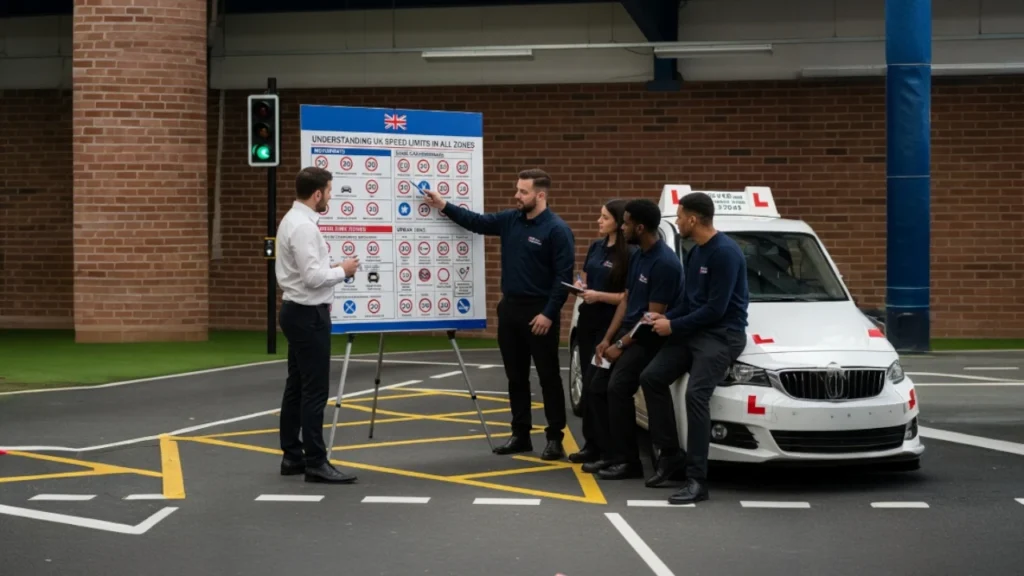
Navigating UK roads requires a clear understanding of UK speed limits – one of the most fundamental yet frequently misunderstood aspects of driving. Whether you’re a complete beginner researching what to know before booking driving lessons or an experienced driver needing a refresher, this comprehensive guide breaks down everything you need to know about speed limits across all zones. We’ll connect this essential knowledge to UK seatbelt and car safety rules and explain how professional instruction from a driving school in Ilford builds proper speed awareness for both your UK Driving Theory Test and real-world driving.
For expert tuition that makes complex rules simple, contact Driving Academy Ltd at 📞 07399 696344, email 📧 drivingacademyltd@gmail.com, or visit 📍 101 Whitechapel High Street, London, E1 7RA.
The Foundation: Why Speed Limits Matter
Before diving into specific numbers, it’s crucial to understand that speed limits represent the maximum speed allowed in ideal conditions. They are not targets. Your actual safe speed depends on multiple factors including weather, traffic, road conditions, and visibility – something every good driving school emphasizes from the first lesson. This mindset connects directly to UK seatbelt and car safety rules – both are about managing risk and protecting lives.
UK National Speed Limits: The Default Settings
When no signs indicate otherwise, these default limits apply. Memorizing these is essential for your UK Driving Theory Test and forms part of what to know before booking driving lessons.
| Road Type | Cars & Motorcycles | Cars Towing Trailers/Caravans |
|---|---|---|
| Built-up areas (street lights present) | 30 mph | 30 mph |
| Single carriageways | 60 mph | 50 mph |
| Dual carriageways | 70 mph | 60 mph |
| Motorways | 70 mph | 60 mph |
Key point about built-up areas: The 30 mph limit applies wherever there’s a system of street lights placed no more than 200 yards (183 metres) apart, unless signs show otherwise.
Special Speed Zones and Variable Limits
20 mph Zones
Increasingly common in residential areas, near schools, hospitals, and shopping districts. These are marked with 20 mph signs and often have traffic calming measures.
40 & 50 mph Limits
Common on the outskirts of towns, in industrial areas, or on safer stretches of road that still require lower speeds than national limits.
Variable Speed Limits
On smart motorways, overhead gantries display mandatory speed limits that change based on traffic conditions, incidents, or weather. These must be obeyed – they’re enforceable by cameras.
How Speed Limits Are Displayed: Reading the Road
Understanding signage is crucial. Here’s what to look for:
- Terminal Signs: Circular signs with red borders indicate the start of a speed limit zone
- Repeater Signs: Smaller rectangular signs reminding you of the current limit
- Speed Limit Ending Signs: White circle with black diagonal stripe indicates return to national limit
- Variable Message Signs: Electronic displays on motorways and some major roads
The Driving School Connection: Building Proper Speed Awareness
When considering what to know before booking driving lessons, understand that a good driving school in Ilford does much more than teach you to stay within limits. They develop your speed awareness – the ability to:
- Recognize different limit zones instantly
- Adjust your speed appropriately for conditions
- Understand how speed affects stopping distances
- Develop the judgment to select safe speeds
This skill is tested throughout your practical driving test and is essential for the hazard perception part of your UK Driving Theory Test.
Speed Limits and Safety: The Critical Links
Connection to UK Seatbelt and Car Safety Rules
Speed dramatically affects crash outcomes. While UK seatbelt and car safety rules provide crucial protection, the laws of physics mean that higher speeds result in more severe collisions. The difference between 30 mph and 35 mph can be fatal. Understanding this relationship is why professional driving instruction always connects speed management with overall safety.
Real-World Consequences
Exceeding speed limits carries serious penalties:
- Minimum £100 fine and 3 penalty points
- Possible disqualification for serious offences
- Speed awareness course option for minor offences
- New driver revocation – 6+ points in first 2 years means licence revocation
Practical Scenarios: Applying Your Knowledge
Scenario 1: Country Road Driving
You’re on a winding country lane with no street lights or signs. The national limit is 60 mph, but would this be safe? A professional instructor would teach you to adjust your speed for the sharp bends, limited visibility, and potential hazards – perhaps driving at 40-45 mph instead.
Scenario 2: Urban Transition
Leaving a 40 mph zone, you see the derestriction sign (white circle with black diagonal). You’re now on a single carriageway with no street lights – the national limit of 60 mph applies.
Scenario 3: Motorway Adaptation
On a smart motorway in heavy rain, the variable signs show 50 mph. Despite the normal 70 mph limit, you must obey the displayed 50 mph limit for safety.
FAQs: Your Speed Limit Questions Answered
Q1: I’m a learner driver. Do speed limits apply differently to me?
A: No, all speed limits apply equally to learner drivers. Your instructor from a driving school will ensure you practice on appropriate roads for your skill level while teaching you to observe all limits.
Q2: Are 20 mph zones enforceable by cameras?
A: Yes, 20 mph limits are fully enforceable. Many use cameras to ensure compliance, especially near schools.
Q3: What if I’m unsure of the speed limit?
A: Look for repeater signs. If still uncertain, err on the side of caution and drive at a lower, safe speed until you confirm the limit. This is particularly important when considering what to know before booking driving lessons – a good instructor will teach you how to never be in this situation.
Q4: How does weather affect speed limits?
A: While numerical limits don’t change, the Highway Code requires you to reduce speed in poor conditions. Ice, snow, heavy rain, or fog all necessitate lower speeds for safety.
Q5: Is the middle lane of a motorway still 70 mph?
A: Yes, all lanes on a motorway have the same speed limit unless variable signs indicate otherwise. Lane discipline is separate from speed limits.
Q6: Can a driving school in Ilford help with local speed limits?
A: Absolutely. Local instructors know specific roads, common speed limit change points, and areas with particular enforcement. This local knowledge is invaluable and forms part of what to know before booking driving lessons with a quality school.
Conclusion: Knowledge, Awareness, Responsibility
Understanding UK speed limits is about more than memorizing numbers – it’s about developing the judgment to drive safely in all conditions. This knowledge connects to every aspect of driving, from basic UK seatbelt and car safety rules to advanced motorway driving.
When researching what to know before booking driving lessons, prioritize schools that emphasize speed awareness and judgment development, not just technical driving skills. At Driving Academy Ltd, we build competent, confident drivers who understand not just the “what” of speed limits, but the “why” and “how” of safe speed selection.
Ready to develop proper speed awareness and master UK driving? Start your journey with professional lessons today.
📞 07399 696344 | 📧 drivingacademyltd@gmail.com | 📍 101 Whitechapel High Street, London, E1 7RA