


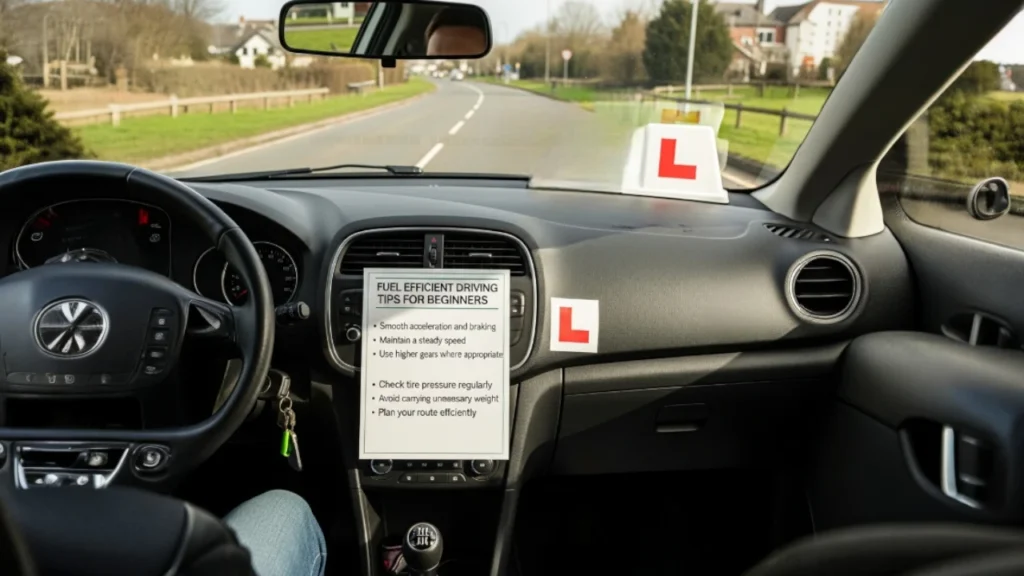
For new drivers, the ongoing cost of fuel can be one of the biggest shocks of car ownership. Many believe a car’s fuel economy is fixed, but in reality, how you drive can improve or worsen it by up to 30%. Mastering fuel efficient driving tips (often called “eco-driving”) is a triple win: it saves you significant money, reduces your environmental impact, and is gentler on your car’s engine, brakes, and tyres. Whether you’re fresh from lessons with a driving school in Ilford or are keen to offset insurance costs, these techniques are an essential, modern driving skill. This is as foundational as knowing how to check tyre pressure correctly—both are simple habits with a major impact on cost and safety.
Part 1: The Core Principle: Smoothness is Everything
Fuel efficiency isn’t about driving painfully slowly; it’s about driving smoothly and proactively. Aggressive driving (rapid acceleration and harsh braking) is the biggest fuel waster.
- Accelerate Gently: Imagine you have an egg between your foot and the accelerator. Press smoothly and progressively. There’s no need to race to the speed limit.
- Anticipate and Coast: Look far ahead. If you see traffic slowing or a red light, lift off the accelerator early and let the car’s momentum carry you forward, using engine braking to slow down. This uses zero fuel!
- Maintain a Steady Speed: The most efficient driving is at a constant speed in the highest appropriate gear. Use cruise control on motorways if you have it.
Part 2: Gear Changing: The Goldilocks Rule
Using the right gear at the right time is crucial for an efficient engine.
- Shift Up Early: For petrol cars, change up around 2,000-2,500 RPM. For diesel, it’s around 1,500-2,000 RPM. Don’t “rev” the engine unnecessarily.
- The Rule of Thumb: A good guideline for steady cruising is:
- 20 mph → 3rd gear
- 30 mph → 4th gear
- 40 mph → 5th gear (if safe and the engine is not labouring)
- Avoid Labouring the Engine: Don’t be in too high a gear at too low a speed (e.g., 5th gear at 30 mph). If the car is juddering or you need to press the accelerator deeply to maintain speed, change down.
Part 3: Speed and Aerodynamics: The Hidden Fuel Thieves
- Observe Speed Limits: Fuel consumption increases dramatically at high speeds due to wind resistance. Driving at 80mph can use up to 25% more fuel than driving at 70mph.
- Reduce Drag: Remove roof racks, boxes, and bike carriers when not in use. An empty roof box can increase fuel consumption by 10-20%.
- Keep Windows Closed at Speed: On motorways, open windows create drag. Use the car’s ventilation system instead for better efficiency.
Part 4: Car Care & Weight: The Supporting Cast
Your car’s condition directly impacts its thirst for fuel. This is where basic car maintenance is key.
- Check Tyre Pressure Monthly: This is non-negotiable. Under-inflated tyres increase rolling resistance. Just 1 PSI below recommendation can reduce efficiency by 0.5%. Learning how to check tyre pressure correctly is one of the simplest ways to save fuel.
- Reduce Weight: Clear out your boot. An extra 50kg of weight can increase fuel consumption by 1-2%.
- Service Regularly: A well-maintained engine with clean air and oil filters runs more efficiently. A faulty oxygen sensor or spark plug can ruin your MPG.
- Use Air Conditioning Wisely: At low speeds, it’s more efficient to open windows. At high speeds, use A/C but avoid the “max” setting unnecessarily.
Part 5: Trip Planning & Technology
- Combine Short Trips: A cold engine uses much more fuel. Several short trips from cold use more fuel than one longer trip covering the same distance.
- Use Sat-Nav: Avoid getting lost and wasting fuel. Many modern units also suggest efficient routes.
- Read the Road: Use downhill gradients to build momentum for the next uphill stretch.
Part 6: The Role of Quality Driving Instruction
These fuel efficient driving tips are not just good habits; they are the hallmark of a skilled, smooth driver. A professional driving school doesn’t just teach you to pass the test—it instills this very style of driving from the beginning. An instructor from a reputable school like Driving Academy Ltd will teach you to be observant, smooth, and mechanically sympathetic. You’ll learn to change gears efficiently and anticipate traffic flow as part of the core curriculum. This is why choosing a quality instructor over simply the cheapest driving instructor near me pays for itself. You learn a safer, more economical driving style that saves you money for as long as you drive.
Conclusion: Drive Smart, Save More
Adopting fuel efficient driving tips transforms you from a passive car user into an active, economical driver. It’s a mindset that benefits your wallet, your vehicle, and the environment. Start with one tip—perhaps smoother acceleration or checking your tyre pressure—and build from there. The savings will quickly add up.
Ready to learn the smooth, efficient driving style that saves you money from your very first lesson?
📞 Call Driving Academy Ltd at 07399 696344 – Our instructors in Ilford and London teach the techniques that lead to safer, cheaper, and more enjoyable driving.
📧 Email: drivingacademyltd@gmail.com
📍 Visit Us: 101 Whitechapel High Street, London, E1 7RA
Invest in skills that keep giving back. Book your fuel-smart lesson today.