


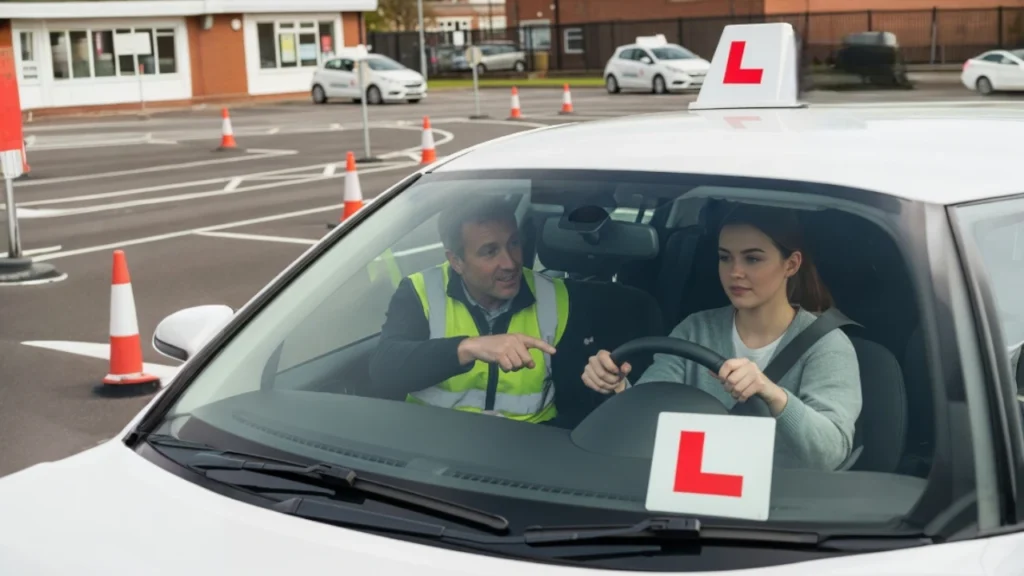
Learning to drive is an exciting journey that opens up a world of independence, but it requires mastering specific essential driving skills for beginners that form the foundation of safe, competent driving. Whether you’re just starting to research manual vs automatic licence options or preparing for your UK Driving Theory Test, understanding these core skills will set you on the right path. This comprehensive guide covers every fundamental skill you’ll need to develop, connecting them to crucial UK seatbelt and car safety rules and explaining how professional instruction from Driving Academy Ltd or a reputable driving school in Ilford builds these skills systematically.
For expert tuition that methodically develops these essential skills, contact Driving Academy Ltd at 📞 07399 696344, email 📧 drivingacademyltd@gmail.com, or visit 📍 101 Whitechapel High Street, London, E1 7RA.
The Foundational Skills: Before You Even Move
1. Cockpit Drill (DSSSM) – Your Safety Ritual
This is the first and most important routine every driver must master. It directly applies UK seatbelt and car safety rules and should become second nature.
- Doors – Secure all doors
- Seat – Adjust for correct reach and vision
- Steering – Position for comfort and control
- Seatbelt – Fasten correctly (non-negotiable safety rule)
- Mirrors – Adjust to eliminate blind spots
This drill isn’t just for tests – it’s a life-saving habit that professional instructors at any good driving school will instil from your very first lesson.
2. Vehicle Controls Familiarisation
Understanding what each control does is fundamental. This varies slightly depending on your manual vs automatic licence choice:
| Control | Manual Car | Automatic Car |
|---|---|---|
| Pedals | Clutch, Brake, Accelerator | Brake, Accelerator only |
| Gear Lever | 5-6 speed manual | P-R-N-D selector |
| Parking Brake | Handbrake (lever) | Often electronic button |
| Essential Concept | Clutch control & gear changing | Brake modulation & mode selection |
Core Driving Skills: The Building Blocks
3. Moving Off & Stopping Safely
This fundamental skill involves a complete routine:
- Prepare – Set gas, find bite point (manual) or release brake (automatic)
- Observe – Check mirrors and blind spots
- Signal – Indicate if needed
- Manoeuvre – Move off smoothly
The stopping routine reverses this process, emphasising smooth braking and secure parking.
4. Steering Control Techniques
Proper steering isn’t about “hand-over-hand” – it’s about the pull-push method:
- Maintain hand position at “10 and 2” or “9 and 3”
- Pull down with one hand while pushing up with the other
- Keep both hands on the wheel except when changing gear
- Learn to steer smoothly around bends and corners
5. Use of Mirrors & Observations
Mirror use should be systematic and regular:
- Centre mirror – Every 5-8 seconds
- Door mirrors – Before changing speed or direction
- Blind spot checks – Essential before lane changes
- The MSM routine (Mirror-Signal-Manoeuvre) should govern all your driving decisions
Intermediate Skills: Building Confidence
6. Junction Procedures
Junctions require methodical approaches:
- Approach – Correct speed and gear selection
- Observation – Look right-left-right (or left-right-left for right turns)
- Decision – Only proceed when absolutely safe
- Positioning – Correct lane positioning for your intended direction
7. Roundabout Navigation
Roundabouts combine several skills:
- Observation – Assess traffic already on the roundabout
- Lane discipline – Correct lane for your exit
- Signalling – Appropriate entry and exit signals
- Priority – Give way to traffic from the right (unless signs indicate otherwise)
8. Manoeuvres
These test your car control precision:
- Parallel parking – Parking alongside other cars
- Bay parking – Parking in marked bays (forwards and reverse)
- Pulling up on the right – Stopping on the opposite side of the road
Advanced Skills: Developing Proficiency
9. Anticipation & Planning
This skill separates competent drivers from exceptional ones:
- Look well ahead – Not just at the car in front
- Predict hazards – Pedestrians, cyclists, emerging vehicles
- Plan early – Prepare for junctions, lane changes, and stops
- Maintain space – The two-second following rule (four seconds in wet conditions)
10. Speed Management
Understanding that speed limits are maximums, not targets:
- Adjust for conditions – Weather, traffic, visibility
- Appropriate approach speeds – Slowing in good time for hazards
- Smooth acceleration/braking – Avoiding sudden speed changes
Special Considerations & Additional Skills
Weather Adaptation
Driving in rain, fog, or ice requires modified techniques:
- Increased stopping distances – At least double in wet conditions
- Reduced speeds – Match your speed to visibility and road conditions
- Light use – Correct use of dipped headlights and fog lights
- Smooth controls – Gentle steering, braking, and acceleration
Night Driving
Presents unique challenges requiring specific skills:
- Headlight use – Dipped beams, main beams, and when to use them
- Glare management – Avoiding being dazzled by oncoming lights
- Enhanced observation – Spotting pedestrians and hazards with limited visibility
How Driving Academy Ltd Develops These Skills
A professional driving school in Ilford like Driving Academy Ltd doesn’t just teach these skills randomly. We follow a structured, progressive approach:
| Skill Stage | Focus Areas | Typical Lesson Content |
|---|---|---|
| Foundation (Hours 1-10) | Cockpit drill, controls, moving off/stopping, steering | Quiet roads, basic car control |
| Development (Hours 11-30) | Junctions, roundabouts, manoeuvres, mirrors | Residential areas, light traffic |
| Refinement (Hours 31-40+) | Dual carriageways, complex junctions, anticipation | Busier roads, test routes, mock tests |
| Test Preparation | Test standards, manoeuvre precision, confidence | Mock tests, test route practice |
Connecting Skills to Tests & Rules
UK Driving Theory Test Connection
Every practical skill has theoretical knowledge behind it:
- Road signs inform your speed and positioning decisions
- Rules and regulations govern right of way and procedures
- Hazard perception develops your anticipation skills
- Safety knowledge underpins all driving decisions
UK Seatbelt and Car Safety Rules Integration
Safety isn’t separate from driving skills – it’s integrated:
- The cockpit drill begins with seatbelt fastening
- Regular vehicle checks (tyres, lights, fluids) maintain safety
- Observation skills prevent collisions
- Appropriate speed choices reduce crash severity
FAQs: Beginner Driving Skills
Q1: How long does it take to master these essential skills?
A: Most learners need 40-50 hours of professional lessons plus 20+ hours of private practice. However, everyone learns at their own pace. Quality instruction from a driving school like ours focuses on mastery, not just hours.
Q2: Do I need different skills for manual vs automatic?
A: The core skills (observation, positioning, anticipation) are identical. Manual requires additional clutch control and gear-changing skills. Automatic is generally easier to learn initially, as noted in our manual vs automatic licence comparison.
Q3: What’s the most important skill for beginners?
A: Systematic observation. If you see hazards early, you have time to respond safely. This skill underpins all others and is heavily tested in both theory and practical exams.
Q4: How can I practice between lessons?
A: With a qualified supervisor (over 21, held licence 3+ years) in an insured car:
- Practice basic controls in quiet areas
- Reinforce what your instructor taught
- Build confidence in familiar environments
- Never practice skills beyond your current level
Q5: Are these skills tested differently in Ilford?
A: The skills are universal, but a good driving school in Ilford will ensure you practice them on local test routes, dealing with specific challenges like the Gants Hill roundabout or Barkingside High Street.
Q6: How does weather affect skill development?
A: We intentionally teach in various conditions (with safety paramount) to build all-weather competence. Rain requires gentler controls, while bright sun demands extra vigilance for shadows and glare.
Conclusion: Building Skills for Life
Mastering these essential driving skills for beginners creates more than just a test-passing driver – it develops a safe, confident, and competent road user for life. Each skill builds upon the last, creating a comprehensive ability to handle UK roads safely.
Remember that choosing between manual vs automatic licence affects some technical skills but not the fundamental principles of safe driving. Whichever path you choose, systematic skill development with a professional instructor provides the strongest foundation.
Ready to develop these essential driving skills with expert guidance? Start your journey with Driving Academy Ltd today.
📞 07399 696344 | 📧 drivingacademyltd@gmail.com | 📍 101 Whitechapel High Street, London, E1 7RA