


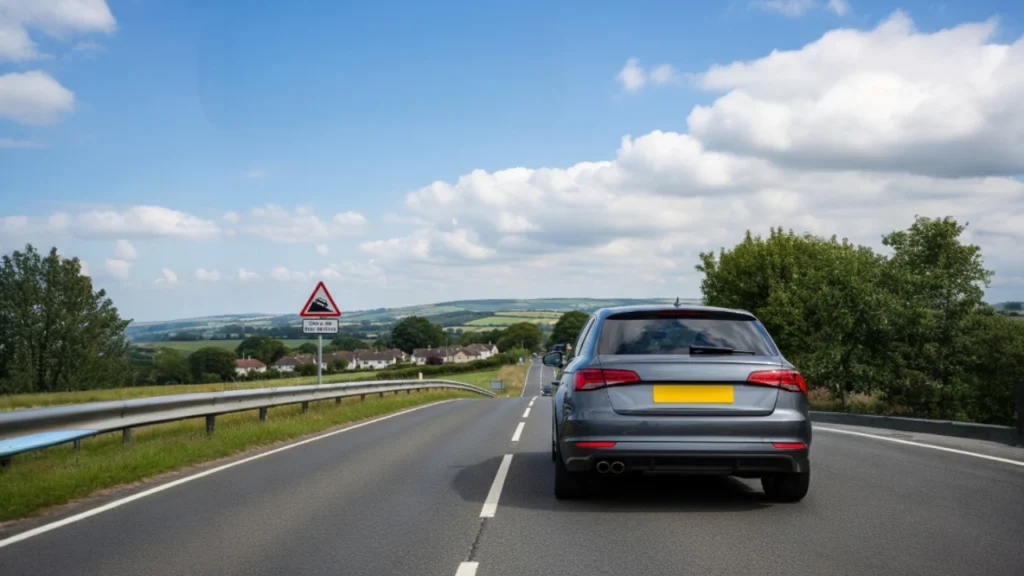
Let’s be honest: that moment of panic on a steep incline, feeling the car roll back as you fumble with the pedals, is a universal rite of passage for every learner driver. In areas like Gants Hill and its surrounding hills, mastering this manoeuvre isn’t just a test requirement—it’s an essential daily skill. The good news? Hill starts can be transformed from a source of anxiety into a simple, automatic action. This guide breaks down the proven step-by-step method, explains the precise mechanics, and provides local Gants Hill driving lessons wisdom to have you tackling inclines with calm confidence, whether it’s on a quiet side street or approaching the busy Gants Hill roundabout.
Mastering hill starts is a cornerstone of skilled driving. It demonstrates control, coordination, and understanding of your vehicle. With the right technique and practice, what feels daunting becomes second nature. Let’s eliminate the fear and build your skill.
Understanding the “Why”: The Science of the Hill Start
Before the steps, understand the forces at play. On a hill, gravity pulls your car backwards. To move forward, you must generate enough driving force from the engine to overcome this pull. The clutch is your mediator—it carefully transfers the engine’s power to the wheels. The handbrake (parking brake) is your best friend, acting as a third hand to hold the car securely while you set up the power.
The Foolproof Step-by-Step Guide to Perfect Hill Starts
Follow this methodical approach. Practice each step in sequence on a quiet, gradual incline before tackling steeper hills.
Step 1: Secure the Vehicle (The Set-Up)
- As you come to a stop on the hill, keep your foot firmly on the foot brake.
- Apply the handbrake fully. This is your anchor. Ensure it’s firmly engaged so the car cannot roll back.
- Select first gear and place your hand back on the handbrake ready for release.
Step 2: Find the “Biting Point” (The Key to Control)
- Press the accelerator gently until the revs rise slightly and steadily. Aim for around 1,500 RPM (you’ll learn the sound).
- Slowly raise the clutch pedal until you feel the car dip at the front and the engine note changes. This is the “biting point” or “holding point.” The engine is now connected to the wheels and wants to move forward.
- Hold both feet perfectly still. At this point, if you released the handbrake, the car would either creep forward or hold steady against gravity.
Step 3: The Move-Off (Smooth & Confident)
- Check your mirrors and blind spot for any approaching traffic, cyclists, or pedestrians.
- Signal your intention if necessary.
- Now, as you apply a little more power with the right foot, release the handbrake fully.
- Simultaneously, lift the clutch pedal smoothly the final small amount while maintaining gentle accelerator pressure.
- The car will move forward smoothly. Steer as needed and continue driving normally.
The Top 5 Common Hill Start Mistakes (& How to Fix Them)
- Rolling Back: Caused by releasing the handbrake before the biting point is found.
- Fix: Always find and hold the biting point before touching the handbrake release button.
- Stalling: Caused by not enough accelerator or lifting the clutch too quickly.
- Fix: Practice finding the biting point on flat ground. Ensure revs are steady (1,500 RPM) before lifting the clutch to the hold point.
- “Riding the Clutch”: Holding the clutch at the biting point for too long while waiting, causing excessive wear.
- Fix: Only find the biting point when you are ready to move imminently. If waiting more than 3-4 seconds, put the car in neutral and apply the handbrake.
- Over-Revving (Harsh Acceleration): Pressing the accelerator too hard, causing wheel spin or jerky movement.
- Fix: Be gentle and precise with the accelerator. Smooth power is the goal.
- Forgetting the Handbrake Altogether: Relying solely on the “heel-and-toe” method with foot brake before moving off.
- Fix: Use the handbrake method consistently. It’s safer, more reliable for learners, and is the method driving lessons in Gants Hill emphasise for test success.
Why Local Practice in Gants Hill is Invaluable
Practicing hill starts in the Gants Hill area provides real-world experience that a generic industrial estate cannot. Your driving lessons Gants Hill instructor will know the perfect gradients for progressive learning:
- Beginner Inclines: Quiet residential streets off Cranbrook Road.
- Intermediate Practice: Navigating the inclines around Gants Hill roundabout approaches, incorporating observation and junction planning.
- Advanced Application: Dealing with stop-start traffic on hills near the A12 slip roads, building confidence under pressure.
This contextual practice ensures you’re prepared for the exact conditions you’ll face on your test and daily driving.
Your Hill Start Practice Drill
Find a safe, quiet hill with minimal traffic.
- Stop and secure the car with the handbrake.
- Practice Step 2 repeatedly: Find the biting point until you can identify it instantly by sound and feel. Hold it, then dip the clutch and relax. Do this 10 times.
- Perform 5 complete hill starts to the left, then 5 to the right (simulating a parked car scenario).
- Repeat until you feel zero roll-back and achieve smooth, controlled pull-aways every time.
Frequently Asked Questions (FAQs)
Q1: What if my car has an electronic handbrake?
A: Most modern cars with electronic handbrakes have a “hill hold” function that automatically releases when you move off. However, for the driving test, you must demonstrate you can use the manual method. Your driving lessons Gants Hill instructor will teach you how to temporarily disable the auto-hold or practice in a manual-handbrake car.
Q2: Can I use the “quick method” (just using the foot brake) on my driving test?
A: It is risky. Examiners want to see a controlled, secure stop with no roll-back. The handbrake method is the most definitive way to prove this. Using only the foot brake increases the chance of rolling, which can be a fault or even a serious fault if it creates danger.
Q3: How do I stop nervously over-revving the engine?
A: Focus on feel and sound, not sight. Don’t stare at the rev counter. Listen for a steady, low hum from the engine. Feel for the car wanting to move. Gentle pressure is key. This is a core focus in quality driving lessons.
Q4: What’s the best way to practice hill starts without an instructor?
A: Only practice in a car you’re insured to drive, with a fully licensed driver over 21 who has held their license for 3+ years. Use the step-by-step guide above and choose a very quiet road with good visibility. Safety is paramount.
Q5: I keep stalling when I’m nervous in traffic on a hill. Help!
A: Breathe. Secure the car with the handbrake. Put the car in neutral. Take a moment. Then restart the process: first gear, handbrake on, find the bite, check, and go. Rushing is the enemy of coordination. This resilience is built through progressive practice on busier roads during your driving lessons.
Q6: Are hill starts still part of the modern driving test?
A: Absolutely. While you might not be explicitly asked to “do a hill start,” the independent driving portion will inevitably include roads with gradients. Your ability to move off safely and under control on an incline will be assessed.
Conclusion: From Fear to Second Nature
Mastering hill starts is a clear milestone in your journey to becoming a competent, confident driver. By breaking the manoeuvre down into a reliable, step-by-step routine—Secure, Set, Go—you remove the uncertainty. The handbrake is your tool for control, the biting point is your point of power, and smooth coordination is your goal.
With dedicated practice, first on quiet Gants Hill slopes and later in more demanding traffic situations, this skill will become an unconscious part of your driving repertoire. Remember, every expert driver was once a learner who, at some point, felt that heartbeat of dread on a steep hill. The difference is they practiced the system. Now you have it too.
3 Responses