


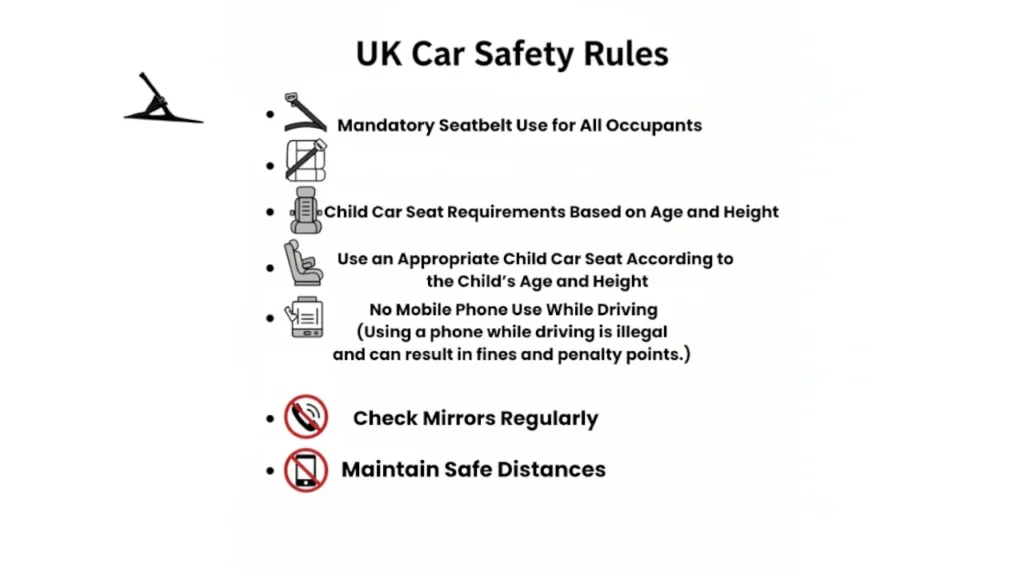
Clicking your seatbelt is the simplest, most effective action you can take to protect yourself in a car. In the UK, it’s not just good practice—it’s the law. A proper understanding of UK seatbelt and car safety rules is fundamental for every driver and passenger. It’s a core part of the UK Driving Theory Test and one of the important UK road rules every beginner should know.
This guide will walk you through exactly what the law requires, who is responsible, and how to ensure your vehicle is legally safe to drive. This knowledge is crucial whether you’re a learner practicing with a driving school, a parent transporting children, or a driver wanting to avoid penalties. For professional driving tuition that embeds safety from the first lesson, contact Driving Academy Ltd at 📞 07399 696344, email 📧 drivingacademyltd@gmail.com, or visit us at 📍 101 Whitechapel High Street, London, E1 7RA.
Part 1: The Seatbelt Law – Who Must Wear One and When?
The law on seatbelts is clear and applies to drivers and passengers in almost all circumstances.
The Basic Rule
You MUST wear a seatbelt if one is fitted in the seat you are using. You are also legally responsible for ensuring any passenger under 14 years old wears a seatbelt or uses the correct child restraint.
Who is Exempt? (A Very Short List)
Very few people are exempt. You may not need to wear a seatbelt if you:
- Are a licensed taxi driver who is ‘plying for hire’ or carrying passengers.
- Are driving a goods vehicle on deliveries that involve travelling 50 metres or less between stops.
- Are a passenger in a vehicle being used for police, fire, or rescue services.
- Have a valid Certificate of Exemption from a doctor for medical reasons (you must carry this certificate in the vehicle).
Crucially, pregnancy is NOT an exemption. Pregnant women must wear a seatbelt, with the strap placed above and below the bump, never across it.
Part 2: Child Car Seats: The Law by Age, Height, and Weight
The rules for children are more specific and are based on the child’s height or weight. It is the driver’s legal responsibility to ensure children are correctly restrained.
| Child’s Status | Legal Requirement | Where must they sit? |
|---|---|---|
| Under 3 years old | MUST use a correct child restraint (car seat) suitable for their weight. | Cannot travel in a car without a seat. If one is not available, they cannot travel. |
| Aged 3 to 12 years old (or under 135cm tall) | MUST use a correct child restraint (car seat) suitable for their weight. | Rear seat is safest. They can use a front seat with the correct restraint, but only if the front passenger airbag is deactivated. |
| Over 12 years or 135cm tall | MUST wear an adult seatbelt. | Can sit in any seat with a seatbelt. |
Key Points for Parents & Drivers:
- Never use a rear-facing child seat in a front seat with an active airbag. The force of the airbag can cause serious injury.
- Only use EU-approved seats. Look for the ‘E’ mark label on the seat.
- Second-hand seats are risky. Do not use one that is damaged, has been in a crash, or is missing instructions.
Part 3: Vehicle Safety Rules – Is Your Car Legal to Drive?
Your legal responsibility extends beyond seatbelts to the basic safety and roadworthiness of the vehicle itself.
The MOT Test
If your vehicle is over 3 years old, it must have a valid MOT certificate. The MOT tests important safety items including:
- Seatbelts: All seatbelts must be in good working order, secure, and retract properly.
- Lights and Indicators: All must work correctly.
- Tyres: Must have the legal minimum tread depth of 1.6mm across the central three-quarters of the tyre, around its entire circumference.
- Brakes: Efficiency and condition are thoroughly tested.
- Steering and Suspension: Must be secure and in good condition.
Driving without a valid MOT is illegal and will invalidate your insurance. You can check any vehicle’s MOT status for free on the GOV.UK website.
Tyres: Your Critical Connection to the Road
Tyres are a primary safety feature. The law states:
- Tread Depth: Minimum of 1.6mm across the central ¾ of the tyre, around the full circumference.
- Condition: Tyres must be free from cuts, bulges, or other damage that could cause failure.
- Type and Size: They must be suitable for the vehicle and compatible with the other tyres on the same axle.
A £100 fine and 3 penalty points can be issued for each illegal tyre.
Part 4: Penalties for Breaking the Rules
Ignoring these rules has serious consequences, designed to deter unsafe behaviour.
| Offence | Potential Penalty | Additional Consequences |
|---|---|---|
| Not wearing a seatbelt | £100 on-the-spot fine. If prosecuted in court, the maximum fine is £500. | Driver is liable for passengers under 14. |
| Child not in correct car seat/restraint | £100 on-the-spot fine. Driver is responsible. | Court prosecution can lead to a £500 fine. |
| Driving without a valid MOT | Up to £1,000 fine. | Your insurance is invalid. The car can be impounded. |
| Dangerous or illegal tyres | £100 fine and 3 penalty points per tyre. | A car with three illegal tyres could mean 9 points and a potential driving ban. |
How This Knowledge Helps You Pass Your Test
Understanding UK seatbelt and car safety rules is not just about avoiding fines; it’s central to becoming a safe, responsible driver.
- For the Theory Test: You will face multiple-choice questions directly on seatbelt law, child restraints, and vehicle safety requirements (like tyre tread depth). This guide covers the exact facts you need to know.
- For the Practical Test: Before you even start moving, your examiner will observe if you put your seatbelt on. They will also mark you on your vehicle safety knowledge through the ‘show me, tell me’ questions. For example: “Tell me how you’d check your tyres to ensure they have sufficient tread depth and are safe to use on the road.”
- For Life-Long Driving: These rules form the bedrock of safety culture on UK roads. A good driving school or driving school in Ilford will instill these habits from your very first lesson.
FAQs: Your Safety Rule Questions Answered
Q1: Who is responsible if an adult passenger isn’t wearing a seatbelt?
A: The adult passenger is responsible for their own seatbelt. However, as a driver, you can be seen to be encouraging a safer environment by reminding them.
Q2: Can I be fined for a passenger not wearing a seatbelt in the back?
A: Yes. The unbelted passenger themselves can be issued a £100 fixed penalty notice by the police.
Q3: Are there different rules for classic cars?
A: Cars first used before 1965 are not required to have seatbelts fitted. However, if they are fitted, you must wear them.
Q4: I’m learning to drive. Do the same seatbelt rules apply?
A: Absolutely. As a learner, you and your supervising driver must wear seatbelts at all times. Your driving school instructor will ensure this is the first thing you do when getting in the car.
Q5: Where can I get my car seat checked for correct fitting?
A: Many local councils offer free child car seat checks. You can also visit retailers like Halfords for a fitting check (sometimes for a fee).
Q6: How does a driving school teach these safety rules?
A: Reputable schools, like Driving Academy Ltd, integrate safety into every lesson. From the first “cockpit drill” (where putting on your seatbelt is step one) to explaining the ‘show me, tell me’ questions, they ensure you understand both the how and the why behind the rules.
Conclusion: Safety is a Habit, Not a Chore
Adhering to UK seatbelt and car safety rules is the clearest sign of a responsible driver. It protects you, your passengers, and other road users. These rules are not complicated bureaucracy; they are well-researched life-saving measures.
Making safety a non-negotiable habit from day one is the mark of a good driver. This starts with high-quality driver education. For learners in London and Ilford looking for instruction that prioritises safety, knowledge, and confidence, Driving Academy Ltd is here to guide you.
Belt up, drive safe, and make it a habit for life.
Driving Academy Ltd
📞 07399 696344 | 📧 drivingacademyltd@gmail.com | 📍 101 Whitechapel High Street, London, E1 7RA