


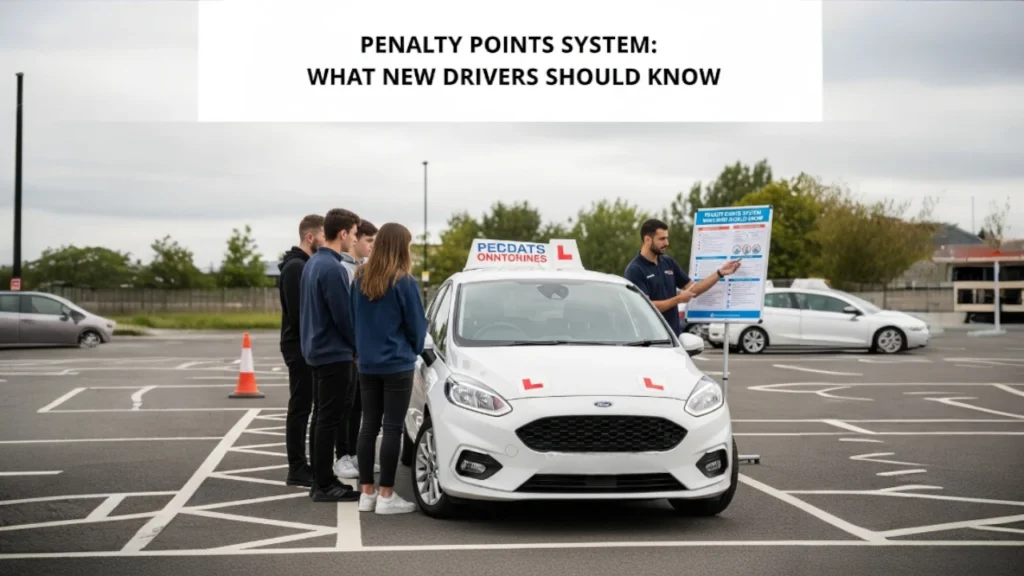
Gaining your first driving licence is a significant achievement, but it comes with serious responsibilities—including understanding the penalty points system for new drivers. In the UK, penalty points (endorsements) are more than just fines; they can quickly lead to licence revocation for new drivers. This guide explains everything you need to know about how points work, common offences that attract them (including breaches of UK seatbelt and car safety rules), and the severe consequences you face in your first two years on the road. Whether you’re a learner preparing for your UK Driving Theory Test or a new licence holder, this knowledge is crucial for protecting your driving future.
For driving instruction that emphasises safety and legal awareness from day one, contact Driving Academy Ltd at 📞 07399 696344, email 📧 drivingacademyltd@gmail.com, or visit 📍 101 Whitechapel High Street, London, E1 7RA.
How the Penalty Points System Works
The Basics
- Endorsement Codes: Each traffic offence has a unique code (e.g., SP30 for speeding).
- Points Range: Offences typically carry 1-11 penalty points.
- Duration on Licence: Points stay on your driving record for 4 years from the date of the offence (3 years for some Northern Ireland offences).
- The ‘Totting-Up’ Rule: If you get 12 or more points within any 3-year period, you can be disqualified from driving for at least 6 months.
The ‘New Driver’ Rules: Your Biggest Risk
A special, stricter rule applies during your probationary period—the first two years after passing your driving test.
The Critical Rule
If you accumulate 6 or more penalty points within your first two years of driving, your licence will be automatically revoked by the DVLA.
- Revocation vs. Disqualification: Your licence is taken away completely—it’s not a temporary ban.
- The Consequences: You revert to being a learner driver. You must:
- Reapply for a new provisional licence.
- Retake and pass both the UK Driving Theory Test and the practical driving test.
- Pay all application and test fees again.
This rule makes seemingly minor offences catastrophic for new drivers.
Common Offences & Penalty Points for New Drivers
Even small mistakes can have major consequences. Below is a table of common offences that new drivers must be vigilant about.
| Offence Category | Example Offences | Typical Penalty Points | Why It’s a Risk for New Drivers |
|---|---|---|---|
| Speeding | Exceeding the speed limit (SP30 code). | 3-6 points (or a speed awareness course). | Very common. Two minor speeding tickets could mean licence revocation. |
| Using a Mobile Phone | Holding or using a hand-held device while driving (CU80). | 6 points and a £200 fine. | A single offence reaches the 6-point threshold, causing immediate revocation. |
| Seatbelt & Safety Violations | Driver or passenger under 14 without a seatbelt (CU10). | 3 points. | Directly breaches UK seatbelt and car safety rules. As the driver, you are responsible for passengers under 14. |
| Careless Driving | Not showing due care and attention (CD10). | 3-9 points. | A broad offence that can cover poor lane discipline, tailgating, or sudden manoeuvres. |
| Ignoring Traffic Signs | Going through a red light (TS10). | 3 points. | Often a result of misjudgement or poor observation at junctions. |
| Defective Tyres | Driving with illegal tyre tread (below 1.6mm) (CU30). | 3 points per tyre. | A simple maintenance failure. Two defective tyres = 6 points and revocation. |
| Insurance Offences | Driving without valid insurance (IN10). | 6-8 points. | Another single offence that can trigger immediate licence revocation. |
How to Check Your Penalty Points
You are responsible for knowing your own status. You can:
- Check your driving licence counterpart online via GOV.UK.
- Contact the DVLA.
Your driving school instructor should have explained this during your training.
Avoiding Points: A Proactive Guide for New Drivers
1. Master and Respect All Rules
Truly internalise the rules you learned for your test. This goes beyond passing—it’s about safe, legal driving for life. A reputable driving school in Ilford like Driving Academy Ltd focuses on building this understanding, not just test-passing skill.
2. Adopt a Defensive Driving Mindset
- Always plan ahead to avoid rushed decisions.
- Assume others will make mistakes and be prepared.
- Keep a safe following distance (at least the two-second rule).
3. Zero Tolerance on Mobile Phones
The law is clear: you must not hold or use a hand-held device while driving. The only exception is making a contactless payment at a drive-through. Use a fixed, hands-free kit if you must, but the safest choice is to switch your phone off or put it out of reach.
4. Regular Vehicle Checks
Make weekly checks of tyres, lights, and fluid levels part of your routine. A defect like a single brake light being out could lead to 3 points.
5. If You’re From Abroad: Licence Exchange Rules
If you exchanged a foreign licence for a UK one, you are subject to the same new driver rules. The two-year probationary period typically starts from the date you first obtained your original foreign licence or the date you became a UK resident, depending on the country. The process for how to exchange a driving licence in the UK varies by country, and it’s crucial to get official advice from the DVLA.
What to Do If You Face a Penalty
- Do Not Ignore It: Respond to any Notice of Intended Prosecution (NIP) within the deadline.
- Seek Legal Advice: For serious matters, consulting a motoring solicitor can be worthwhile.
- Consider a Speed Awareness Course: If offered for a speeding offence, it avoids points but you must pay the course fee. You can usually only take one every three years.
- Prepare for the Worst: If you reach 6 points, understand the revocation process fully. Contact the DVLA and start planning to retake your tests.
FAQs on Penalty Points for New Drivers
Q1: Do points from my provisional licence count towards the 6-point limit?
A: Yes. Any points you received while on a provisional licence will carry over to your full licence and count towards the 6-point, two-year total.
Q2: I got 3 points. How long until I’m ‘safe’ from revocation?
A: The two-year probationary period is fixed from the day you pass your test. Points stay on your licence for 4 years but only affect the ‘new driver’ rule if 6 are accumulated within the first 2 years.
Q3: Can I still drive after my licence is revoked?
A: No. You must not drive until you have successfully reapplied for a provisional licence, which means displaying L plates and being supervised by a qualified driver. Driving without a valid licence is a serious offence.
Q4: Does this system apply if I exchanged my licence?
A: Generally, yes. If you obtained your UK licence by exchanging a foreign one from a country not on the “designated country” list for direct exchange, you are likely treated as a new driver. The rules for how to exchange a driving licence in the UK are complex, so check your status with the DVLA.
Q5: How can a driving school help me avoid points?
A: A good driving academy ltd doesn’t just teach you to pass a test. It instills a deep understanding of the rules, hazard awareness, and a responsible attitude that keeps you safe and within the law long after you’ve passed.
Conclusion: Your Licence is a Privilege, Not a Right
The UK penalty points system for new drivers is intentionally strict to promote road safety during your most vulnerable driving years. Treat every journey with the same care and attention you showed on your test. The consequences of minor infractions are disproportionately severe, making vigilance non-negotiable.
Protecting your licence starts with high-quality education. At Driving Academy Ltd, our goal is to equip you with the skills and mindset to be a safe driver for life, helping you navigate not just the roads, but the rules that keep them safe.
Drive smart, drive safe, and protect your future on the road from day one.
📞 07399 696344 | 📧 drivingacademyltd@gmail.com | 📍 101 Whitechapel High Street, London, E1 7RA