

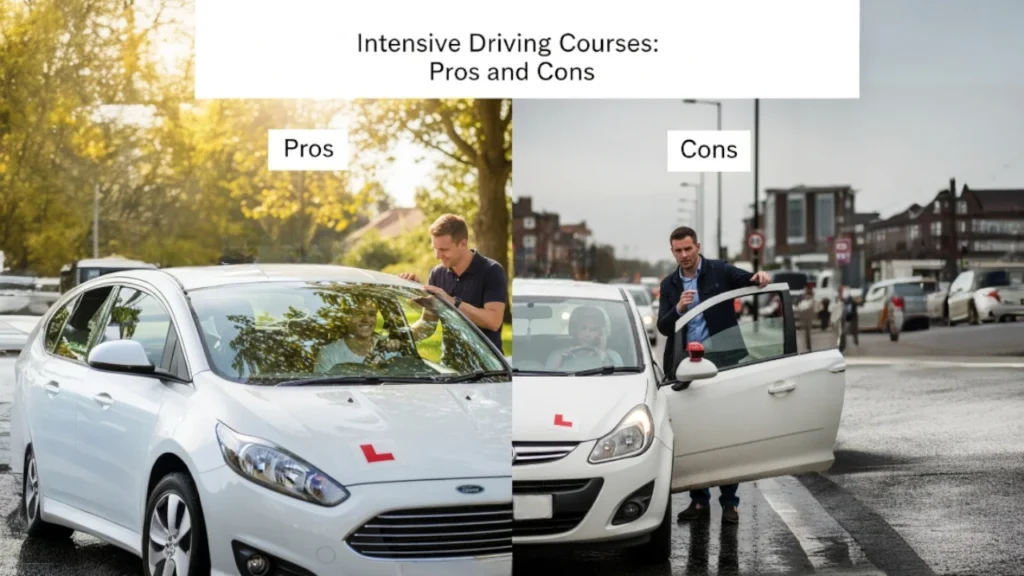
The traditional path of weekly driving lessons can feel slow. For learners eager to get on the road quickly, intensive driving courses (or “crash courses”) offer an alternative route, compressing months of learning into just one or two weeks of full-time training. But is this high-pressure approach the right choice for everyone? This comprehensive guide examines all the pros and cons of intensive driving courses, connecting this decision to the essential driving skills beginners must learn and the crucial UK seatbelt and car safety rules you must know. We’ll help you decide if this fast-track method aligns with your learning style, goals, and situation, whether you’re considering a course with a local driving school in Ilford or a national provider.
For personalized advice on whether an intensive course suits you, contact Driving Academy Ltd at 📞 07399 696344, email 📧 drivingacademyltd@gmail.com, or visit 📍 101 Whitechapel High Street, London, E1 7RA.
What Exactly Are Intensive Driving Courses?
An intensive driving course packages all necessary tuition into a short, concentrated burst—typically 5 to 10 consecutive days with 4 to 6 hours of driving daily. The course is designed to take you from beginner (or near-beginner) to test-ready, culminating in your practical driving test booked for the final day. This format demands full immersion, making it vastly different from traditional weekly lessons.
The Advantages: Why Choose an Intensive Course?
1. Unmatched Speed and Efficiency
- Rapid License Acquisition: Achieve in weeks what typically takes months. This is the single biggest draw.
- Total Immersion: Daily practice prevents skill fade between lessons, accelerating muscle memory and confidence.
- Perfect for Time-Pressed Learners: Ideal for students on holiday, those between jobs, or anyone who can dedicate a solid block of time.
2. Focused Learning and Momentum
- Concentrated Skill Building: The continuous learning curve helps integrate complex essential driving skills for beginners, like clutch control, observation routines, and maneuvers, more cohesively.
- Single Instructor Advantage: Learning from one dedicated instructor ensures consistency in teaching methods.
- Structured Syllabus: A clear, daily plan covers every aspect of the driving test systematically.
3. Practical and Logistical Benefits
- Guaranteed Test Slot: The driving school books your test as part of the package, bypassing long public waiting lists—a huge advantage in busy areas.
- All-Inclusive Packages: Often include training, test fee, and use of the instructor’s car for the test in one upfront price.
The Disadvantages and Risks: The Other Side of the Coin
1. Intensity and Pressure
- Mental and Physical Fatigue: Several hours of intense concentration daily is demanding and can lead to diminishing returns.
- High-Stakes Environment: The pressure of a pre-booked test at the end can increase anxiety for some learners.
- Limited Time to Process: Unlike weekly lessons, there’s little downtime to subconsciously absorb and reflect on new skills.
2. Suitability and Learning Style Mismatch
- Not for the Anxious: Learners who are nervous or need to build confidence slowly may find the pace overwhelming.
- Requires a Learning Prerequisite: Most reputable providers insist you have passed your UK Driving Theory Test before starting and strongly recommend some prior driving experience.
- All-or-Nothing Gamble: If you fail the final test, you may have to pay again for a new course or additional lessons, representing a significant financial and emotional setback.
3. Potential Compromises on Skill Depth
- Rote Learning for the Test: The focus can sometimes shift to passing the test rather than internalizing deep, lifelong safe driving habits.
- Limited Weather/Time Experience: A one-week course might not expose you to diverse driving conditions (e.g., night, heavy rain), which are part of building comprehensive essential driving skills.
Critical Connections: Intensive Courses and Foundational Knowledge
Choosing an intensive path doesn’t mean shortcuts on safety or knowledge. A quality course will rigorously integrate:
- UK Seatbelt and Car Safety Rules: From the very first cockpit drill, these non-negotiable rules are instilled. The habit of the DSSSM check (Doors, Seat, Steering, Seatbelt, Mirrors) becomes second nature through daily repetition.
- UK Driving Theory Test Content: Your theory knowledge is immediately applied on the road, reinforcing the ‘why’ behind every rule and maneuver.
- Essential Driving Skills: A good intensive syllabus ensures all core skills—from moving off safely to mastering roundabouts—are covered in depth, not just rushed through.
Who Should (and Shouldn’t) Consider an Intensive Course?
Ideal Candidates:
- Fast, confident learners who thrive under pressure.
- Individuals with previous experience (e.g., lapsed learners, those with overseas experience).
- People who can commit 100% to the course with no other distractions.
- Learners who have already passed their theory test.
Likely Poor Candidates:
- Very nervous or hesitant beginners.
- Those who need time to process information between lessons.
- Learners unable to take time off work/studies to focus fully.
- Anyone who hasn’t passed their theory test.
Cost Comparison: A Realistic Look
| Aspect | Intensive Course | Traditional Weekly Lessons |
|---|---|---|
| Typical Total Cost | £1,200 – £2,000+ | £1,500 – £2,500+ (spread over months) |
| Payment | Large upfront sum. | Weekly or block payments, aiding budgeting. |
| Test Fee & Car Hire | Usually included. | Often paid separately by the learner. |
| Financial Risk if You Fail | High. May require a new course. | Lower. You simply book more lessons and a new test. |
Key Insight: While the upfront cost of an intensive course can seem high, it may be comparable to or even less than the total cost of traditional lessons spread over many months.
Making the Decision: Key Questions to Ask
- What is my learning style? Do I excel in fast-paced, immersive environments?
- What is my starting point? Have I passed my theory test? Do I have any driving experience?
- Can I handle the pressure? How do I perform in high-stakes exam situations?
- Is the provider reputable? Are they a known driving school in Ilford with verified reviews and pass rates?
- What are the terms if I fail? Does the package include a free or discounted retest?
FAQs
Q1: Can a complete beginner with zero experience pass an intensive course?
A: It is possible but very challenging. Most providers strongly recommend at least 10-20 hours of prior experience. The course pace is extremely fast, and starting from absolute zero adds significant pressure.
Q2: What happens if I get ill during the course or fail my test?
A: Policies vary drastically. This is the most important question to ask before booking. Some may offer a free retest, others may offer discounted lessons, and some offer nothing. Always get the policy in writing.
Q3: How do I choose a good intensive course provider?
A: Prioritise local providers like a driving academy ltd with intimate knowledge of Ilford test routes. Check their DVSA approval, read independent reviews, and ask for their first-time pass rate for intensive students. Avoid providers that make unrealistic guarantees.
Q4: Does a crash course properly teach safety rules?
A: A reputable course should. Safety rules are the bedrock of driving. Ensure the syllabus explicitly includes daily reinforcement of UK seatbelt and car safety rules and vehicle safety checks.
Conclusion: A Powerful Tool for the Right Learner
Intensive driving courses are a powerful, effective tool for the right candidate. They offer a legitimate fast track to a license, combining efficiency with focused learning. However, they are not a magic bullet. The intensity, pressure, and financial risk are real.
The decision hinges on self-awareness. If you are a resilient, fast learner with some foundation and can fully commit, an intensive course with a quality provider like Driving Academy Ltd could be perfect. If you are anxious, need a gentler pace, or lack the theory test pass, traditional lessons are likely the wiser, more successful path. Whichever you choose, the goal remains the same: not just to pass a test, but to become a safe, confident driver for life.
Still unsure if an intensive course is right for you? Contact us for a frank, no-obligation assessment of your readiness.
📞 07399 696344 | 📧 drivingacademyltd@gmail.com | 📍 101 Whitechapel High Street, London, E1 7RA