

The day of your practical driving test is a milestone you’ve been building towards for months. That mix of excitement and nerves is completely normal for every learner driver. The key to turning those nerves into confidence isn’t a secret—it’s meticulous preparation.
A great driving school teaches you how to drive. This practical test day checklist is here to ensure you know how to perform on the day. Think of it as your co-pilot, guiding you through every single step from the night before to the moment you hear your result. By following this structured plan, you transform anxiety into focused readiness, dramatically increasing your chances of success.
Why a Test Day Checklist is Your Best Friend
Just as you wouldn’t start a long journey without checking your fuel and tyres, you shouldn’t approach test day without a systematic plan. A checklist eliminates nasty surprises and puts you firmly in control.
The Tangible Benefits of Being Prepared
- Eliminates “Morning Panic”: With everything organised the night before, you can sleep better and start your day calmly.
- Builds Unshakeable Confidence: Ticking off items creates a sense of accomplishment and control before you even get in the car.
- Prevents Automatic Fails: Forgetting your provisional licence is an instant test cancellation—this checklist makes that impossible.
- Optimises Your Mindset: By handling the logistics, you free up mental space to focus entirely on safe and smooth driving.
Your Complete Pre-Test Preparation Guide
True preparation begins 24 hours before your test appointment. Break it down into these manageable stages.
The Night Before: Get Organised
This is the most critical phase. Your goal is to make the morning as smooth as possible.
1. Document & Admin Check (The Non-Negotiables):
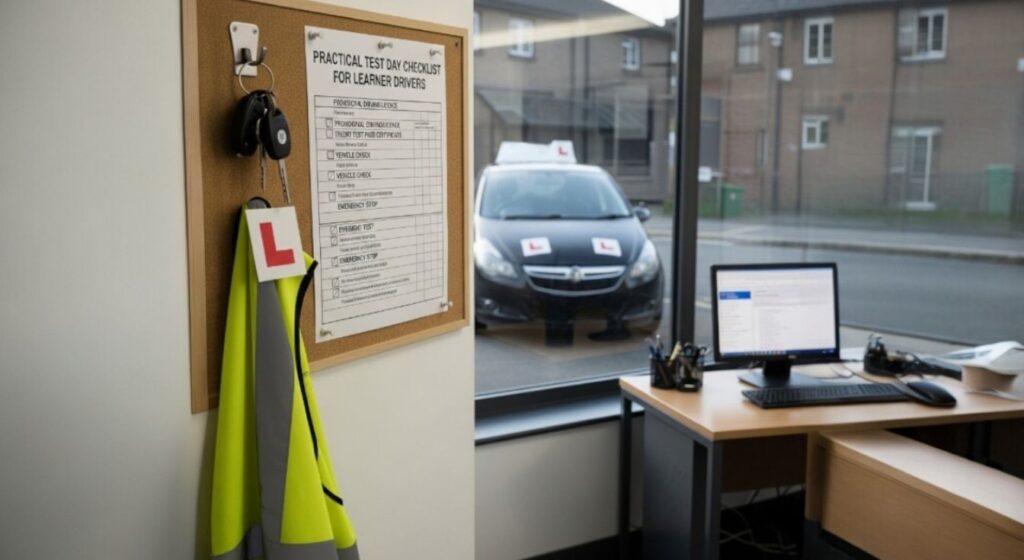
- Provisional Licence: Place your physical photocard licence by your keys. The examiner must see this before your test starts.
- Theory Test Pass Certificate: You must have passed your UK driving theory test to book the practical. Have your pass certificate number or the email confirmation handy.
- Test Booking Confirmation: Know your test time and test centre location.
2. Instructor & Vehicle Confirmation:
- Finalise Details: Confirm your pick-up time and location with your instructor. If you’re using your own car, ensure your instructor or supervising driver is available.
- Vehicle Readiness: If with a driving school, they will ensure the car is legal, clean, and has L plates fitted. If using a private car, check it meets all requirements (see Vehicle Checklist below).
3. Personal Preparation:
- Plan Your Journey: If travelling independently, plan your route to the test centre and leave a huge time buffer.
- Lay Out Clothes: Choose comfortable, non-restrictive shoes (trainers are ideal for pedal control).
- Prepare a Snack: Pack water and a light, energy-boosting snack like a banana.
- Get a Good Night’s Sleep: Aim for 7-8 hours. Avoid last-minute cramming.
🚗 Vehicle Safety Checklist
Before the test, the examiner will expect your vehicle to be safe and legal. Use this quick guide to avoid an automatic fail before you start.
| Item to Check | Why It’s Important | Pass/Fail Consequence |
|---|---|---|
| L Plates | Must be clearly displayed on the front and rear. | FAIL if missing. |
| Tyres | Must have legal tread depth (min. 1.6mm) and be in good condition. | FAIL if illegal or unsafe. |
| Lights & Indicators | All must work: headlights, brake lights, indicators. | FAIL if not functioning. |
| Windscreen & Mirrors | Must be clean and offer a clear, unobstructed view. | Could lead to faults for observation. |
| Warning Lights | No engine management or brake warning lights should be on. | FAIL if a serious warning light is illuminated. |
| Seatbelts | All seatbelts must be in working order. | FAIL if driver’s belt is faulty. |
| Fuel | Have enough fuel for the 40-minute test plus extra. | Test may be cancelled if risk of running out. |
The Morning of Your Test: The Final Countdown
Follow this timeline to ensure a calm, punctual arrival.
- 2-3 Hours Before: Wake up. Have a normal, healthy breakfast. Avoid excessive caffeine.
- 1-2 Hours Before: Do a light activity—a short walk or some stretching to burn off nervous energy.
- “Show Me, Tell Me” Refresh: Spend 15 minutes reviewing the vehicle safety questions. The examiner will ask one ‘tell me’ question before you drive and one ‘show me’ question while driving.
- Final Personal Check: Use the bathroom. Do a final document check.
The Essential “At the Test Centre” Checklist
You’ve arrived. Now, switch to calm, focused mode.
✅ What to Do When You Arrive:
- Check-In: Go to reception and present your provisional licence.
- Eyesight Test: The examiner will ask you to read a number plate from 20 metres (or 20.5 for older plates). Have your glasses or contacts on if you need them.
- “Show Me, Tell Me” Questions: You’ll be asked the two vehicle safety questions. Take a breath and answer clearly.
- The Briefing: The examiner will explain the test format: around 40 minutes of driving, including 20 minutes of independent driving (following a sat-nav or signs), and one reversing manoeuvre.
🧠 Mindset & Conduct During the Test:
- Breathe: Use deep breaths if you feel flustered.
- Listen & Clarify: If you miss an instruction, politely ask the examiner to repeat it.
- Commentary Drive (in your head): Verbalise your observations (“Mirror, signal, manoeuvre”) to stay systematic.
- Drive for Safety, Not Perfection: The examiner wants to see safe driving for life. Don’t assume one mistake is a fail; put it behind you and focus ahead.
How Your Driving School in Ilford Can Be a Game-Changer
Choosing the right instruction isn’t just about learning to drive; it’s about strategic test preparation. A good driving school in Ilford, like SMA Driving School which specifically trains learners on local test routes, provides a significant advantage.
- Local Test Route Knowledge: Instructors familiar with the Goodmayes, Barking, or Wanstead test centres know the complex junctions, challenging roundabouts, and common examiner routes. This means you practice in the exact environment you’ll be tested in.
- Mock Tests: Professional instructors conduct realistic mock tests, simulating the pressure and format of the real day.
- Test Day Support: Many schools offer test day packages, including use of the familiar dual-control car and moral support before you go in.
Common Test Day Mistakes (And How to Avoid Them)
Even well-prepared learners can stumble. Be aware of these pitfalls.
| Mistake | Why It Happens | The Smart Fix |
|---|---|---|
| Forgetting the Provisional Licence | Morning rush and nerves. | Use this checklist. Put it with your keys the night before. |
| Failing the Eyesight Check | Not knowing the distance or having dirty glasses. | Practice reading plates during lessons. Clean your lenses. |
| Poor Observation at Junctions | Not making obvious, full head checks. | Exaggerate your observations so the examiner cannot miss them. |
| Nerves Overwhelming Skill | Letting anxiety dictate your actions. | See nerves as excitement. Focus only on the next instruction. |
| Misunderstanding the Independent Drive | Panicking if you go off-route. | Remember, going the wrong way while following directions is not a fault if done safely. Just listen for the next instruction. |
Your Practical Test Day FAQs Answered
Q1: What happens if I’m late for my driving test?
A: The DVSA is strict. If you arrive more than 5 minutes late, you will likely lose your slot and your £62 fee. Always plan to arrive 15 minutes early.
Q2: Can my instructor sit in the back during the test?
A: Only with the examiner’s permission. Discuss this with your instructor beforehand. Some find it reassuring, others distracting.
Q3: What’s the most common reason for failing?
A: Observation at junctions (not looking properly) and mirrors (not using them before signalling or changing speed) are consistently top reasons. This is why a systematic routine is vital.
Q4: I failed my theory test twice. Where can I get extra help?
A: The official GOV.UK website offers free practice questions and hazard perception clips. For structured revision, commercial platforms like TheoryTest.org.uk offer comprehensive question banks and mock tests based on official DVSA materials.
Q5: How soon can I retake my test if I fail?
A: You must wait at least 10 working days before taking another car test. Use this time for targeted practice on the weaknesses noted in your report.
Q6: Are intensive ‘crash’ courses a good idea before my test?
A: They can be effective for final preparation or if you’ve failed and need a quick refresher. Some schools in Ilford, like SMA Driving School, offer them to accelerate learning. However, they are intense and work best if you have a solid foundation already.
Conclusion: You Are Ready to Pass
Walking into your test with this practical test day checklist completed means you have done everything in your power to succeed. You have the documents, the plan, the vehicle check, and the mindset.
Remember, the examiner isn’t looking for a perfect robot. They are assessing whether you can drive safely and responsibly for a lifetime. Trust the skills your driving school has given you, take a deep breath, and show them what you can do.
Your licence is waiting. Go and get it.
Need an Instructor in Ilford?
For expert, patient tuition from DVSA-approved instructors who know the local test routes inside out, consider reaching out to a local school like SMA Driving School, which operates in the Ilford (IG1) area.
- 📞 General DVSA Theory Test Enquiries: 0300 200 1122
- 📧 Email: theorycustomerservices@dvsa.gov.uk