


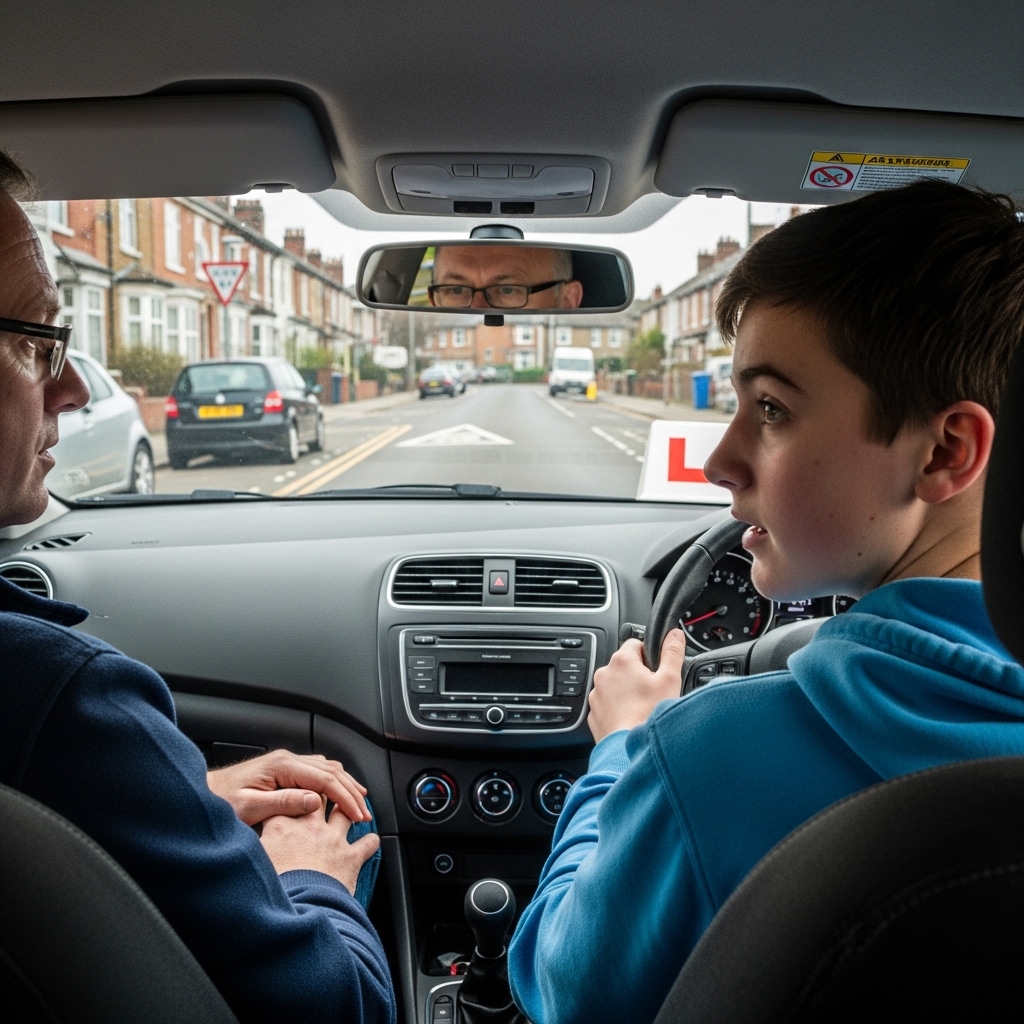
Every driver has blind spots – areas around your vehicle that you cannot see in your mirrors, no matter how well they’re adjusted. These hidden zones are where cyclists, motorcyclists, and other vehicles can disappear from view, creating a serious risk of collision. Understanding and checking blind spots while driving is not just a test requirement – it’s a life-saving skill
For new drivers, mastering blind spot checks is essential for passing your driving test and staying safe on the road. This guide explains exactly what blind spots are, where they’re located, how to check them properly, and common mistakes to avoid. Whether you’re learning with a driving school in Ilford or have found the cheapest driving instructor near me, these skills are fundamental. They’re also a core part of the essential driving skills every UK beginner must master .
Part 1: What Are Blind Spots?
Definition
A blind spot is any area around your vehicle that you cannot see in your mirrors, even when they’re correctly adjusted. You must physically turn your head to check these areas before changing position or direction.
Where Are Your Blind Spots?
| Location | Description |
|---|---|
| Over your left shoulder | The area alongside and slightly behind your left rear quarter |
| Over your right shoulder | The area alongside and slightly behind your right rear quarter |
| Directly behind your vehicle | The area your rear-view mirror can’t cover (especially for reversing) |
| In front of the bonnet | Low objects close to the front of the car (children, animals) |
Why Mirrors Aren’t Enough
Even with perfectly adjusted mirrors, there are gaps. When a vehicle is alongside you, slightly behind your side mirror’s field of view, it can disappear completely. That’s why the “lifesaver” glance over your shoulder is essential before any manoeuvre that involves changing your lateral position.
Part 2: The Highway Code on Blind Spots
Rule 161 – Mirrors and Blind Spots
The Highway Code states: “Before you change direction, change lane, or move off, you MUST check your mirrors and blind spots to ensure it’s safe.”
Rule H3 – Priority for Cyclists and Vulnerable Road Users
Drivers MUST give way to cyclists when turning into or out of a junction. This makes blind spot checks even more critical – cyclists can be in your blind spot as you turn left, leading to a serious collision.
The “Lifesaver” Check
In professional driving instruction, the over-the-shoulder blind spot check is often called the “lifesaver” check. It’s called that for a reason – it genuinely saves lives, especially for motorcyclists and cyclists.
Part 3: When Must You Check Your Blind Spots?
Every Time You:
| Situation | Why |
|---|---|
| Move off from the kerb | Check left blind spot for pedestrians, cyclists, or vehicles approaching from behind |
| Change lanes (motorway or dual carriageway) | Check the side you’re moving into – vehicles can be alongside |
| Overtake | Check right blind spot before moving out, then left before moving back |
| Turn left | Check left blind spot for cyclists filtering on your inside |
| Turn right | Check right blind spot for vehicles overtaking you |
| Merge onto a roundabout | Check right blind spot before entering |
| Reverse | Check all blind spots (360° check) before moving |
| Open your door | Check for cyclists approaching from behind (the “Dutch Reach”) |
The Dutch Reach
The “Dutch Reach” is a technique where you open your car door with the hand furthest from the door (e.g., left hand to open the right door). This forces your body to turn, naturally making you look over your shoulder for approaching cyclists. It’s recommended in the Highway Code.
Part 4: How to Check Your Blind Spots Correctly
The “Lifesaver” Glance
- Identify the direction you intend to move (left or right)
- Check your mirrors first (interior and appropriate side mirror)
- Signal if necessary
- Glance over your shoulder in the direction you’re moving – don’t take your eyes off the road ahead for more than a second
- Only manoeuvre when you’re certain it’s clear
What NOT to Do
- ❌ Don’t just move your eyes – turn your head so you actually see the blind spot
- ❌ Don’t glance for too long – keep focus on the road ahead
- ❌ Don’t rely solely on mirrors – always check the blind spot
- ❌ Don’t forget to check BOTH sides when needed (e.g., moving off)
How Long Should the Glance Be?
A blind spot check should take less than one second. Quick enough to keep your eyes on the road, long enough to register any hazard.
Example: Moving Off from the Kerb
- Check interior mirror
- Check right door mirror
- Signal right (if needed)
- Glance over your right shoulder (your main blind spot when moving off)
- Also glance over your left shoulder (for cyclists filtering on the inside)
- Move off when safe
Part 5: Adjusting Your Mirrors to Minimise Blind Spots
Correct Mirror Positioning
| Mirror | How to Adjust |
|---|---|
| Interior rear-view | Should show the entire rear window, centred |
| Left side mirror | You should just see the side of your car, with the horizon in the middle |
| Right side mirror | Same as left – just see the side of your car |
The “Lean” Technique
Some advanced drivers angle their side mirrors slightly further outward so they just overlap with the interior mirror’s field of view. This can reduce blind spots, but you’ll still need to glance over your shoulder.
Blind Spot Monitoring Systems
Many modern cars have blind spot monitoring (BSM) systems that light up a warning in your side mirror when a vehicle is in your blind spot. These are aids, not replacements – you must still physically check.
Part 6: Blind Spots and Vulnerable Road Users
Cyclists
Cyclists are most vulnerable in your left blind spot when you’re turning left. They may be filtering up the inside of traffic, and if you turn without checking, you can cut them off.
The rule: Always check your left blind spot before turning left, even if you think no one is there.
Motorcyclists
Motorcycles are smaller and can easily hide in blind spots. They may also be moving faster than you expect. Check blind spots before any lane change.
Pedestrians
When reversing, pedestrians – especially children – can be in your blind spot directly behind the car. Do a full 360° check before reversing, and use your reversing camera if fitted.
HGVs and Large Vehicles
When driving near HGVs, remember: if you can’t see the driver’s mirrors, they can’t see you. Avoid lingering alongside lorries – you’re in their blind spot. Either drop back or move past decisively.
Part 7: Common Blind Spot Mistakes on the Driving Test
According to DVSA data, blind spot-related faults are common reasons for test failure.
| Mistake | Why It’s a Fault | How to Avoid |
|---|---|---|
| Not checking blind spot before moving off | Serious fault – could hit passing traffic | Always glance over right shoulder |
| Not checking left blind spot before turning left | Serious fault – could hit cyclist | Always glance over left shoulder |
| Relying only on mirrors when changing lanes | Serious fault – vehicle could be alongside | Mirror, signal, blind spot glance |
| Not checking blind spot on roundabout entry | Serious fault – vehicle from right may be obscured | Glance right before entering |
| Not checking behind before reversing | Serious or dangerous fault – pedestrian risk | 360° check before reversing |
Examiner’s Perspective
Examiners need to see you checking your blind spots. Make your head movements obvious – don’t just move your eyes. A subtle glance that the examiner misses could be marked as not checking.
The “Tell Me” Question
You may be asked: “Tell me how you’d check your blind spots before moving off.”
Answer: “I would check my mirrors, then glance over my right shoulder to check the blind spot for any vehicles, cyclists, or pedestrians before moving off.”
Part 8: Blind Spots in Different Vehicles
Cars vs Vans vs HGVs
| Vehicle | Blind Spot Characteristics |
|---|---|
| Small car | Smaller blind spots, but still present over both shoulders |
| Large car/SUV | Larger blind spots, especially over the shoulder on the driver’s side |
| Van | No rear windows – huge blind spot directly behind; rely on mirrors and cameras |
| HGV | Massive blind spots on both sides, directly behind, and immediately in front – never linger alongside |
When Driving a Different Car
If you drive a car you’re not used to, spend a moment adjusting mirrors and identifying blind spots before you set off. Rental cars, family cars, or your instructor’s car may have different visibility.
Part 9: The Connection Between Blind Spots and Essential Driving Skills
Mastering blind spot checks is one of the essential driving skills every UK beginner must master. It’s not just about passing your test – it’s about developing the observation habits that will keep you safe for life.
Blind spot awareness connects to:
- Observation – the foundation of safe driving
- Anticipation – knowing where hazards may appear
- Vulnerable road user safety – protecting cyclists and motorcyclists
- Motorway driving – lane changes require blind spot checks
- Manoeuvres – reversing and parking need full 360° awareness
Part 10: Practical Exercises to Build the Habit
Exercise 1: The Moving Off Drill
Practice moving off from the kerb in a quiet area. Consistently follow: mirrors → signal → blind spot glance → move. Do it 20 times until it’s automatic.
Exercise 2: The Left Turn Check
Approach a left turn. Before turning, practice: mirrors → signal → glance over left shoulder → turn. Even if no one is there, build the habit.
Exercise 3: The Lane Change
On a quiet dual carriageway, practice changing lanes using: mirrors → signal → blind spot glance → move. Do it in both directions.
Exercise 4: Verbalising
Talk yourself through the routine: “Mirrors, signal, blind spot, clear, moving off.” Verbalising helps cement the sequence.
Part 11: Frequently Asked Questions
Q: Do I need to check my blind spot if I have blind spot monitoring?
A: Yes. Blind spot monitoring is an aid, not a replacement. Always physically check.
Q: How many blind spots does a car have?
A: At least four: left shoulder, right shoulder, directly behind, and low front. Some cars have additional blind spots (e.g., thick pillars).
Q: Can blind spots be eliminated?
A: Not completely, but proper mirror adjustment and regular shoulder checks minimise the risk.
Q: Is it a fail if I don’t check my blind spot on the driving test?
A: Yes. Missing a blind spot check can be a serious fault, especially if it’s in a hazardous situation.
Q: Should I check my blind spot when turning right at a junction?
A: Yes. Check right blind spot for vehicles overtaking you as you slow to turn.
Q: What about the “blind spot” directly behind?
A: When reversing, do a 360° check including looking directly behind. Use reversing cameras but don’t rely solely on them.
Q: How do I check my blind spot without veering?
A: Keep your hands steady on the wheel. The glance should be quick – less than one second. If you need longer, check mirrors first to reduce the time needed.
Conclusion: The Glance That Saves Lives
Understanding blind spots while driving is one of the most important safety skills you’ll ever learn. That one-second glance over your shoulder could be the difference between a safe journey and a devastating collision. Make it a habit. Practice it until it’s automatic. And never skip it, even if you think nothing is there.
Remember the golden rule: Mirrors, signal, blind spot glance, manoeuvre. Every time.
Ready to master all the essential driving skills with expert guidance?
📞 Call Driving Academy Ltd at 07399 696344 – Our patient instructors in Ilford and London will ensure you develop perfect observation habits from your very first lesson.
📧 Email: drivingacademyltd@gmail.com
📍 Visit Us: 101 Whitechapel High Street, London, E1 7RA
Your journey to safe, confident driving starts here. Book your lesson today.