


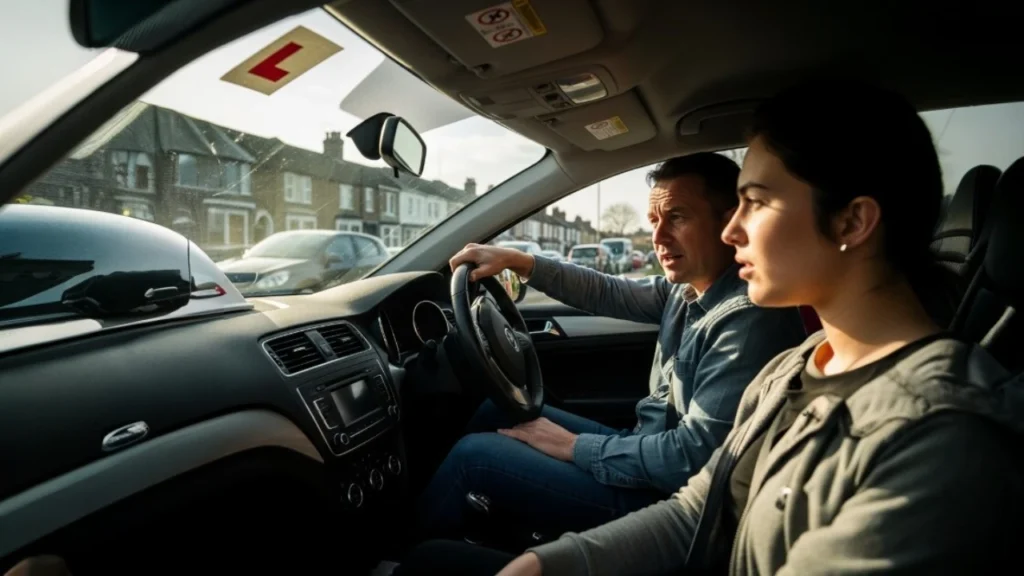
Congratulations – you’ve passed your test! But now a whole new set of questions arises. How does insurance work? Can I drive on the motorway? What if I get points? How do I maintain my car?
Every new driver asks these same questions. You’re not alone, and there are no silly questions when it comes to your safety and legal responsibilities. This guide answers the most common questions new drivers have – from practical driving tips to legal requirements and car maintenance. Whether you’re learning with a driving school in Ilford or have found the cheapest driving instructor near me, this FAQ will help you navigate your first months as a qualified driver. And for more detailed guidance, check out our engine oil and fluid check guide for new UK drivers .
Part 1: Insurance Questions
Q1: How much will my insurance cost?
A: For new drivers, insurance is expensive. The average annual premium for a 21-year-old driver with 2 years’ experience is around £1,098 (2025 figure) . For a newly qualified 17-year-old, it can be significantly higher.
Factors that affect your premium:
- Your age (younger = more expensive)
- Your car (engine size, insurance group)
- Where you live (urban areas cost more)
- Where you park (garage/driveway cheaper than street)
- Your annual mileage (lower = cheaper)
- Your job title (some professions cost less)
Q2: How can I save money on insurance?
A: Try these proven strategies:
| Strategy | Potential Saving |
|---|---|
| Black box (telematics) policy | Significant – proves you’re a safe driver |
| Add an experienced named driver | 20-50% (parent on policy) |
| Pay annually | Save up to 31% on interest |
| Choose a low insurance group car | Hundreds of pounds |
| Increase voluntary excess | Lower premium (but ensure you can afford it) |
| Compare quotes 20-29 days before renewal | Cheapest prices found 20 days before |
Q3: What’s the difference between Third Party and Comprehensive?
A:
- Third Party Only (TPO): Legal minimum. Covers damage you cause to others. Does NOT cover your own car.
- Third Party, Fire and Theft (TPFT): TPO + covers fire damage and theft.
- Comprehensive: TPFT + covers damage to your own car, even if it’s your fault.
For new drivers: Comprehensive is often the best value. The premium difference is often small, and you get full protection for your investment.
Q4: Do I need to insure a car I’m not driving?
A: Yes, under Continuous Insurance Enforcement (CIE) , your vehicle must be insured at all times unless you’ve declared it off the road with a Statutory Off Road Notification (SORN) . Even if parked on the street, it must be insured.
Part 2: Driving Rules and Legal Questions
Q5: Can I drive on the motorway as a new driver?
A: Yes! Once you’ve passed your test, you can legally drive on motorways. However, many new drivers are nervous about motorways – over half (53%) have never driven on one before passing .
Tips for first motorway drive:
- Start at quiet times (Sunday morning)
- Take an experienced passenger
- Practice joining, lane discipline, and leaving
- Consider a Pass Plus course (includes motorway module)
Q6: What’s the 2-year probation period?
A: Under the Road Traffic (New Drivers) Act 1995 , new drivers are on probation for 2 years after passing their first test . If you accumulate 6 or more penalty points during this time, your licence will be automatically revoked .
How easily can you get 6 points?
- 1 mobile phone offence = 6 points
- 2 speeding tickets = 6 points
- 2 red light offences = 6 points
- 1 insurance offence = 6-8 points
Q7: What happens if my licence is revoked?
A: You must:
- Reapply for a provisional licence
- Display L-plates
- Drive only with supervision
- Retake both the theory and practical tests
- Pay for everything again
Q8: Can I use my phone while driving?
A: It is illegal to use a hand-held phone while driving , including:
- Being stopped at traffic lights
- Queuing in traffic
- Supervising a learner
Penalty: 6 points and £200 fine – for new drivers, that’s automatic licence revocation .
Permitted use: Only when safely parked, for 999 emergency calls, or contactless payment at drive-through (while stationary).
Q9: What’s the legal alcohol limit for driving?
A:
- England & Wales: 35 micrograms per 100ml of breath (80mg blood)
- Scotland: 22 micrograms (50mg blood)
Best advice for new drivers: Zero alcohol if driving. Any amount affects your ability. Proposed changes may introduce a near-zero limit for new drivers .
Part 3: Car Maintenance Questions
Q10: How often should I check my car?
A: Perform a 10-minute weekly check :
| Check | Frequency |
|---|---|
| Tyre pressure | Weekly |
| Tyre tread (20p test) | Weekly |
| Engine oil | Weekly |
| Coolant | Weekly |
| Screenwash | Weekly |
| Lights | Weekly |
Q11: How do I check my tyre pressure?
A:
- Find recommended pressure in owner’s manual or driver’s door frame
- Check when tyres are cold (not driven for 2-3 hours)
- Use a pressure gauge (petrol stations have them)
- Press firmly onto the valve
- Add air if low, release if over-inflated
Q12: What’s the 20p test?
A: Insert a 20p coin into the main tread grooves of your tyre. If you can see the outer rim of the coin , your tread may be below the legal limit (1.6mm). Driving with illegal tyres can result in fines of up to £2,500 per tyre and 3 penalty points .
Q13: How often does my car need a service?
A:
- At least once a year – even if you drive low mileage
- Every 10,000-12,000 miles – whichever comes first
- More frequently for high-mileage drivers – consider interim service every 6 months
Q14: What’s the difference between a service and an MOT?
A:
- MOT: Legal requirement after 3 years. Tests minimum safety standards. Pass/fail only.
- Service: Recommended maintenance. Comprehensive inspection + replacements. Prevents breakdowns.
A car can pass its MOT and break down the next day. A service catches issues before they leave you stranded.
Q15: What do dashboard warning lights mean?
A: Colour code:
- RED – STOP IMMEDIATELY (oil pressure, brakes, overheating)
- AMBER – Check soon (engine, ABS, tyre pressure)
- GREEN/BLUE – Information only (headlights on)
Never ignore a red warning light – it could save your engine or your life.
Part 4: Driving Skills Questions
Q16: How do I overcome test day nerves?
A:
- Prepare thoroughly – mock tests build confidence
- Breathe – use 4-7-8 technique (in 4, hold 7, out 8)
- Don’t dwell on mistakes – focus on the rest of the drive
- Talk to yourself – verbalising helps focus
- Remember – the examiner wants you to pass
Q17: How do I drive safely on motorways?
A:
- Join at the same speed as traffic (not slower)
- Keep left unless overtaking
- Maintain safe following distance (2 seconds, 4 in rain)
- Check mirrors every 5-8 seconds
- Never drive in a lane with a red ‘X’ (lane closed)
- If you miss your exit, continue to the next one – never reverse or stop
Q18: How do I drive in the dark?
A:
- Use dipped headlights normally; full beam on unlit roads
- Dip headlights for oncoming traffic
- Increase following distance to 4 seconds
- Watch for pedestrians, cyclists, and animals
- Keep windscreen clean to reduce glare
- Take breaks every 2 hours – fatigue kills
Q19: How do I drive in rain?
A:
- Increase following distance to 4+ seconds
- Use dipped headlights
- Reduce speed – stopping distances double in wet conditions
- Watch for standing water (risk of aquaplaning)
- Demist windows for clear visibility
Part 5: Practical Questions
Q20: How do I get my first car?
A:
- Budget – include purchase price, insurance, tax, maintenance
- Insurance group – choose a low group car (1-10 is best)
- Engine size – smaller is cheaper to insure (1.0-1.2 litre)
- Age – older cars may be cheaper but less safe; newer cars have safety features
- Check history – MOT history, service records, mileage
Q21: Should I take a Pass Plus course?
A: Pass Plus is a 6-hour course covering:
- Motorway driving
- Night driving
- All-weather driving
- Rural roads
- Town driving
Benefits:
- Builds confidence in challenging situations
- May reduce insurance premiums (check with your insurer)
- Some insurers offer significant discounts
Q22: What should I keep in my car?
A: Essential items:
- Legal: Insurance certificate, V5C logbook (not always required to carry)
- Safety: Hi-vis vest, warning triangle, first aid kit
- Practical: Phone charger, screenwash, de-icer (winter)
- Emergency: Water, snacks, blanket, torch
Q23: How do I find a good garage?
A:
- Look for reviews on Google, Trustpilot
- Ask for recommendations from family/friends
- Check for qualifications (Garage Watchdog, Which? Trusted Trader)
- Get multiple quotes for major work
- Ask questions – a good garage will explain what they’re doing
Part 6: Quick Reference – New Driver Checklist
| Category | Action | Frequency |
|---|---|---|
| Insurance | Compare quotes, consider black box | Annually |
| Car checks | Tyres, oil, coolant, lights | Weekly |
| Service | Professional inspection | Annually |
| MOT | Legal requirement | Annually (after 3 years) |
| Tax | Vehicle tax | Annually or monthly |
| Driving | Practice regularly, build experience | Ongoing |
| Learning | Consider Pass Plus | Once (recommended) |
| Legal | Stay under 6 points in first 2 years | Ongoing |
Conclusion: Your Questions Answered
The questions every new driver asks are normal – and important. From insurance costs to motorway driving, from car maintenance to legal requirements, understanding the answers keeps you safe, legal, and confident on the road.
Remember:
- 6 points in first 2 years = licence revoked
- Check your car weekly – 10 minutes saves money and stress
- Build experience gradually – start with familiar roads
- Keep learning – Pass Plus, advanced courses, every drive is practice
Ready to continue your driving journey with expert support?
📞 Call Driving Academy Ltd at 07399 696344 – Even after you pass, we’re here to help with Pass Plus, refresher lessons, and any questions you have. Based in Whitechapel, serving Ilford and London.
📧 Email: drivingacademyltd@gmail.com
📍 Visit Us: 101 Whitechapel High Street, London, E1 7RA
Your journey to confident, responsible driving continues here. Book a refresher or Pass Plus course today.