


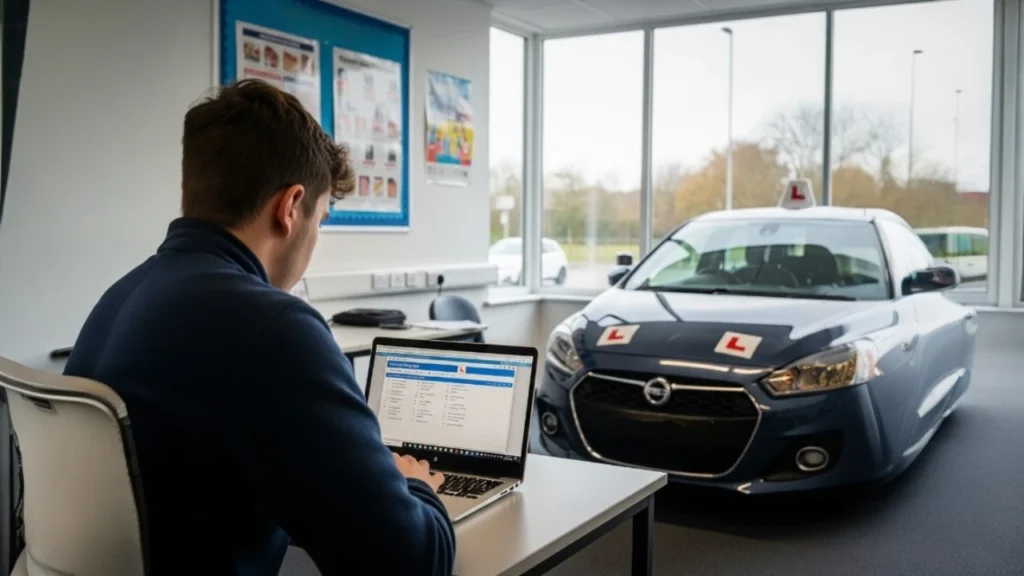
Before you can get behind the wheel for your practical test, you must pass the UK theory driving test. For many learners, this is the first real hurdle on their driving journey. The good news? With the right approach, it’s completely manageable.
This guide breaks down everything you need to know into easy steps. We’ll cover how to study effectively, master the hazard perception section, and what’s changed for 2026. Whether you’re just starting with a driving school in Ilford or have found the cheapest driving instructor near me, these strategies will help you pass first time. And once you’ve got your theory test sorted, you’ll be ready to move on to the UK provisional licence application process if you haven’t already .
Part 1: Understanding the Theory Test Format
The theory test has two parts, and you must pass both to succeed.
| Section | Duration | Questions | Pass Mark |
|---|---|---|---|
| Multiple choice | 57 minutes | 50 questions | 43 correct (86%) |
| Hazard perception | Approx. 15 minutes | 14 video clips | 44 out of 75 (approx. 59%) |
Key Facts
- You need to pass both sections in the same sitting
- If you fail one section, you must retake both
- You can take the test at your local test centre
- You need your provisional licence number to book
Part 2: What’s New for 2026?
The theory test has been updated for 2026 with important changes:
New CPR and Defibrillator Questions
From early 2026, the theory test includes enhanced first aid questions about:
- Cardiopulmonary resuscitation (CPR)
- Automated external defibrillators (AEDs)
The DVSA has updated its official learning materials to include this content. These questions are designed to equip more drivers with life-saving skills and improve the UK’s low cardiac arrest survival rates .
New Theory Test App
The official DVSA theory test app has been updated with:
- All new questions and answers
- Hazard perception video clips
- Practice tests that simulate the real exam
- Progress tracking features
Part 3: Step 1 – Get the Right Study Materials
Official Resources Only
Use only DVSA-approved materials. Third-party apps and websites may contain outdated or incorrect information.
Essential Resources:
| Resource | Cost | What It Covers |
|---|---|---|
| The Highway Code | £5-£10 | All road rules and signs |
| Know Your Traffic Signs | £5-£10 | Complete sign guide |
| DVSA Theory Test App | £4.99 | Official questions, hazard perception, mock tests |
| DVSA Hazard Perception App | £4.99 | Practice video clips |
Why Official Matters
The official app contains the exact question bank used in the real test. Using anything else risks learning incorrect answers.
The Highway Code Online
You can also access The Highway Code for free on the GOV.UK website.
Part 4: Step 2 – Create Your Study Plan
How Much Time to Allow
The average learner needs around 20-30 hours of study to feel confident. Spread this over 4-6 weeks rather than cramming.
Sample Study Schedule
| Week | Focus | Time per Day |
|---|---|---|
| 1 | The Highway Code – rules and signs | 30 mins |
| 2 | Multiple choice practice tests | 30 mins |
| 3 | Hazard perception training | 30 mins |
| 4 | Full mock tests, review weak areas | 30 mins |
| 5-6 | Intensive practice, focus on weaker topics | 45 mins |
The “Little and Often” Approach
Studying for 30 minutes daily is more effective than 3 hours once a week. Short, regular sessions improve retention.
Part 5: Step 3 – Master the Multiple Choice Section
50 Questions, 57 Minutes
You have just over 1 minute per question. This is plenty of time if you’ve prepared properly.
Question Categories
Questions cover:
- Road signs and markings
- Traffic rules and regulations
- Safety and vehicle handling
- Driving in adverse conditions
- Eco-driving and fuel efficiency
- Vehicle maintenance
- NEW: CPR and defibrillators
Study Strategy
- Learn the rules first – don’t jump straight into tests
- Use the official app – it has the full question bank
- Read explanations – understand WHY the answer is correct
- Flag difficult questions – revisit them
- Take topic-specific tests – focus on weak areas
The Flag Feature
In the real test, you can “flag” questions you’re unsure about and return to them later. Use this feature – it’s there to help you.
Practice Test Target
Aim to consistently score 47/50 or higher on practice tests before booking your real test. This gives you a comfortable buffer.
Common Question Types
| Type | Example | Strategy |
|---|---|---|
| Factual | “What’s the stopping distance at 30mph?” | Memorise key facts |
| Scenario | “What should you do if…” | Apply Highway Code principles |
| Sign recognition | “What does this sign mean?” | Learn shapes and colours |
| Hazard perception | “When should you slow down?” | Apply defensive driving principles |
Part 6: Step 4 – Conquer the Hazard Perception Section
What Is Hazard Perception?
You’ll watch 14 video clips showing real road scenes. Your task is to click when you see a developing hazard – something that would cause you to change speed, direction, or stop.
What’s a Developing Hazard?
A hazard becomes “developing” when it would require you to take action:
- A pedestrian steps towards the road
- A car ahead brakes suddenly
- A cyclist wobbles
- A vehicle pulls out from a side road
The Clicking Strategy
| Do | Don’t |
|---|---|
| Click when you first see the hazard develop | Click constantly (“spamming”) |
| Click again as the hazard becomes more imminent | Click in a pattern or rhythm |
| Click for each separate hazard | Click for things that aren’t hazards |
Why Spamming Fails
The software detects cheating patterns. If you click more than 5-10 times per clip, or in a regular rhythm, you’ll score zero for that clip.
Scoring System
Each clip has a score window of 5 points, decreasing as time passes:
- First click within the window: 5 points
- Later click: 4, 3, 2, or 1 point
- No click or too late: 0 points
Practice Tips
- Use the official DVSA app – it has the same style of clips
- Practice daily – hazard perception is a skill, not just knowledge
- Focus on reaction time – click as soon as you spot the hazard
- Learn to spot potential hazards before they become developing
- Watch real driving videos – practice identifying hazards
Part 7: Step 5 – Take Mock Tests
Why Mock Tests Are Essential
Mock tests:
- Familiarise you with the format
- Identify weak areas
- Build confidence
- Reduce test-day anxiety
How to Mock Test
- Use the official app – it simulates the real test exactly
- Find a quiet space – no distractions
- Time yourself – 57 minutes for multiple choice, then hazard perception
- Don’t cheat – no looking up answers
- Review your mistakes – understand why you got them wrong
What to Aim For
| Mock Test Score | Readiness Level |
|---|---|
| 45-50/50 multiple choice | Ready to pass |
| 40-44/50 multiple choice | More practice needed |
| Under 40/50 | Not ready – keep studying |
For Hazard Perception
Aim to score over 50/75 consistently before booking your test.
Part 8: Step 6 – The Week Before Your Test
Final Preparation
| Day | Activity |
|---|---|
| 7 days before | Take a full mock test, note weak areas |
| 5-6 days before | Focus practice on weak topics |
| 3-4 days before | Another mock test – review progress |
| 2 days before | Light revision only – no cramming |
| 1 day before | Relax. Trust your preparation |
| Day of test | Eat breakfast, arrive early, stay calm |
What NOT to Do
- ❌ Don’t cram the night before – it creates stress
- ❌ Don’t take a mock test the morning of your real test
- ❌ Don’t discuss the test with nervous people
Part 9: Step 7 – Test Day Strategy
Before You Arrive
- Eat a light breakfast – porridge, toast, banana
- Drink water, but not too much
- Leave with plenty of time – allow for traffic
- Use the loo before you leave
At the Test Centre
- Arrive 15 minutes early
- Bring your provisional licence – you CANNOT take the test without it
- Turn your phone off
During the Multiple Choice Section
- Read each question twice – don’t rush
- Use the flag feature for difficult questions
- Don’t change answers unless you’re sure
- You can review flagged questions at the end
During the Hazard Perception Section
- Watch the whole clip – hazards can appear late
- Click as soon as you see the hazard develop
- One or two clicks per hazard is enough
- Don’t click for things that aren’t hazards
If You Feel Anxious
- Take deep breaths
- Use the 4-7-8 technique if needed
- Remember: you’ve prepared for this
Part 10: After the Test – What Happens Next
If You Pass
- You’ll receive your theory test pass certificate
- You can now book your practical driving test
- Your certificate is valid for 2 years
- Keep your certificate – you’ll need it for your practical test
If You Don’t Pass
- You’ll receive feedback on your weak areas
- You can retake as soon as you’re ready
- There’s no limit on attempts
- Use the feedback to focus your study
Important: Certificate Validity
If you don’t pass your practical test within 2 years of passing your theory test, you’ll need to retake your theory test .
Part 11: Common Theory Test Mistakes
| Mistake | How to Avoid It |
|---|---|
| Using unofficial study materials | Only use DVSA-approved resources |
| Cramming the night before | Study consistently over 4-6 weeks |
| Not practising hazard perception | Practice daily – it’s a skill |
| Skipping the official app | It has the exact question bank |
| Rushing through questions | Read twice, answer once |
| Not using the flag feature | Flag difficult questions, return later |
| Spamming in hazard perception | One or two clicks per hazard only |
| Arriving late | Allow extra time for travel |
Part 12: Quick Reference – Theory Test Checklist
| Task | Status |
|---|---|
| ✅ Booked test online | ☐ |
| ✅ Have provisional licence | ☐ |
| ✅ Studied The Highway Code | ☐ |
| ✅ Studied Know Your Traffic Signs | ☐ |
| ✅ Used official DVSA app | ☐ |
| ✅ Practised hazard perception daily | ☐ |
| ✅ Taken multiple mock tests | ☐ |
| ✅ Know 2026 updates (CPR/AED) | ☐ |
| ✅ Planned journey to test centre | ☐ |
| ✅ Arrive 15 minutes early | ☐ |
| ✅ Bring provisional licence | ☐ |
Conclusion: You Can Pass First Time
The UK theory driving test is challenging, but with the right preparation, you can pass first time. Follow these easy steps:
- Use official materials – The Highway Code and DVSA app
- Study consistently – 30 minutes daily for 4-6 weeks
- Practise hazard perception – it’s a skill, not just knowledge
- Take mock tests – until you consistently pass
- Know the 2026 updates – CPR and defibrillator questions
- Stay calm on test day – you’ve prepared for this
Ready to start your theory test preparation with expert support?
📞 Call Driving Academy Ltd at 07399 696344 – Our instructors in Ilford and London can help you understand the theory behind practical driving.
📧 Email: drivingacademyltd@gmail.com
📍 Visit Us: 101 Whitechapel High Street, London, E1 7RA
Your theory test success starts here. Book your lessons today.