


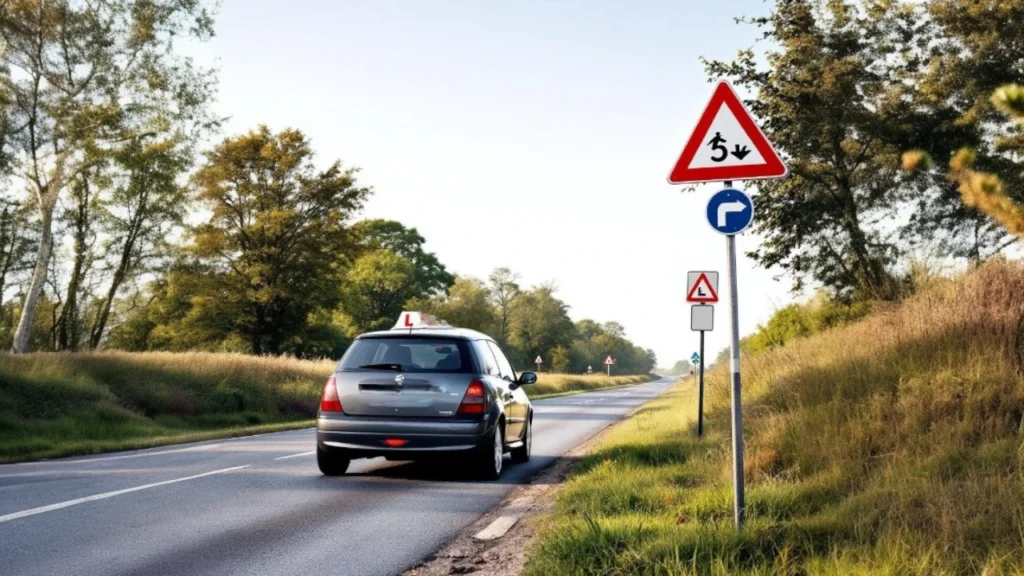
Road signs are the universal language of driving. They communicate vital information, warnings, and legal requirements that keep traffic flowing safely. For learners, understanding UK road signs isn’t just about passing the theory test—it’s fundamental to becoming a safe, confident driver.
The good news? UK road signs follow a logical system based on shapes and colours. Once you understand the code, you can interpret any sign you encounter. This guide breaks down everything beginners need to know, from the three basic shapes to the most common signs you’ll see on your driving journey. Whether you’re learning with a driving school in Ilford or have found the cheapest driving instructor near me, mastering road signs is essential. They’re also a crucial part of the important UK road rules every beginner should know .
Part 1: The Shape and Colour Code – Your Cheat Sheet
The UK road sign system, designed by Jock Kinneir and Margaret Calvert in the 1960s, is based on a simple principle: shape tells you the type of message, colour gives you more detail .
The Three Basic Shapes
| Shape | What It Means | Example |
|---|---|---|
| Circle | Gives an order – something you MUST or MUST NOT do | Speed limits, no entry |
| Triangle | Gives a warning – be alert for hazards ahead | Bend ahead, pedestrian crossing |
| Rectangle | Gives information – directions, places, facilities | Route signs, tourist attractions |
Colour Coding
| Colour | What It Means |
|---|---|
| Red circles | Mostly prohibitive – things you must NOT do |
| Blue circles | Mostly positive instruction – things you MUST do |
| Red triangles | Warning of hazards |
| Green backgrounds | Primary routes – main roads |
| Blue backgrounds | Motorways |
| White backgrounds | Non-primary or local routes |
| Brown backgrounds | Tourist attractions |
| Yellow backgrounds | Temporary signs (road works) |
Part 2: Signs Giving Orders (Circular Signs)
Red Circles – Things You Must NOT Do
Signs with red circles are mostly prohibitive – they tell you what’s not allowed . Plates below the sign may give additional information, such as times or exceptions .
| Sign | Meaning | Notes |
|---|---|---|
| 30 in a red circle | Maximum speed 30 mph | The number shows the limit |
| Red circle with white bar | National speed limit applies | The limit depends on road type |
| Red circle with diagonal bar | No entry for vehicular traffic | You cannot enter here |
| Red circle with car symbol | No motor vehicles | Pedestrians and cyclists may still use the road |
| Red circle with bicycle | No cycling | Cyclists must dismount |
| Red circle with ‘No Overtaking’ | No overtaking | Usually where visibility is restricted |
| Red circle with right-turn arrow crossed | No right turn | Often at junctions where right turns are banned |
| Red circle with left-turn arrow crossed | No left turn | Similar to above |
| Red circle with U-turn arrow crossed | No U-turns | Where turning around is prohibited |
| Red circle with lorry symbol | No goods vehicles over weight shown | Weight in tonnes |
Blue Circles – Things You MUST Do
Signs with blue circles but no red border mostly give positive instruction – they tell you what you must do .
| Sign | Meaning | Notes |
|---|---|---|
| White arrow pointing straight up | Ahead only | You must go straight ahead |
| White arrow pointing left | Turn left ahead | Direction may be reversed for right turns |
| White arrow pointing left with bend | Turn left (at junction) | Direction may be reversed |
| White arrow pointing left with line | Keep left | Pass to the left of an obstacle |
| White arrows splitting left and right | Pass either side | Vehicles may pass either side to reach same destination |
| Blue circle with roundabout symbol | Mini-roundabout | Give way to traffic from the immediate right |
| Blue circle with ’30’ | Minimum speed 30 mph | You must drive at least this fast |
| Blue circle with ’30’ crossed | End of minimum speed | No longer required to maintain minimum speed |
| Blue circle with bus symbol | Buses and cycles only | Other vehicles prohibited |
| Blue circle with tram symbol | Trams only | Lane reserved for trams |
Part 3: Warning Signs (Triangular Signs)
Warning signs are mostly triangular with a red border . They alert you to hazards ahead so you can adjust your speed and observation accordingly.
| Sign | Meaning | Notes |
|---|---|---|
| Crossroads symbol | Crossroads ahead | Be aware of traffic from all directions |
| T-junction symbol | T-junction ahead | You’ll need to turn left or right |
| Staggered junction symbol | Staggered junction | Side roads offset from each other |
| Bend symbol | Bend to right (or left) | Direction indicated by symbol |
| Double bend symbol | Double bend first to left | Series of bends |
| Roundabout symbol | Roundabout ahead | Prepare to give way |
| Traffic lights symbol | Traffic signals ahead | May be at a junction or crossing |
| Slippery road symbol | Slippery road | Reduce speed, avoid harsh braking |
| Steep hill downwards | Steep hill downhill | Gradients may be shown as a ratio (e.g., 20% = 1:5) |
| Steep hill upwards | Steep hill uphill | You may need lower gears |
| Road narrows symbol | Road narrows on both sides | Be prepared for reduced width |
| Two-way traffic symbol | Two-way traffic crosses one-way road | Or straight ahead |
| Pedestrian crossing symbol | Zebra crossing ahead | Be alert for pedestrians waiting to cross |
| School crossing patrol | School crossing patrol ahead | Some have amber lights that flash when crossings are in use |
| Cyclists symbol | Cycle route ahead | Watch for cyclists |
| Horses symbol | Accompanied horses or ponies | Often in rural areas |
| Wild animals symbol | Wild animals | Deer, etc. – especially at dawn/dusk |
| Cattle symbol | Cattle | Farm animals may be on road |
| Low-flying aircraft | Low-flying aircraft | Or sudden aircraft noise |
| Falling rocks symbol | Falling or fallen rocks | Common in hilly areas |
| Tunnel ahead | Tunnel ahead | Lights may be needed |
| Queues likely | Traffic queues likely ahead | Be prepared to slow or stop |
| Other danger | Other danger | Plate below indicates nature of danger |
Part 4: Information and Direction Signs (Rectangular Signs)
Information signs are mostly rectangular and come in various colours depending on the type of road .
Motorway Signs (Blue Background)
| Sign | Meaning |
|---|---|
| Blue sign with route number | Motorway route |
| Blue sign with junction number | Motorway junction ahead |
| Blue sign with arrow and destinations | Direction to motorway destinations |
| Blue sign with distance | Route confirmatory sign |
| Blue sign with ‘The NORTH’ | Direction to region |
| Blue sign with ‘M25’ in brackets | Motorway can be reached via the route |
| Blue sign with aircraft symbol | Route to airport |
| Blue sign with ‘Countdown’ markers | Exit approaching (each bar = 100 yards to exit) |
Primary Route Signs (Green Background)
Green backgrounds indicate primary routes – main roads between important destinations .
| Sign | Meaning |
|---|---|
| Green sign with route number | Primary route |
| Green sign with arrow and destinations | Direction to primary route destinations |
| Green sign with distance | Route confirmatory sign |
| Green panel with motorway number | Motorway can be reached via the primary route |
Local Route Signs (White Background)
White backgrounds with black borders indicate non-primary or local routes .
| Sign | Meaning |
|---|---|
| White sign with black text | Local route direction |
| White sign with place name | Direction to local destination |
Tourist Information Signs (Brown Background)
Brown panels show the route to tourist attractions .
| Sign | Meaning |
|---|---|
| Brown sign with white text | Tourist attraction |
| Brown sign with picnic symbol | Picnic site |
| Brown sign with camping symbol | Camping and caravan site |
| Brown sign with historic monument symbol | Ancient monument or heritage site |
Other Information Signs
| Sign | Meaning |
|---|---|
| White ‘P’ on blue square | Car park |
| White ‘P’ with disabled symbol | Disabled parking |
| WC symbol | Toilets |
| Hospital symbol | Hospital with A&E facilities |
| ‘No through road’ symbol | Cul-de-sac – no exit for vehicles |
| Home Zone entry | Home Zone – pedestrians have priority |
| Camera symbol | Area where cameras enforce traffic regulations |
| Bus lane sign | With-flow bus lane ahead |
Part 5: Road Works and Temporary Signs
Road works signs have a yellow background and are usually temporary .
| Sign | Meaning |
|---|---|
| Man with shovel symbol | Road works ahead |
| Loose chippings symbol | Loose chippings – risk of stone chips |
| Temporary hazard sign | Temporary hazard at road works |
| Temporary lane closure diagram | Shows which lanes are open/closed |
| Slow-moving works vehicle | Warning of works vehicle ahead |
| Temporary speed limit | Mandatory speed limit at road works |
| End of road works | All temporary restrictions end |
Part 6: Road Markings – Signs on the Road Surface
Road markings work alongside signs to give instructions and warnings .
Along the Carriageway
| Marking | Meaning |
|---|---|
| Broken white centre line | Separates traffic. Overtake when safe |
| Broken white line with longer gaps | Hazard warning line – extra caution needed |
| Double white lines (solid line nearest you) | Do not cross or straddle |
| Double white lines (broken line nearest you) | May cross if safe |
| Double white lines (both solid) | Do not cross – overtaking visibility restricted |
| White diagonal lines (hatched markings) | Keep traffic apart. Do not enter unless emergency |
| Lane lines (short broken white) | Divides lanes in same direction. Change lanes when safe |
| White edge lines | Mark edge of road – helpful at night |
| White arrows | Indicate permitted or required direction |
Across the Carriageway
| Marking | Meaning |
|---|---|
| Solid white line across road | Stop line at signals or police control |
| Thick solid white line with ‘STOP’ | Must come to a complete stop |
| Two broken white lines across road | Give way to traffic on major road |
| Broken white line at roundabout | Give way to traffic from the right |
| Yellow box junction | Do not enter unless exit clear |
| White triangle pointing towards you | Give way line ahead |
Waiting and Parking Restrictions
| Marking | Meaning |
|---|---|
| Single yellow line | No waiting at certain times (see signs) |
| Double yellow lines | No waiting at any time |
| Single yellow line on kerb | Loading/unloading restriction at certain times |
| Double yellow line on kerb | No loading/unloading at any time |
| Single red line | No stopping during times shown (red routes) |
| Double red line | No stopping at any time (red routes) |
| White bay markings | Parking allowed – check signs for times |
| ‘Loading Only’ bay | For loading/unloading only |
| Yellow zig-zag lines | School Keep Clear – no stopping |
| White ‘Slow’ on road | Slow down – hazard ahead |
| White ‘Keep Clear’ | Do not block this area |
Part 7: Special Sign Types
The STOP Sign
The STOP sign is an octagon – a unique shape that makes it instantly recognisable . You must come to a complete stop at the line.
The GIVE WAY Sign
The GIVE WAY sign is an upside-down triangle . You must give way to traffic on the main road, but you don’t have to stop if it’s clear.
Directional Arrow Signs
Downward pointing arrows mean ‘Get in lane’ – the left-hand lane leads to a different destination from other lanes .
Emergency Diversion Route Symbols
Different symbols (circle, triangle, square, diamond) on yellow backgrounds indicate emergency diversion routes when the motorway is closed .
Part 8: How to Learn Road Signs Effectively
1. Understand the System, Don’t Just Memorise
Once you understand that circles order, triangles warn, and rectangles inform, you can work out the meaning of any sign you encounter.
2. Use Official Resources
- The Highway Code – contains the most common signs
- ‘Know Your Traffic Signs’ booklet – the comprehensive guide to all signs
- Official DVSA theory test app – includes practice questions on signs
3. The Official Know Your Traffic Signs App
The Department for Transport (DfT) and DVSA have released the official Know Your Traffic Signs app . Features include:
- Over 1000 signs, markings, and road layouts
- Interactive copy of the official publication
- 150 practice questions with explanations
- Offline access – learn anytime, anywhere
- Search function for specific signs
- English voiceover option for accessibility
Cost: £3.99
4. Practice While Driving
When you’re a passenger or practising with your instructor, verbalise what you see: “That’s a triangular warning sign – there must be a bend ahead.” This active learning reinforces your knowledge.
5. Take Mock Tests
Theory test apps include sign recognition questions. Keep taking tests until you consistently score 100% on signs.
Part 9: Quick Reference Table
| Sign Type | Shape | Colour | Meaning |
|---|---|---|---|
| Order – prohibition | Circle | Red border | You MUST NOT |
| Order – instruction | Circle | Blue background | You MUST |
| Warning | Triangle | Red border | Hazard ahead |
| Direction – motorway | Rectangle | Blue background | Motorway route |
| Direction – primary route | Rectangle | Green background | Main road |
| Direction – local route | Rectangle | White background | Local road |
| Tourist information | Rectangle | Brown background | Attraction |
| Temporary | Rectangle | Yellow background | Road works |
Conclusion: Your Key to Safe Driving
Understanding UK road signs is not just about passing your theory test – it’s about being able to read the road and respond correctly in any situation. The system is logical, consistent, and designed to be understood at a glance, even at high speeds.
Remember the three shapes: circles order, triangles warn, rectangles inform. Once you have this foundation, you can interpret any sign you encounter.
Ready to put your sign knowledge into practice with expert guidance?
📞 Call Driving Academy Ltd at 07399 696344 – Our patient instructors in Ilford and London will help you master road signs and all the essential driving skills.
📧 Email: drivingacademyltd@gmail.com
📍 Visit Us: 101 Whitechapel High Street, London, E1 7RA
Your journey to becoming a confident, knowledgeable driver starts here. Book your lesson today.