

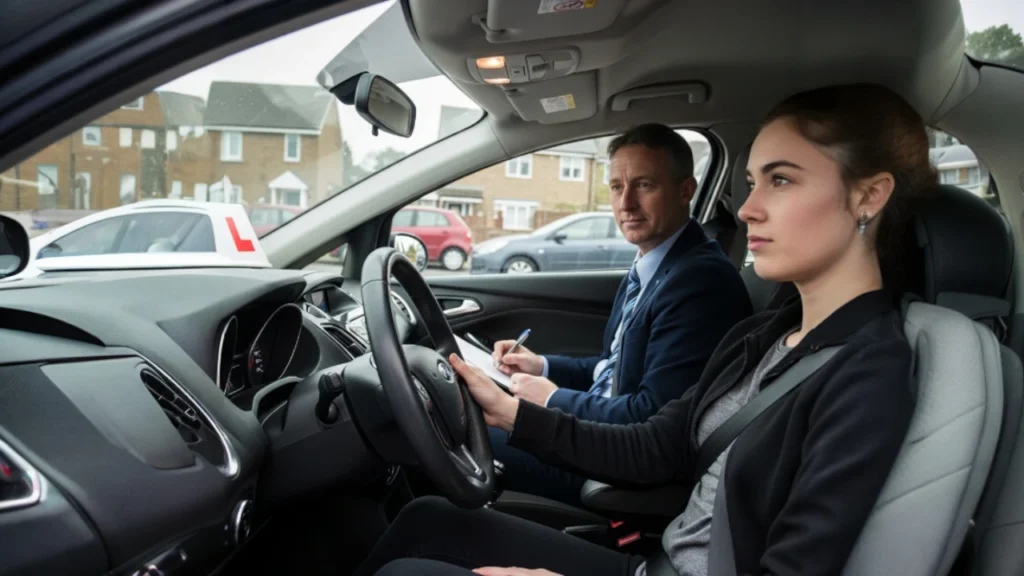
The practical driving test is the final hurdle on your journey to getting a UK driving licence. For many learners, the thought of it brings anxiety—not just about driving, but about the unknown. What will happen? What will the examiner ask? How will I be marked? This comprehensive guide breaks down the UK practical driving test format minute by minute, explaining exactly what to expect, how you’ll be assessed, and what you need to do to pass. Whether you’re learning with a driving school in Ilford or have found the cheapest driving instructor near me, understanding the test structure is essential for success. And if you’re an international driver, knowing the UK test format is crucial when you need to exchange a foreign driving licence in the UK.
Part 1: Test Basics – What You Need to Know
Test Duration
The practical driving test lasts about 40 minutes .
What You Need to Bring
- Your UK provisional driving licence (the photocard)
- Your theory test pass certificate (if you haven’t already provided it)
- A suitable, roadworthy car (your instructor will usually provide this)
What Happens If You’re Late
If you arrive more than 5 minutes late, the test centre may refuse to conduct your test, and you’ll lose your fee .
Part 2: The Test Format – Step by Step
Step 1: The Eyesight Check (2-3 minutes)
Before you even get in the car, the examiner will ask you to read a number plate.
What you need to do:
- Read a number plate from 20 metres away (or 20.5 metres for older-style plates)
- If you wear glasses or contact lenses, you must wear them for the test
What happens if you fail:
If you cannot read the number plate correctly, your test will not proceed, and you will fail .
Step 2: The “Show Me, Tell Me” Questions (5 minutes)
Before you start driving, you’ll be asked one “tell me” question. During the drive, you’ll be asked one “show me” question.
“Tell Me” Question (before driving):
You’ll be asked to explain how you’d carry out a safety check. For example:
- “Tell me how you’d check that the brakes are working before starting a journey.”
- “Tell me how you’d check the tyres have sufficient tread depth.”
“Show Me” Question (while driving):
When it’s safe to do so, the examiner will ask you to demonstrate a safety feature. For example:
- “Show me how you’d wash the windscreen.”
- “Show me how you’d switch on your dipped headlights.”
How to prepare:
Your instructor will practise these with you. The DVSA publishes the official list of questions and answers .
Step 3: The Main Drive (about 35 minutes)
This is the core of your test. You’ll drive in various road and traffic conditions, including:
- Town centres
- Residential areas
- Dual carriageways
- Country roads (if available locally)
The examiner will assess:
- Your ability to drive safely and confidently
- Your observation skills
- Your use of mirrors and signals
- Your positioning on the road
- Your ability to follow directions
Step 4: The Reversing Manoeuvre (5-10 minutes)
You’ll be asked to complete one of the following exercises :
- Parallel park at the side of the road
- Park in a bay – either driving in and reversing out, or reversing in and driving out
- Pull up on the right-hand side of the road, reverse for 2 car lengths, and rejoin the traffic
What the examiner looks for:
- Control of the vehicle
- Accurate positioning
- Effective observation throughout
- Confidence in the manoeuvre
Step 5: Independent Driving (20 minutes)
For about 20 minutes, you’ll drive independently without step-by-step instructions from the examiner .
How it works:
- You’ll follow directions from a sat nav (set up by the examiner), OR
- You’ll follow traffic signs
What’s being tested:
- Your ability to make your own decisions
- Your observation and planning skills
- How well you cope with real-world driving situations
Important: The examiner will tell you if you go off route. It won’t count as a mistake unless you drive unsafely.
Step 6: The Result and Feedback (5 minutes)
After the drive, the examiner will tell you immediately whether you’ve passed or failed.
If you pass:
- You’ll receive a pass certificate
- You can drive immediately (once you’re insured)
- Your full UK driving licence should arrive within 3 weeks
If you fail:
- The examiner will explain your mistakes
- You must wait 10 working days before rebooking another test
- You can rebook immediately online
Part 3: How the Test Is Marked
You start with zero faults . The examiner records:
| Fault Type | What It Means | Example |
|---|---|---|
| Driving Fault (Minor) | A mistake that doesn’t cause danger | Stalling once, slightly late signal |
| Serious Fault | A potentially dangerous mistake | Failing to look properly at a junction |
| Dangerous Fault | An actual danger to you, examiner, public, or property | Pulling out in front of another vehicle |
To pass, you must have:
- No serious faults
- No dangerous faults
- 15 or fewer driving faults
Part 4: Common Reasons for Failing
According to DVSA data, the top 10 reasons for test failure are :
- Junctions – observation (not looking properly)
- Mirrors – change direction (not checking before signalling or moving)
- Control – steering (poor control)
- Junctions – turning right (incorrect positioning or observation)
- Move off – safely (not checking blind spots)
- Response to signs – traffic signs (missing or ignoring signs)
- Reverse park (control or observation issues)
- Use of speed (exceeding limits or inappropriate speed)
- Positioning – normal driving (being in the wrong lane)
- Response to signs – road markings (ignoring lane markings)
Part 5: What Happens After You Pass
Once you pass, you become a fully licensed driver. But there are important rules to remember:
The Two-Year Probation Period
For the first 2 years after passing, you’re on probation. If you get 6 or more penalty points during this time, your licence will be revoked, and you must :
- Reapply for a provisional licence
- Retake both the theory and practical tests
Upgrading to a Full Licence
Your pass certificate allows you to drive immediately. Your full UK driving licence photocard will arrive by post within 3 weeks . Keep your pass certificate with you until it arrives.
If You Learned in an Automatic
If you passed in an automatic car, your licence only allows you to drive automatics. You cannot drive a manual car .
Part 6: Special Circumstances
Tests in Welsh
If you take your test in Wales, you can choose to conduct it in Welsh or English .
Tests with Special Needs
If you have a disability or health condition, you can ask for reasonable adjustments when booking your test, such as:
- Extra time
- A bilingual examiner
- A vehicle adapted to your needs
If Your Test is Cancelled
If the DVSA cancels your test for any reason, you’ll be offered a new date or a refund .
Part 7: How Professional Training Prepares You
Understanding the UK practical driving test format is only half the battle. The other half is developing the skills and confidence to perform on the day. A quality driving school in Ilford like Driving Academy Ltd ensures you’re fully prepared by:
- Conducting mock tests under real conditions
- Practising test routes in your local area
- Teaching you to handle nerves with proven techniques
- Providing clear feedback on your progress
- Ensuring you’re test-ready before you book
This is why choosing a professional school over simply the cheapest driving instructor near me matters. The right preparation can mean the difference between passing first time and facing a retest.
For international drivers, understanding the UK test format is essential when you need to exchange a foreign driving licence in the UK. Many countries don’t have the same test structure, so proper preparation with a qualified instructor is crucial.
Part 8: Test Day Tips for Success
Before the Test
- Get a good night’s sleep
- Eat a light meal – don’t drive on empty or full
- Arrive early but not too early (5-10 minutes is ideal)
- Use the loo before you start – nerves affect everyone!
During the Test
- Breathe – take deep breaths if you feel anxious
- Talk to yourself – it helps focus your mind
- Don’t dwell on mistakes – if you make a minor error, forget it and focus on the rest of the drive
- Drive as you’ve been taught – don’t try anything new on test day
Remember
The examiner isn’t trying to fail you. They’re checking that you can drive safely. Most people who take the test pass eventually .
Part 9: Quick Reference – Test Checklist
| Item | Details |
|---|---|
| Test length | 40 minutes |
| Eyesight check | Read number plate from 20m |
| Questions | 1 “tell me” (before), 1 “show me” (during) |
| Manoeuvre | 1 of: parallel park, bay park, pull up on right |
| Independent driving | 20 minutes (sat nav or signs) |
| Pass mark | ≤15 minors, 0 serious, 0 dangerous |
| Cost | £62 (weekday), £75 (evening/weekend) |
| Retake wait | 10 working days |
Conclusion: Knowledge + Preparation = Confidence
The UK practical driving test format is designed to assess whether you can drive safely and independently. It’s not a trick or a mystery—it’s a structured evaluation of skills you’ve been practising for months. By understanding exactly what will happen, how you’ll be marked, and what examiners look for, you remove the fear of the unknown and replace it with calm confidence.
Ready to prepare properly for your test?
📞 Call Driving Academy Ltd at 07399 696344 – Our expert instructors in Ilford and London will ensure you’re fully prepared for every aspect of the practical test.
📧 Email: drivingacademyltd@gmail.com
📍 Visit Us: 101 Whitechapel High Street, London, E1 7RA
Don’t just take the test – pass it. Book your lessons today.