


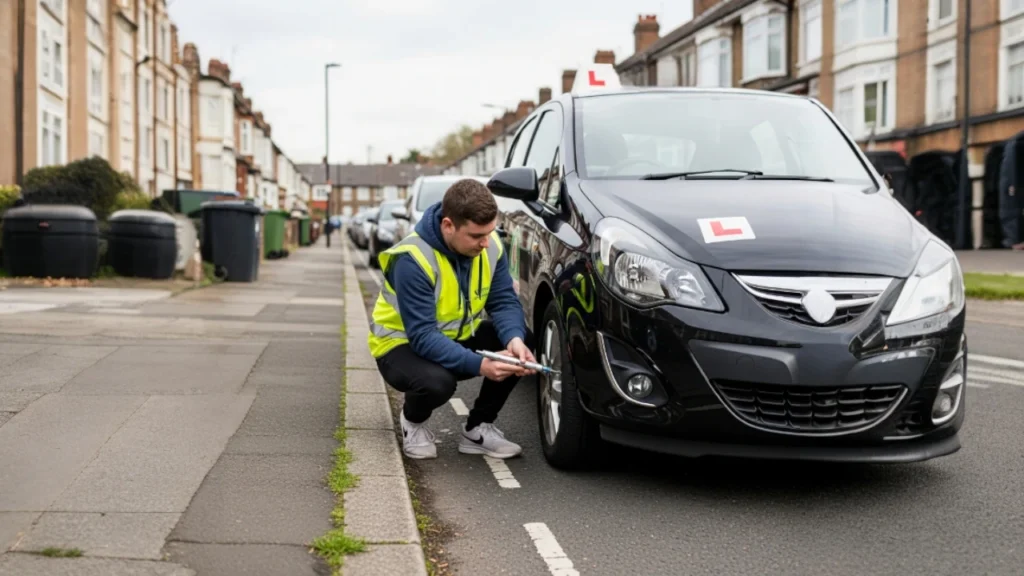
Your tyres are the only part of your car that touches the road. Their condition and pressure directly affect your safety, fuel economy, and the longevity of your vehicle. Yet, many drivers rarely check their tyre pressure—or do it incorrectly. Learning to check tyre pressure correctly is one of the simplest, most important car maintenance skills you can master. It takes just five minutes, requires no special tools beyond what you can find at any petrol station, and can save you money, improve your driving experience, and even help you pass your driving test. Whether you’re a new driver learning with a driving school in Ilford or an experienced motorist who once searched for the cheapest driving instructor near me, this guide will ensure you never get tyre pressure wrong again. It’s a foundational skill that connects directly to both eco-friendly driving tips and understanding essential processes like how to exchange a foreign driving license in the UK—all part of becoming a fully informed, responsible driver
Part 1: Why Correct Tyre Pressure Is Non-Negotiable
Safety First
- Under-inflated tyres overheat at high speeds, increasing the risk of a blowout.
- Over-inflated tyres have less contact with the road, reducing grip, especially in wet conditions.
- Incorrect pressure affects braking distances and cornering stability.
Save Money on Fuel
Under-inflated tyres increase rolling resistance. Your engine has to work harder, burning more fuel. Just 1 PSI below recommendation can reduce fuel efficiency by 0.5% . Running all four tyres 10 PSI too low can increase fuel consumption by 5–10% .
Extend Tyre Life
- Under-inflation wears the outer edges of the tyre.
- Over-inflation wears the centre of the tread.
- Correct pressure means even wear and maximum tyre life.
Pass Your Driving Test
Examiners check your basic car knowledge. You may be asked “Tell me how you’d check the tyres” in the ‘tell me’ question at the start of your test. Knowing how to check tyre pressure correctly and explain the process is a guaranteed pass for that question.
Part 2: When and How Often to Check
Frequency
- At least once a month. Tyres naturally lose pressure over time (about 1-2 PSI per month).
- Before any long journey.
- After a significant temperature change. Cold weather reduces tyre pressure.
- If the car feels different. Reduced grip, pulling to one side, or a bumpy ride can indicate pressure issues.
When to Check
Check when tyres are COLD. “Cold” means the car hasn’t been driven for at least 2–3 hours. Driving heats up the tyres and increases pressure, giving a false reading.
Part 3: What You’ll Need
- A reliable tyre pressure gauge. You can buy a digital or analogue gauge for home use, or use the machines at most UK petrol stations.
- An air compressor. Petrol stations have these, or you can buy a portable one.
- Your car’s recommended tyre pressures. Found in your owner’s manual, inside the fuel filler flap, or on a sticker inside the driver’s door frame.
Part 4: Step-by-Step Guide to Checking Tyre Pressure Correctly
Step 1: Find Your Recommended Pressure
Look up the correct pressure for your car. It will be shown in PSI (pounds per square inch) or BAR. Note that front and rear pressures may be different, especially if you carry passengers or heavy loads regularly.
Example:
- Front: 32 PSI
- Rear: 30 PSI
Step 2: Remove the Valve Cap
Unscrew the small black cap from the tyre valve on your first tyre. Keep it in a safe place (like your pocket) so you don’t lose it.
Step 3: Attach the Pressure Gauge
- If using a petrol station gauge: Press the gauge firmly onto the valve stem. You should hear a brief hiss of air, then the reading will appear.
- If using a hand-held gauge: Push it onto the valve firmly and hold until the reading stabilises.
Step 4: Read the Pressure
Note the reading. Compare it to your recommended pressure.
Step 5: Add or Release Air
- If pressure is too LOW: Use the air compressor to add air in short bursts. Recheck after each burst until you reach the correct pressure.
- If pressure is too HIGH: Press the small pin in the centre of the valve with the back of the gauge cap or a small tool to release air. Recheck frequently.
Step 6: Repeat for All Tyres
Don’t forget the spare tyre (if you have one) – it’s often overlooked but essential in an emergency.
Step 7: Replace Valve Caps
Screw all valve caps back on firmly. They keep dirt and moisture out of the valve mechanism.
Part 5: Using Petrol Station Air Machines
Most UK petrol stations have air compressors, often with built-in pressure gauges. Many are now free, but some charge a small fee (usually £1 for a few minutes of use).
Tips for petrol station use:
- Park close enough that the hose reaches all four tyres.
- Set the machine to your desired pressure if it has an auto-stop function.
- Work quickly, as most machines have a time limit.
- Don’t trust the built-in gauge completely—they can be inaccurate. Consider carrying your own gauge to double-check.
Part 6: Common Mistakes to Avoid
| Mistake | Why It’s Wrong | How to Fix It |
|---|---|---|
| Checking when tyres are hot | Heat increases pressure, giving a false reading. | Check when cold, or add 3-4 PSI to the hot reading as a rough guide. |
| Guessing the pressure | Every car is different. | Always check your manual or door sticker. |
| Forgetting the spare | A flat spare leaves you stranded. | Check it monthly too. |
| Over-tightening valve caps | Can damage the valve. | Screw on firmly but gently. |
| Relying on “eye” checks | Tyres can look fine even when 10 PSI low. | Always use a gauge. |
| Not checking at all | The most common mistake! | Set a monthly reminder on your phone. |
Part 7: Understanding Tyre Pressure Monitoring Systems (TPMS)
Most modern cars (2014 onwards) have a Tyre Pressure Monitoring System (TPMS). This system warns you when a tyre is significantly under-inflated.
Two Types of TPMS:
- Direct TPMS: Sensors inside each tyre send real-time pressure data to your dashboard.
- Indirect TPMS: Uses wheel speed sensors to detect when a tyre is rotating faster (meaning it’s under-inflated).
Important: TPMS is a warning system, not a substitute for manual checks. It typically only alerts you when pressure is 25% below recommended, by which point you’ve already lost efficiency and increased wear.
Part 8: The Eco-Driving Connection
Correct tyre pressure is a cornerstone of eco-friendly driving tips. When your tyres are at the right pressure:
- Your engine uses less fuel (lower emissions)
- Your tyres last longer (less waste)
- You drive safer (fewer accidents)
It’s one of the simplest green driving habits you can adopt, and it costs nothing but a few minutes of your time each month.
Part 9: The “Tell Me” Question – Your Driving Test
At the start of your practical driving test, the examiner will ask you one “tell me” question. A common one is:
“Tell me how you’d check that the tyres have sufficient tread depth and that they are safe to use on the road.”
Your answer should include:
- “I would check the tyre pressure using a reliable gauge when the tyres are cold.”
- “I would check the tread depth meets the legal minimum of 1.6mm across the central three-quarters of the tyre.”
- “I would also check for any cuts, bulges, or other damage.”
Practising this answer with your instructor from a reputable driving school in Ilford ensures you’re ready.
Part 10: The Bigger Picture – Tyre Safety and Legal Requirements
Legal Tread Depth
The legal minimum tread depth in the UK is 1.6mm across the central three-quarters of the tyre. Driving with tyres below this limit carries:
- £2,500 fine per tyre
- 3 penalty points per tyre
Seasonal Considerations
- Winter: Consider switching to winter tyres if you drive frequently in snow or ice.
- Summer: Hot roads can increase pressure; check more frequently.
Tyre Age
Tyres older than 10 years should be replaced regardless of tread depth, as rubber degrades over time.
Conclusion: Five Minutes That Save Lives and Money
Learning to check tyre pressure correctly takes five minutes once a month. In return, you get:
- Better fuel economy (saving money)
- Longer tyre life (saving more money)
- Safer handling and braking (saving lives)
- Peace of mind on every journey
It’s one of the simplest, most impactful skills any driver can master. Whether you’re a new driver just starting with a driving school or an experienced motorist, make it a habit.
Ready to learn all the essential skills of safe, responsible driving?
📞 Call Driving Academy Ltd at 07399 696344 – Our expert instructors in Ilford and London teach everything from basic maintenance to advanced driving techniques.
📧 Email: drivingacademyltd@gmail.com
📍 Visit Us: 101 Whitechapel High Street, London, E1 7RA
Start your journey to becoming a complete, confident driver. Book your lesson today.