


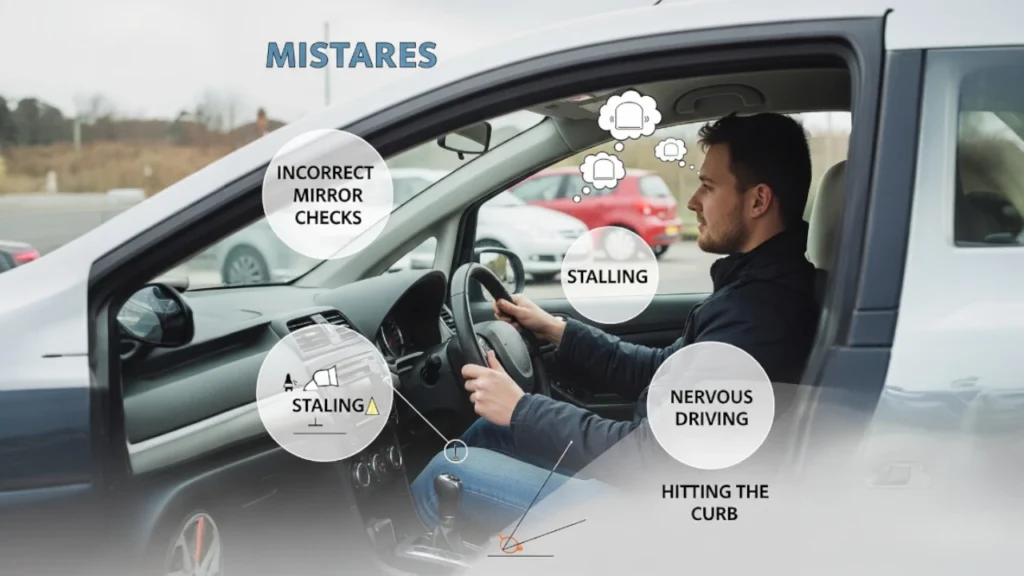
Walking into your driving test can feel intimidating, but what if you knew exactly what traps to avoid? Understanding the most common driving test mistakes gives you a powerful advantage. These aren’t minor issues—they’re the recurring errors that DVSA examiners see daily, which often lead to immediate test failure. At Driving Academy Ltd, we’ve trained thousands of learners in Ilford and across London, and we know precisely which habits need extra attention. This guide breaks down these critical errors from an examiner’s perspective, helping you focus your practice. Remember, while finding the cheapest driving instructor near me might save money short-term, learning to avoid these fundamental errors requires quality instruction from a proper driving school.
Mistake #1: Inadequate Observation at Junctions (The #1 Failure)
Why it’s critical: This is consistently the leading cause of test failures. It’s not about glancing—it’s about effective observation that ensures it’s truly safe to proceed.
- The Error: A quick “tick-box” look without properly assessing the speed and distance of approaching traffic. Failing to look right on a left turn, or vice versa.
- Examiner’s View: They need to see clear, deliberate head movements and pauses that show you’re actually processing what you see. Rushing out because you glanced once is a serious fault.
- How to Fix: Practice the “right-left-right” (or appropriate sequence) drill until it’s automatic. At every junction, pause and verbally confirm to yourself: “Clear right, clear left, safe to go.”
Mistake #2: Poor Mirrors-Signal-Manœuvre (MSM) Routine
Why it’s critical: The MSM routine is the backbone of safe driving. Getting it out of order or skipping steps shows a lack of planning.
- The Error: Signalling before checking mirrors, or changing position/speed without any mirror check at all. Forgetting to check the blind spot before moving off.
- Examiner’s View: They assess whether you use mirrors before every signal and before changing speed or direction. Missing the blind spot check when moving off is a frequent serious fault.
- How to Fix: Chant “Mirrors, Signal, Manœuvre” in your head. Make your mirror checks obvious. Before moving the steering wheel, ask: “Have I checked?”
Mistake #3: Incorrect Positioning (Especially on Roundabouts and Bends)
Why it’s critical: Being in the wrong lane or too close to the kerb/centre line confuses other drivers and can be dangerous.
- The Error: Entering a roundabout from the wrong lane, not following lane markings, “driftng” across lanes on a bend, or being too far from the kerb when parking.
- Examiner’s View: They look for confident, correct lane discipline. Poor positioning often leads to last-minute corrections, which are a sign of a lack of control.
- How to Fix: Look well ahead at road markings and signs. Plan your lane early. Practice staying a consistent, safe distance from the kerb.
Mistake #4: Lack of Control (Steering & Use of Gears)
Why it’s critical: This demonstrates your fundamental command of the vehicle.
- The Error:
- Steering: “Crossing hands” habitually, “shuffling” the wheel, or over-steering on bends requiring lots of corrections.
- Gears: “Coasting” (driving with the clutch down), staying in too low a gear (over-revving), or selecting the wrong gear for the speed.
- Examiner’s View: They want to see smooth, controlled inputs. Coasting shows a loss of control and is a serious fault. Poor steering looks unprofessional and can be unsafe.
- How to Fix: Practice the pull-push steering method. Learn to listen to your engine and feel the car’s need for a gear change. Never hold the clutch down unless you’re stopping.
Mistake #5: Undue Hesitation or Lack of Progress
Why it’s critical: While safety is paramount, being overly cautious and disrupting the flow of traffic is also a fault.
- The Error: Waiting unnecessarily long at a clear junction, driving 10-15 mph below the speed limit without reason, or being too timid to join a flowing roundabout.
- Examiner’s View: They assess your ability to make safe and timely decisions. Causing other drivers to slow or wait because of your hesitation shows a lack of confidence and judgement.
- How to Fix: Build confidence through practice. Learn to judge safe gaps in traffic. Trust your skills and go when you have a clear, safe opportunity.
Mistake #6: Not Following Signs or Road Markings
Why it’s critical: This tests your independent observation and compliance with the rules.
- The Error: Missing a “Stop” sign, driving in a bus lane during its hours of operation, or ignoring a directional arrow.
- Examiner’s View: This is a clear-cut serious fault. It shows you are not reading the road effectively.
- How to Fix: Actively scan for signs and markings, not just other cars. Verbalise what you see: “30 speed limit,” “Give way ahead.”
Mistake #7: Manoeuvre Nerves (Parallel Park, Bay Park, Pull Up on the Right)
Why it’s critical: Nerves can ruin an otherwise perfect manoeuvre.
- The Error: Rushing, forgetting observations, or giving up after one attempt without trying to correct.
- Examiner’s View: They are marking your control and observations during the manoeuvre. You can adjust and correct as long as it’s safe and under control.
- How to Fix: Practice each manoeuvre until it’s boring. Go slowly. Remember, you have time. Make your observation checks dramatic and obvious.
How Professional Training from a Driving School Prevents These Mistakes
This list highlights why professional instruction is irreplaceable. A quality driving school in Ilford like Driving Academy Ltd does more than just show you the skills; we:
- Anticipate Errors: We spot your personal tendencies towards these common mistakes early.
- Provide Structured Correction: We have drills and exercises specifically designed to eliminate each error.
- Offer Mock Tests: We simulate the test environment, so you experience pressure in a safe space and learn to perform despite nerves.
- Give DVSA-Standard Feedback: Our advice mirrors what an examiner is looking for.
Choosing the right learning partner is the most effective strategy to avoid becoming a statistic on this list.
Conclusion: Practice Doesn’t Make Perfect, Perfect Practice Does
Awareness is your first weapon. By focusing your practice on eliminating these common driving test mistakes, you dramatically increase your chances of success. Move beyond simply “driving around” to targeted, error-focused practice with a professional who can give you the right feedback.
Ready to learn with a school that specializes in turning common mistakes into passing skills?
📞 Call Driving Academy Ltd at 07399 696344 – Our expert instructors in Ilford and London are trained to identify and correct these exact errors.
📧 Email: drivingacademyltd@gmail.com
📍 Visit Us: 101 Whitechapel High Street, London, E1 7RA
Don’t just hope to pass. Train to pass. Book your lesson today.