


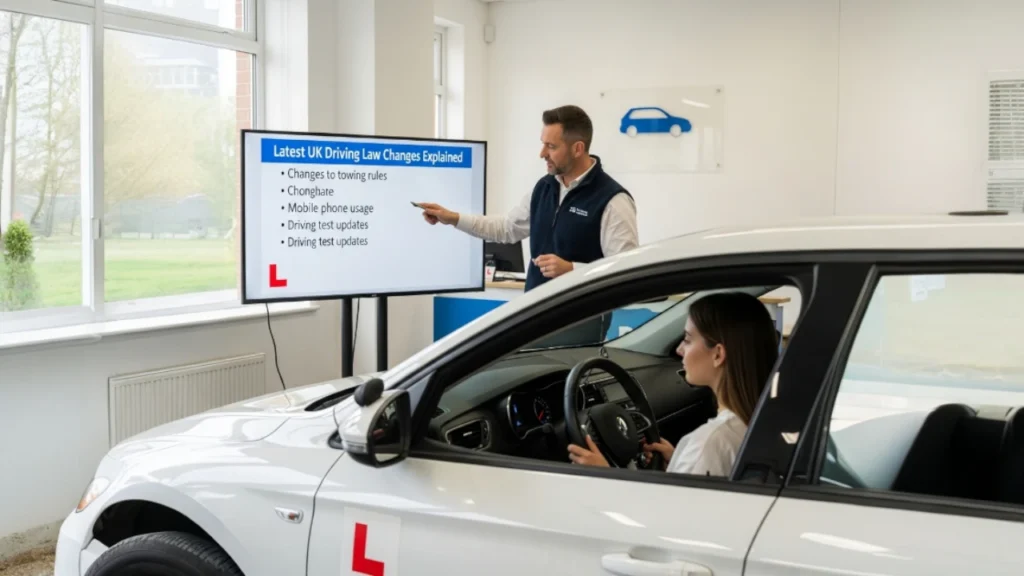
The UK’s driving laws are not static; they evolve to address new safety challenges, technology, and road usage patterns. For every driver—from those who just passed with a driving school in Ilford to experienced motorists—ignorance of the latest UK driving law changes is not a legal defence. New regulations can significantly alter what is legal and safe on the roads. This comprehensive guide breaks down the most important recent and upcoming changes, explaining what they mean for you in practical terms. Staying informed protects your licence, your wallet, and, most importantly, lives on the road. It also complements a thorough understanding of the UK penalty points system, as new offences often carry specific endorsements.
Part 1: Major Changes to Smart Motorway Rules
Smart motorways (where the hard shoulder is used as a live lane) have seen the most significant regulatory updates following safety reviews.
1.1 The End of Dynamic Hard Shoulder Running
- The Change: The government has halted the rollout of new “Dynamic Hard Shoulder” smart motorways, where the hard shoulder opens during busy periods. Existing schemes remain but are under review.
- What It Means for You: On these existing stretches, you MUST obey the overhead lane signals. A red ‘X’ means the lane (including a former hard shoulder) is closed. Driving in a lane with a red ‘X’ is now a fixed penalty offence (£100 fine and 3 points).
1.2 Increased Use of Stationary Vehicle Detection
- The Change: All existing smart motorways without a permanent hard shoulder are being retrofitted with enhanced technology to detect stopped vehicles more quickly.
- What It Means for You: While this improves safety, the core rule remains: if your vehicle has a problem, try to reach an Emergency Refuge Area (ERA). If you can’t, stop in the leftmost lane, turn on hazards, stay in your car with seatbelts on, and call 999 immediately.
Part 2: Stricter Mobile Phone Laws (In Effect)
The law around mobile phone use while driving was significantly tightened in 2022, and many drivers are still unaware of the full scope.
- The Change: It is now illegal to use a hand-held mobile phone for almost any purpose while driving. This includes:
- Scrolling playlists.
- Taking photos or videos.
- Checking the time.
- Using apps at traffic lights or while stationary in traffic.
- Permitted Use: You may only use a hand-held phone if you are safely parked, need to call 999 in an emergency, or are making a contactless payment at a drive-through (while stationary).
- Penalty: 6 penalty points and a £200 fine. For drivers within their first two years post-test, this means instant licence revocation.
Part 3: Updates to the Highway Code Hierarchy of Road Users (Rule H1)
While introduced in 2022, this remains a critical change that is still bedding in.
- The Change: A new hierarchy places those most at risk at the top. Drivers of large vehicles (HGVs, vans, cars) have the greatest responsibility to reduce danger to more vulnerable users like cyclists, horse riders, and pedestrians.
- What It Means for You: When turning, you should give way to pedestrians waiting to cross. The “Dutch Reach” method (opening your car door with the hand furthest from the door) is recommended to prevent “car dooring” cyclists. This is about cultivating a more defensive, aware driving attitude.
Part 4: Changes to MOT Testing and Diesel Car Rules
- Stricter Diesel Emissions (ULEZ Expansion): While not a national driving law per se, the expansion of Ultra Low Emission Zones in cities like London directly affects where you can drive. Older, more polluting diesel cars (generally pre-2015) and petrol cars (pre-2006) face daily charges. Always check your vehicle’s compliance before driving into major UK cities.
- Enhanced MOT Checks: Testers now conduct more rigorous checks on diesel particulate filters (DPF), reversing lights, and brake fluid contamination. Tampering with a DPF will now result in an automatic MOT failure.
Part 5: Zero-Tolerance Drug Driving Limits & New Offences
The law around driving under the influence of drugs (medicinal and recreational) is now as strict as for alcohol.
- The Change: There are now 17 illegal drugs with specified near-zero limits, and 8 prescription drugs with higher but strictly enforced limits (e.g., morphine, methadone).
- What It Means for You: If you are taking prescription medication that advises it may cause drowsiness, you could be over the limit. You must consult your doctor about driving. The police can now use roadside “drugalyser” devices.
Part 6: The Critical Role of Professional Instruction in a Changing Landscape
This is where choosing a quality driving school over simply the cheapest driving instructor near me proves its worth. A professional, DVSA-approved instructor’s knowledge is continuously updated. They don’t just teach you to pass a test based on old rules; they instil an understanding of the principles of safe driving and the importance of staying updated on UK driving law changes. This creates adaptable, resilient drivers who understand that passing the test is the beginning of a lifelong learning process. Knowing the UK penalty points system is one thing; understanding how new laws create new ways to acquire points is another.
Conclusion: An Ongoing Journey of Compliance
The latest UK driving law changes reinforce a clear trend: greater protection for vulnerable road users, stricter enforcement of distractions, and adaptation to new technology. As a driver, your responsibility is to stay informed. Regularly checking official GOV.UK channels, subscribing to motoring organisation updates, and choosing a driving school committed to current standards are the best ways to ensure you never fall foul of a change you didn’t know about.
Learn with a school that teaches the latest standards, not just the test.
📞 Call Driving Academy Ltd at 07399 696344 – Our instructors in Ilford and London are committed to teaching up-to-date, safe, and legal driving practices.
📧 Email: drivingacademyltd@gmail.com
📍 Visit Us: 101 Whitechapel High Street, London, E1 7RA
Drive with confidence, drive within the law. Book your refresher or first lesson today.