

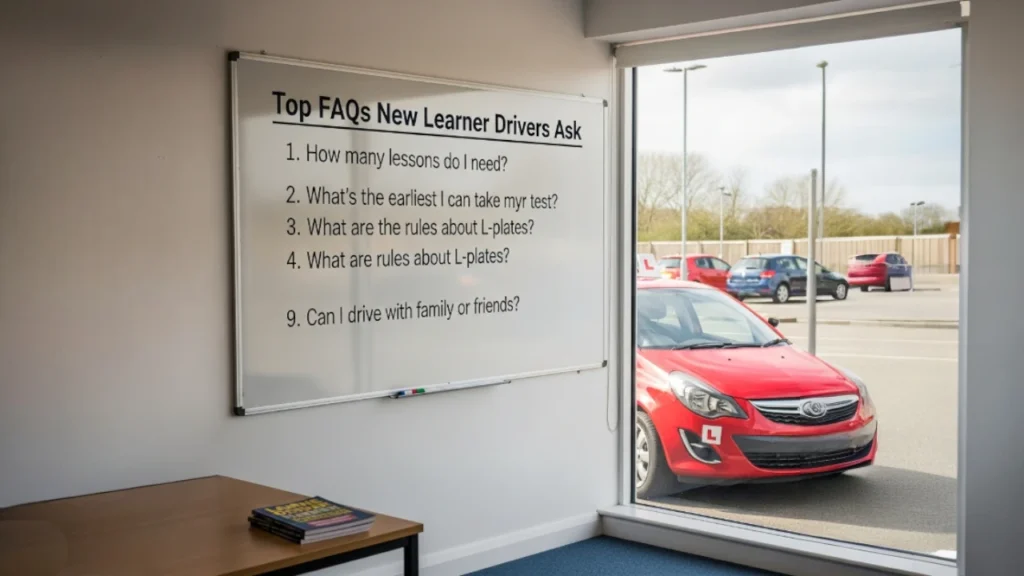
Starting your journey to become a driver is exciting, but it’s normal to have plenty of questions. Whether you’re searching for the cheapest driving instructor near me or wondering what to expect in your first lesson, getting clear answers early can boost your confidence and set you on the right path. This guide compiles the top FAQs new learner drivers ask, with honest answers from the experienced DVSA-approved instructors at Driving Academy Ltd. Consider this your one-stop resource for practical advice, whether you’re in Ilford or anywhere else in London.
FAQ Category 1: Getting Started with Lessons
1. How many driving lessons will I need to pass my test?
This is the most common question. The DVSA suggests the average learner needs around 45 hours of professional lessons, plus 22 hours of private practice. However, this varies greatly depending on your:
- Natural aptitude: Some people take to driving more quickly than others.
- Frequency of lessons: Having 2 lessons per week is more effective than 1 every fortnight.
- Practice outside lessons: If you can practice with family or friends (with proper supervision).
- Quality of instruction: A good instructor from a reputable driving school will teach efficiently.
2. How do I choose a good driving instructor/school?
Don’t just search for the cheapest driving instructor near me. Look for:
- DVSA Approval: Ensure they are a fully qualified ADI (Approved Driving Instructor).
- Reviews and Recommendations: Check Google, Facebook, and word-of-mouth.
- Structured Learning: A good driving school in Ilford will have a clear curriculum.
- Personality Match: You’ll spend many hours together—choose someone you feel comfortable with.
- Modern Teaching Methods: Do they use dual controls, and are they patient and clear?
3. What should I expect in my first driving lesson?
Your first lesson is about getting comfortable. Typically, your instructor will:
- Pick you up from a safe, agreed location.
- Check your provisional licence.
- Start with a chat about the car’s controls (cockpit drill).
- Have you drive in a very quiet, low-risk area to get a feel for the basics.
- Focus on clutch control (in a manual), moving off, and stopping safely.
FAQ Category 2: Costs, Tests, and Logistics
4. How much do driving lessons cost?
Lesson prices vary by location and instructor. In London and Ilford, expect to pay £35 – £45 per hour on average for a qualified ADI. Block bookings often offer a discount. Remember, the cheapest option isn’t always the best value if it takes you longer to learn.
5. How do I book my theory and practical tests?
- Theory Test: Book online via the official GOV.UK website. You’ll need your provisional licence number.
- Practical Test: You can only book this after passing your theory test. Use the same GOV.UK portal. Waiting times can be several weeks, so book as soon as you feel ready.
6. What happens if I fail my driving test?
Don’t panic! Many people don’t pass first time. The examiner will give you a debrief. You must wait at least 10 working days before taking another test. Use this time to practice the specific skills you struggled with. Our guide on how to reduce car maintenance costs also highlights the importance of regular checks, a habit that starts with good learning.
FAQ Category 3: Skills, Anxiety, and Preparation
7. How can I overcome driving test nerves?
Nerves are normal. To manage them:
- Be Prepared: Thorough practice is the best antidote to anxiety.
- Mock Tests: Ask your instructor for full mock tests to simulate the real experience.
- Focus on Breathing: Take deep breaths if you feel overwhelmed.
- View the Examiner as a Sat Nav: They’re just giving directions; you’re in control of the car.
- Eat Well: Have a light meal beforehand and avoid too much caffeine.
8. What are the most common reasons people fail the driving test?
Examiners see the same mistakes repeatedly:
- Observation at Junctions: Not looking properly before emerging.
- Mirror Use: Not checking mirrors before signalling or changing speed/position.
- Control: Issues with steering (over-steering) or poor clutch control leading to stalling.
- Positioning: Incorrect lane use, especially on roundabouts.
- Moving Off Safely: Not checking blind spots.
9. Is it better to learn in a manual or automatic car?
- Manual: Gives you a full licence to drive both manual and automatic cars. It’s often cheaper to learn in and teaches you more about car control.
- Automatic: Easier to learn as you don’t have to master clutch coordination. You’re only licensed to drive automatics.
Our advice: Learn manual if you can. It keeps all your options open for future car hires or jobs that require driving.
10. What documents do I need for my driving test?
You MUST bring:
- Your UK provisional driving licence (the photocard).
- Your theory test pass certificate.
- Your own face mask (if required by current guidelines).
Your instructor will usually provide the test-ready car.
Conclusion: Your Journey Starts with the Right Information
Having your questions answered is the first step to becoming a confident, safe driver. The right driving school doesn’t just teach you to pass a test—they guide you through this entire journey, from your first question to your first solo drive.
Ready to start your lessons with clear, expert guidance?
📞 Call Driving Academy Ltd at 07399 696344 – We’re here to answer all your questions and provide top-quality lessons in Ilford and across London.
📧 Email: drivingacademyltd@gmail.com – Send us your FAQs!
📍 Visit Us: 101 Whitechapel High Street, London, E1 7RA
Don’t just learn to drive—learn to drive with confidence.