


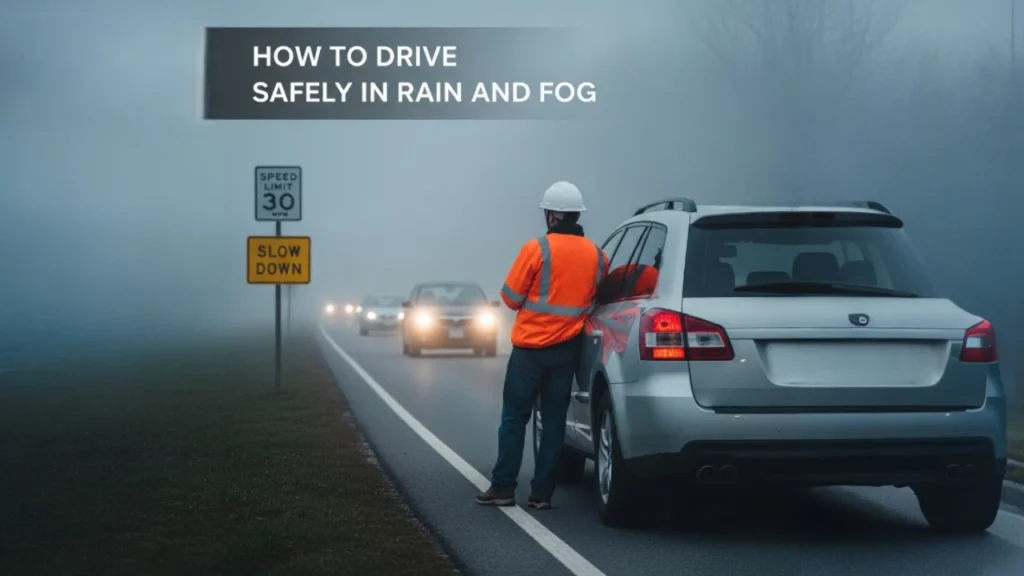
Driving in challenging weather is an inevitable part of motoring in the UK. Conditions like rain and fog dramatically change how you must control your vehicle and perceive hazards. Mastering the skills for driving safely in rain and fog isn’t just about comfort—it’s a critical safety requirement that connects to your foundational knowledge of UK seatbelt and car safety rules and practical skills like how to master hill starts easily. Whether you’re a learner preparing for your UK Driving Theory Test or a new driver gaining confidence, this guide provides the complete set of techniques to handle reduced visibility and slippery roads with confidence.
For professional instruction that includes practical bad-weather driving in Ilford, contact Driving Academy Ltd at 📞 07399 696344, email 📧 drivingacademyltd@gmail.com, or visit 📍 101 Whitechapel High Street, London, E1 7RA.
The Fundamental Shift: How Weather Changes Everything
Before learning specific techniques, understand why rain and fog are so dangerous:
- Rain reduces tyre grip (increasing stopping distances by at least double), creates spray (reducing visibility), and can lead to aquaplaning.
- Fog eliminates depth perception, hides hazards, and makes judging distance and speed nearly impossible.
Both conditions demand that the basic UK seatbelt and car safety rules are non-negotiable—your primary physical protection in the event of an incident caused by poor conditions.
Part 1: Your Pre-Drive Vehicle Check (Non-Negotiable)
A safe car is your first line of defence. This check takes two minutes but is vital.
| Component | Why It’s Critical in Rain/Fog | The Simple Check |
|---|---|---|
| Tyres | Worn tyres cannot disperse water, leading to aquaplaning. | Tread depth must be well above the legal 1.6mm minimum. 3mm is safer. |
| Windscreen Wipers | Streaky wipers make a bad situation dangerous. | Do they clear the screen in one pass without juddering? Replace if needed. |
| Washer Fluid | You will need to clear road spray and grime constantly. | Top up with a good quality screen wash that won’t freeze. |
| All Lights | You must be seen. Faulty lights make you invisible. | Check headlights (dipped/main beam), fog lights, brake lights, and indicators. |
| Demister & Blowers | Windows will fog up instantly from breath and dampness. | Ensure the system clears the windscreen and side windows quickly. |
Part 2: Core Techniques for Driving Safely in Rain
1. See and Be Seen: Light Use is Law
- Dipped Headlights are MANDATORY when visibility is seriously reduced. If your wipers are on continuously, your headlights should be too.
- Use Front & Rear Fog Lights only when visibility drops below 100 metres (328 feet). You MUST switch them off when visibility improves to avoid dazzling others.
- Never use rear fog lights in rain alone—they mask your brake lights and dazzle drivers behind.
2. Control and Space: The Golden Rules
- Double Your Following Distance: From the standard 2-second rule to at least 4 seconds. This is your critical buffer.
- Slow Down: Your stopping distance is at least doubled on wet roads. Your speed must reflect this.
- Smooth is Safe: Any sudden action—braking, accelerating, steering—can break traction. Be gentle and progressive with all controls.
3. Dealing with Aquaplaning
If the steering feels light and the engine note rises, you may be aquaplaning (riding on a film of water).
- DO NOT brake or jerk the steering wheel.
- DO ease off the accelerator gently and hold the wheel straight until you feel the tyres regain grip.
Part 3: Core Techniques for Driving Safely in Fog
1. Lights and Visibility
- Use Dipped Headlights. Main beams will reflect off the fog, creating a white wall and reducing your vision.
- Use Fog Lights Correctly: As per the rule above. Familiarise yourself with your car’s fog light controls before you drive.
- Keep All Windows Clear: Use air conditioning (A/C) with your heater. The A/C dehumidifies air, clearing mist far faster than heat alone.
2. Navigation and Judgement
- Follow the Left-Hand Kerb: Use it as a guide to your position on the road, but don’t focus on it exclusively.
- Increase Following Distance Dramatically: You need enormous space to react to suddenly appearing hazards.
- Beware of Deceptive Clear Patches: Fog is often patchy. Do not speed up suddenly in a clear section, as you may drive straight back into thick fog.
Part 4: The Skill Connection: Hill Starts in Bad Weather
Mastering hill starts is a core skill of car control, and its importance multiplies in bad weather. Here’s the connection, especially for areas like Gants Hill with its gradients:
- Reduced Grip: On a wet or foggy hill, your tyres have less grip. This means you need to be even more precise with finding the biting point to avoid spinning the wheels or rolling back.
- Smoothness is Paramount: The “gas and gentle clutch lift” technique you learn for how to master hill starts easily must be feather-light in the rain to prevent wheel spin.
- Confidence Under Pressure: Successfully performing a hill start in poor conditions without stalling or rolling builds immense confidence and proves true vehicle control. A good driving school in Ilford will practice this in various conditions.
The Driving School Advantage: From Theory to Wet Roads
A professional driving academy ltd does more than fair-weather training. The right instructor will:
- Take you out in light rain to practice these techniques in a safe, dual-control car.
- Explain the theory behind the practice, linking your UK Driving Theory Test knowledge on stopping distances and lighting rules to real-world application.
- Use local hills around Ilford to build confidence in all conditions, ensuring you’re prepared for any scenario on your test and beyond.
FAQs: Driving in Rain and Fog
Q1: Is it illegal to drive with a dirty windscreen in bad weather?
A: While not a specific offence, driving with impaired vision could lead to a charge of “driving without due care and attention.” It is a serious safety failing.
Q2: What speed should I drive in fog?
A: You must be able to stop within the distance you can see clearly. This often means driving well below the posted limit. If you can’t see more than 20 metres ahead, your speed must be appropriate for that.
Q3: Should I cancel my driving test if it’s raining or foggy?
A: No. Tests go ahead in all but the most extreme weather. Examiners expect you to adapt your driving appropriately. Being well-practiced in these conditions can demonstrate high skill level.
Q4: My car has automatic wipers and lights. Can I rely on them completely?
A: No. Use them as an aid, but you are the driver. You must manually ensure your lights are on when needed (the auto setting can be slow to react in daytime fog) and that your wiper speed is correct for the conditions.
Q5: What’s the most common mistake in the rain?
A: Driving too fast for the conditions and following too closely. Drivers fail to appreciate just how much stopping distance increases.
Conclusion: Confidence Comes from Preparedness
Driving safely in rain and fog is about a combination of preparedness (vehicle checks), correct technique (lights, speed, space), and the right mindset (patience and focus). These conditions test the full range of your skills, from basic car control to advanced hazard perception.
Developing this confidence is best done with expert guidance. At Driving Academy Ltd, we ensure our learners in Ilford and London are prepared for sunshine, showers, and everything in between, building drivers who are safe for life, not just fair-weather motorists.
Don’t let the weather dictate your confidence. Learn to drive safely in all conditions with us.
📞 07399 696344 | 📧 drivingacademyltd@gmail.com | 📍 101 Whitechapel High Street, London, E1 7RA