


Knowing and respecting UK speed limits is a fundamental part of safe, legal, and responsible driving. Whether you’re a learner preparing for your UK Driving Theory Test, a new driver navigating Ilford’s roads, or an experienced motorist, a clear understanding of speed zones is non-negotiable. This guide provides a comprehensive breakdown of all UK speed limits, explains how they interact with vital UK seatbelt and car safety rules, and highlights why proper vehicle care through basic car maintenance tips for beginners is crucial for staying safe at any speed.
For expert, structured driving tuition that builds this knowledge into practical skill, contact Driving Academy Ltd at 📞 07399 696344, email 📧 drivingacademyltd@gmail.com, or visit 📍 101 Whitechapel High Street, London, E1 7RA.
The Golden Rule: Limits, Signs, and Your Responsibility
The most important principle in UK speed law is this: A posted speed limit sign always overrides the national limit. Your primary duty is to observe and obey the signage. The national limits apply only where no signs are present.
UK National Speed Limits: The Default Rules
When you see no repeaters or signs indicating otherwise, these are the maximum speeds allowed. They form a core part of your UK Driving Theory Test.
| Type of Road | Cars & Motorcycles | Cars Towing Trailers/Caravans |
|---|---|---|
| Built-up areas (street lights) | 30 mph | 30 mph |
| Single carriageways | 60 mph | 50 mph |
| Dual carriageways | 70 mph | 60 mph |
| Motorways | 70 mph | 60 mph |
Key Definition: A “built-up area” is typically defined by the presence of street lights placed no more than 200 yards (183 metres) apart. This is why the 30 mph limit is often called the “street light limit.”
Understanding Speed Limit Signs and Zones
Speed limits are communicated through a system of signs.
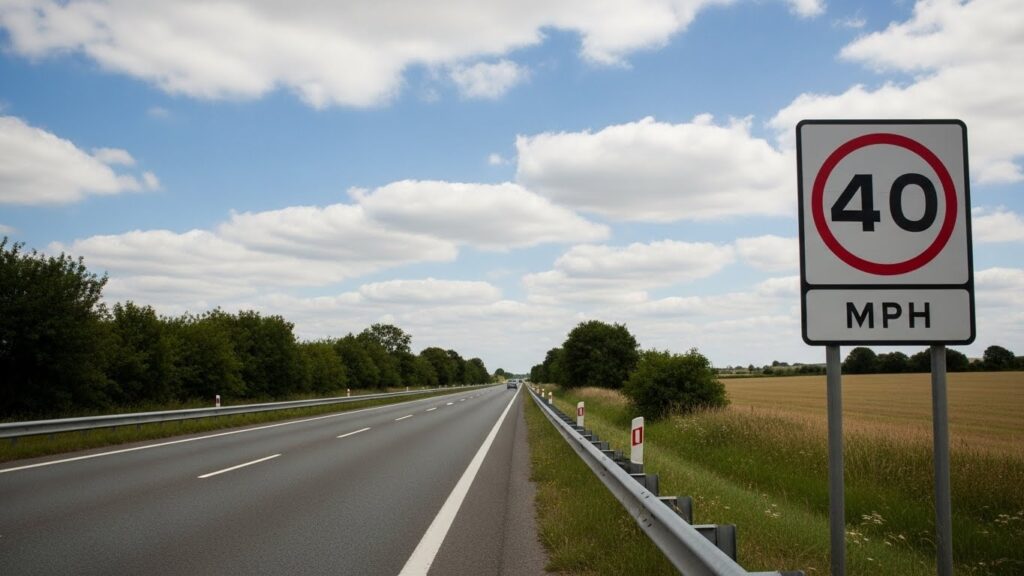
- Terminal Signs: A circular sign with a red border marks the start of a new speed limit zone (e.g., entering a 40 mph area).
- Repeater Signs: Smaller rectangular signs placed along a road to remind you of the applicable limit.
- Derestriction Sign: A white circular sign with a black diagonal stripe indicates the national limit for that type of road now applies (e.g., the end of a 40 mph zone and the start of a national 60 mph limit on a single carriageway).
Special Speed Limits and Variable Zones
Certain areas and vehicles have specific limits.
- 20 mph Zones: Increasingly common in residential areas, near schools, and in town centres to improve safety.
- Variable Speed Limits: On smart motorways, electronic signs overhead can set temporary mandatory limits (e.g., 50, 60 mph) due to congestion, incidents, or weather. You must obey these.
- Goods Vehicles and Buses: Have lower national speed limits (e.g., 50 mph on single carriageways, 60 mph on dual carriageways and motorways).
Speed, Safety, and the Law: The Vital Connections
Adhering to UK speed limits is intrinsically linked to other safety pillars.
Connection to UK Seatbelt and Car Safety Rules
Speed dramatically affects the outcome of a collision. Wearing a seatbelt, as mandated by UK seatbelt and car safety rules, is your primary defence. However, the forces involved in a crash increase exponentially with speed. The difference between 30 mph and 35 mph can be the difference between survival and a fatal injury. A safe speed for the conditions is the first part of the safety chain.
Connection to Basic Car Maintenance Tips for Beginners
Your car must be in a safe condition to be driven at any speed, especially higher ones. This is where basic car maintenance tips for beginners are critical:
- Tyres: Worn or under-inflated tyres have drastically reduced grip, increasing stopping distances and the risk of a blowout—a catastrophic event at high speed.
- Brakes: Effective, well-maintained brakes are essential for controlling your speed and stopping safely.
- Lights and Indicators: Essential for communicating your presence and intentions to others, a legal requirement at all times.
How a Driving School Builds Speed Awareness
A professional driving school in Ilford doesn’t just teach you to stick to a number. They develop your speed awareness—the judgement to select a safe speed based on:
- The posted limit.
- Road conditions: Is it wet, icy, or foggy?
- Traffic conditions: How busy is it?
- Your own vehicle’s condition (linking back to maintenance).
This skill is vital for passing your driving test and for a lifetime of safe driving. Examiners want to see that you can make safe speed choices independently.
Penalties for Speeding: More Than Just a Fine
Breaking UK speed limits carries serious consequences, designed to deter unsafe behaviour.
- A Minimum £100 Fine and 3 Penalty Points on your licence.
- Speed Awareness Course: For minor offences, you may be offered this course as an alternative to points, but you will still pay a fee.
- Court Summons: For higher speeds, you can be summoned to court, facing a fine of up to 150% of your weekly income, 6 penalty points, or even a driving ban.
- Impact on New Drivers: If you get 6 or more points within two years of passing your test, your licence will be revoked and you must reapply for a provisional and retake both tests.
FAQs on UK Speed Limits
Q1: Is the national limit always 60 mph on country roads?
A: No. The national limit is 60 mph on single carriageways, but this is a maximum, not a target. On narrow, winding country lanes with sharp bends and hidden entrances, a safe speed may be 40 mph or less. The limit is not an instruction to drive at that speed regardless of conditions.
Q2: What speed should I drive on a motorway in bad weather?
A: The legal limit is still 70 mph, but it is unlikely to be safe. The Highway Code (Rule 227) states you must reduce your speed in adverse weather. Variable speed limits may be activated, but if not, you must use your judgement to select a safe speed, which could be 50 mph or lower in heavy rain, fog, or ice.
Q3: I’m a learner driver. Do the same speed limits apply to me?
A: Yes, absolutely. You must obey all speed limits when you are driving. Your instructor from a driving school will ensure you practice on roads with appropriate speed limits for your skill level.
Q4: Are there questions about speed limits in the theory test?
A: Yes, many. The UK Driving Theory Test will include multiple-choice questions on national limits, signs, and safe speeds for conditions. It’s a major topic you must know.
Q5: How can I be sure what the speed limit is if I miss a sign?
A: Use context clues. Are there street lights? Then it’s likely 30 mph unless signs say otherwise. Is it a single-lane or dual-lane road? If unsure, err on the side of caution and drive at a lower, safe speed until you confirm the limit with a repeater or terminal sign.
Q6: Does a driving school help with understanding variable limits?
A: A good local driving school in Ilford will, if possible, incorporate driving on roads with variable messaging (like major A-roads) into later lessons to explain how they work, preparing you for motorway driving and smart motorways post-test.
Conclusion: Speed is a Choice, Safety is the Priority
Understanding UK speed limits is about more than memorising numbers; it’s about developing the judgement to use speed appropriately. It connects directly to the safety of your vehicle, the legal requirement to wear a seatbelt, and your overall responsibility as a driver.
Building this comprehensive understanding is best achieved through professional instruction. At Driving Academy Ltd, we equip our learners with the knowledge, skills, and attitudes needed to navigate UK roads safely and legally at all times.
Master the rules of the road. Book a lesson with Driving Academy Ltd today.
📞 07399 696344 | 📧 drivingacademyltd@gmail.com | 📍 101 Whitechapel High Street, London, E1 7RA