


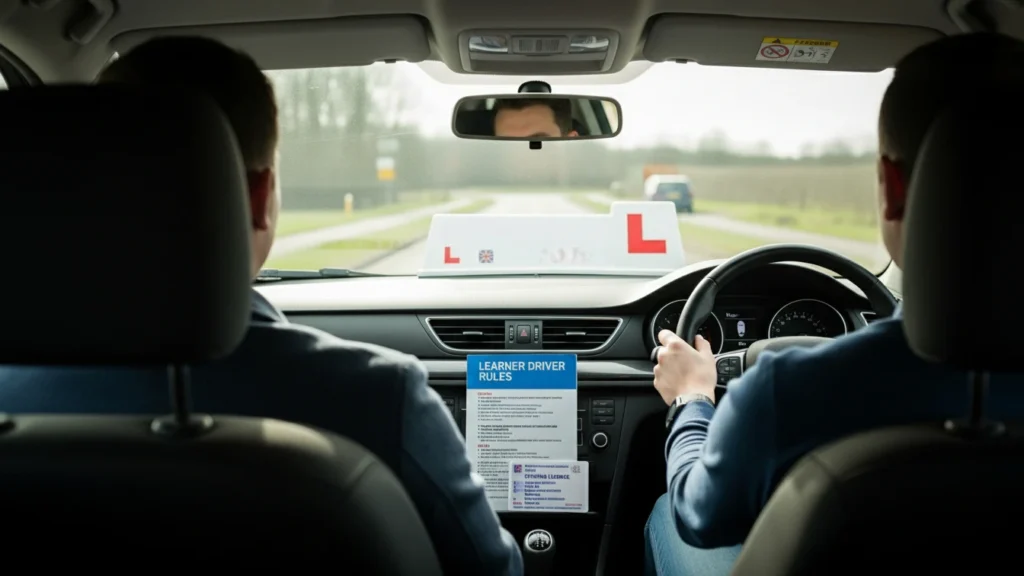
That moment you receive your provisional driving licence is filled with anticipation—it’s your official pass to start learning. But here in the UK, that green card comes with a very specific set of learner driver rules that form the legal framework for your entire learning journey.
Understanding these rules, along with the important UK road rules every beginner should know, is about much more than just passing tests. It’s about building a foundation of safety, responsibility, and skill that will last a lifetime. Whether you’re researching driving schools in Ilford or considering a national driving academy UK, every professional lesson will reinforce these essential regulations.
This comprehensive guide serves as your roadmap. We’ll clarify the must-know legal requirements for learners, explain how professional instruction from a quality driving school accelerates your progress, and detail the critical road rules that keep everyone safe.
Part 1: The Legal Foundation – Your Provisional Licence Rules
Before you switch on the engine, you must have the correct legal permissions in place. Your provisional licence is the first step.
How to Apply for Your Provisional Licence
You can apply online via the official GOV.UK website when you are 15 years and 9 months old, though you cannot legally drive a car on public roads until you are 17. The process requires:
- Proof of identity (typically a valid UK passport).
- Your National Insurance number.
- Details of all addresses where you’ve lived over the past three years.
- Payment of the £34 application fee (online rate).
The Four Absolute Rules for Every Learner Driver
Once your licence arrives, these four pillars are non-negotiable. Breaching them constitutes a serious traffic offence.
1. L Plates Must Be On Display
Regulation-sized ‘L’ plates (or ‘D’ plates in Wales) must be clearly visible on the front and rear of the vehicle. They are a vital communication tool, informing other road users to give you extra space and patience.
2. You Must Have a Qualified Supervisor
Driving alone is illegal. Your supervisor must be:
- At least 21 years old.
- Held a full, valid driving licence for the type of vehicle you’re driving (e.g., manual car) for a minimum of three years.
- Seated next to you in the front passenger seat.
3. Correct Insurance is Mandatory
This is the most critical and often overlooked rule. The vehicle must be specifically insured for you as a learner driver.
- In a family car: You must be formally added as a named driver on the policy. Verbal permission is not enough.
- During a professional lesson: Your Approved Driving Instructor’s (ADI) car is covered by a specialist dual-control policy.
- Consequences: Driving without correct insurance can result in 6-8 penalty points, an unlimited fine, and court prosecution.
4. The Car Must Be Road Legal
The vehicle needs a valid MOT (if over three years old), current road tax (VED), and must be in a safe, roadworthy condition with all lights, tyres, and brakes functioning properly.
Part 2: Choosing Your Guide: Driving Schools and Academies
While private practice with a family member is valuable, professional instruction from a reputable driving school or driving academy UK is indispensable for structured, safe, and efficient learning.
What Defines a Quality Driving School?
| Feature | Why It’s Important |
|---|---|
| DVSA-Approved Instructors (ADIs) | This guarantees they are fully qualified, have passed rigorous standards, and adhere to a professional code of conduct. |
| Structured, Student-Centred Learning | Lessons should follow a proven curriculum that adapts to your personal pace, ensuring no key skill is missed. |
| Modern, Dual-Control Vehicles | These provide a crucial safety net and are typically well-maintained, reliable, and fitted with the latest safety features. |
| Transparent Pricing & Progress Reviews | Clear costs for hourly lessons, block bookings, or intensive courses, with regular feedback on your development. |
| Local Test Centre Knowledge | Instructors familiar with your local test routes can provide specific, invaluable insight into common test scenarios. |
Getting Professional Instruction in Ilford and Beyond
For learners in East London, choosing among driving schools in Ilford offers a distinct advantage: local expertise. An instructor who knows the Ilford area intimately—from the complex Gants Hill roundabout to the busy high-street traffic—can prepare you specifically for the challenges you’ll face in your test and daily driving.
A national driving academy UK often provides standardised high-quality training and might be ideal if you need flexibility or are likely to move during your learning period. Whichever you choose, the goal is to find an instructor whose teaching style makes you feel confident and supported.
Ready to Start Your Professional Lessons?
The right instruction is the fastest route to passing your test and becoming a safe driver. For expert, patient tuition tailored to your needs:
- 📞 Call: 07399 696344
- 📧 Email: drivingacademyltd@gmail.com
- 📍 Visit: 101 Whitechapel High Street E1 7RA London, United Kingdom
Part 3: Critical UK Road Rules Every Beginner Must Master
Knowledge of these rules is tested in your theory exam and applied in every driving lesson.
1. Speed Limits: The National Defaults
When no signs are present, these are the limits:
- Built-up areas (with street lights): 30 mph
- Single carriageways: 60 mph
- Dual carriageways and motorways: 70 mph
Always look for signs first, as they take precedence.
2. Roundabout Procedure: Priority and Positioning
A major source of anxiety, mastered through practice.
- Give Way to the Right: Always yield to traffic already on the roundabout approaching from your right.
- Signal Your Intent: Left signal for the first exit, right signal for later exits (switch to left after passing the exit before yours).
- Correct Lane Discipline: Use the left lane for turning left or going straight on (unless signs/markings say otherwise). Use the right lane for turning right or going full circle.
3. The Mobile Phone Law: A Total Ban
It is illegal to hold or use any hand-held mobile phone or device while driving. This includes when you are stopped at traffic lights or in queuing traffic. The law allows only a single exception: using a device to make a contactless payment at a drive-through. Penalties are severe: 6 points and a £200 fine.
4. The Highway Code Hierarchy
This fundamental new rule establishes a responsibility hierarchy. Those in charge of vehicles that can cause the greatest harm (cars, vans, lorries) bear the greatest responsibility to look out for more vulnerable road users:
- Pedestrians
- Cyclists
- Horse riders
- Motorcyclists
This changes how you should approach junctions, especially when turning.
5. Stopping Distances: The Two-Second Rule
A vital UK road rule for collision prevention. In dry conditions, pick a fixed point. When the car ahead passes it, say “only a fool breaks the two-second rule.” If you pass the point before finishing the phrase, you’re too close. Double the gap in wet conditions; increase it massively in ice or snow.
Part 4: Common Learner Mistakes and How to Correct Them
- Incomplete Observations: Failing to check blind spots or mirrors properly before changing speed or direction. The Fix: Make your “Mirror, Signal, Manoeuvre” routine exaggerated and habitual. Your instructor should see your head moving.
- Poor Junction Judgement: Emerging into traffic without accurately judging the speed and distance of oncoming vehicles. The Fix: When in doubt, wait. It’s better to be safe than to cause a “major” fault on your test.
- Stalling and Poor Clutch Control: Often caused by nervousness or rushing. The Fix: Practice finding the “biting point” on quiet, flat roads or gentle slopes until it becomes muscle memory. Don’t panic if you stall; secure the car and restart the process calmly.
- Ignoring Road Signs and Markings: Missing speed limit changes, yellow box junctions, or bus lane times. The Fix: Actively scan ahead for information. A good driving school will teach you systematic scanning techniques.
- Assuming Insurance Coverage: The gravest error. The Fix: Always get written confirmation from the insurance provider that you are a named learner driver on the specific vehicle’s policy before you drive it.
FAQs: Your Learner Driver Questions Answered
Q1: Can I drive on motorways as a learner?
A: Yes, but only with an Approved Driving Instructor (ADI) in a car fitted with dual controls and L plates. You cannot drive on a motorway with a family member supervising.
Q2: How many passengers can I have in the car?
A: You can carry as many passengers as there are seatbelts, but your supervising driver must agree. Be aware that extra passengers can be a significant distraction for a new driver.
Q3: What happens if I drive without my supervisor?
A: You would be prosecuted for driving without a licence and without insurance—this almost always results in at least 6 penalty points and a substantial fine, making future insurance prohibitively expensive.
Q4: Can I practise in my own car as a learner?
A: Yes, provided the car is taxed, MOT’d, displays L plates, and—crucially—is insured for you as a learner driver. You must still be supervised by a qualified person.
Q5: Should I learn manual or automatic?
A: This is a personal choice. A manual licence gives you flexibility to drive any car. An automatic is often easier to learn, but restricts you to automatic vehicles. Discuss with your instructor.
Q6: I’m in Ilford. How do I choose the best local instructor?
A: Look for driving schools in Ilford with strong local reviews and DVSA-approved instructors. Ask about their knowledge of the Goodmayes or Barkingside test centre routes. A personal recommendation or a trial lesson is often the best way to gauge if an instructor is right for you. For a professional assessment, you can contact the team at Driving Academy UK on 07399 696344.
Conclusion: From Learner to Confident, Legal Driver
Your path from holding that green provisional licence to becoming a full, independent driver is built on a clear understanding of the learner driver rules UK. These regulations, combined with a mastery of important UK road rules every beginner should know, are not barriers—they are the essential framework that keeps you and others safe.
The investment you make in a good driving school, whether a dedicated local driving schools in Ilford or a established driving academy UK, pays dividends in confidence, safety, and test success. Their expertise turns complex rules into second nature.
Take the Next Step in Your Driving Journey
If you’re ready to turn theory into practice with expert guidance, get in touch with our team of DVSA-approved instructors. We provide structured, patient tuition tailored to your pace in modern, dual-control cars.
- 📞 Phone: 07399 696344
- 📧 Email: drivingacademyltd@gmail.com
- 📍 Visit: 101 Whitechapel High Street E1 7RA London, United Kingdom
Embrace the learning process. Understand the rules, respect the road, and drive towards your independence with confidence.